
For me…weed tea is kinda optional but it could be really important, and I use it. How so? What if there was no fertilizer available? Or, maybe you wanted to save some money by not buying commercial fertilizer. Weed tea can fill the void for either…to some degree. But there is real value in weed tea.
Word of caution…don’t throw away all store-bought fertilizer and use weed tea to replace them for your everyday gardening.
First off…weed tea is a homemade liquid (quasi/semi)-fertilizer that you make by soaking weeds in water until nutrients leach out and the mixture begins to ferment. It’s just that simple. Benefits?
- Cheap and easy to make
- Uses weeds that would otherwise be discarded
- Provides a range of nutrients depending on what weeds are used
- Works more like a mild liquid fertilizer than a complete feeding program
- You spent all that time pulling the weeds…use em
- You use what you have available
Fair warning…weed tea works surprisingly well, but it can smell like something died behind the barn.
Plants don’t care whether nutrients come from an expensive bag, a jug of fish fertilizer, rich compost, or homemade weed tea. They care whether the nutrients are available when needed.
Is weed tea the perfect fertilizer? Nope. Is it cheap, easy, and surprisingly effective? Yep. Sometimes the weeds you’re pulling out of the garden can help feed the plants you’re trying to grow.
Recipe & Directions –
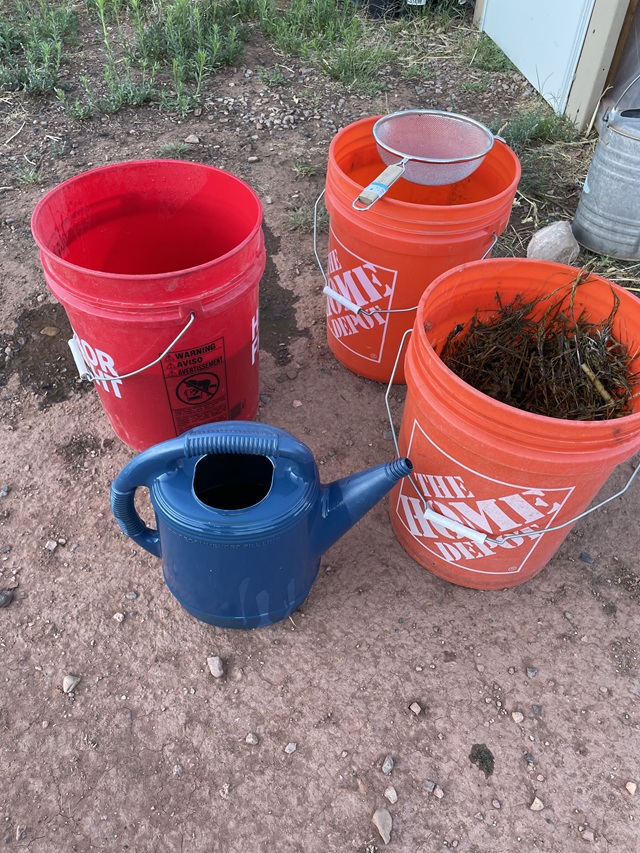
- Fill a 5-gallon bucket about halfway (+/-) with chopped weeds* and then cover them with water, about 3 gals (+/-). Put a lid loosely on the bucket.
- Let the mixture steep for 1–2 weeks (+/-), stirring occasionally if you think about it.
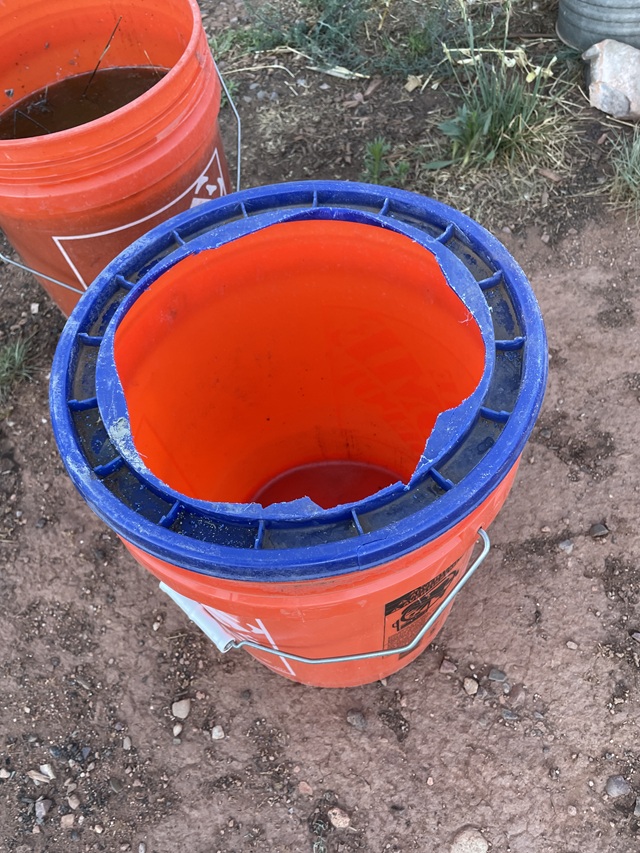
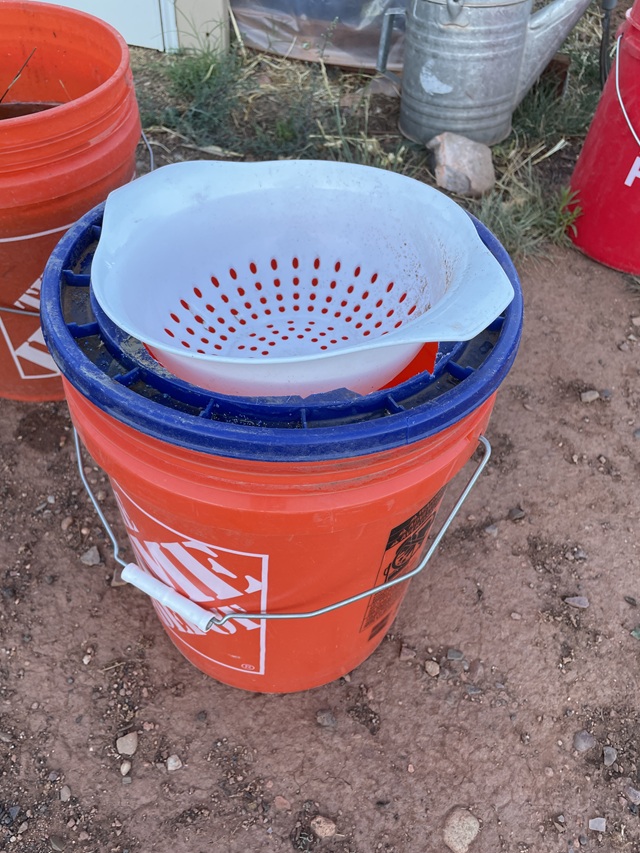
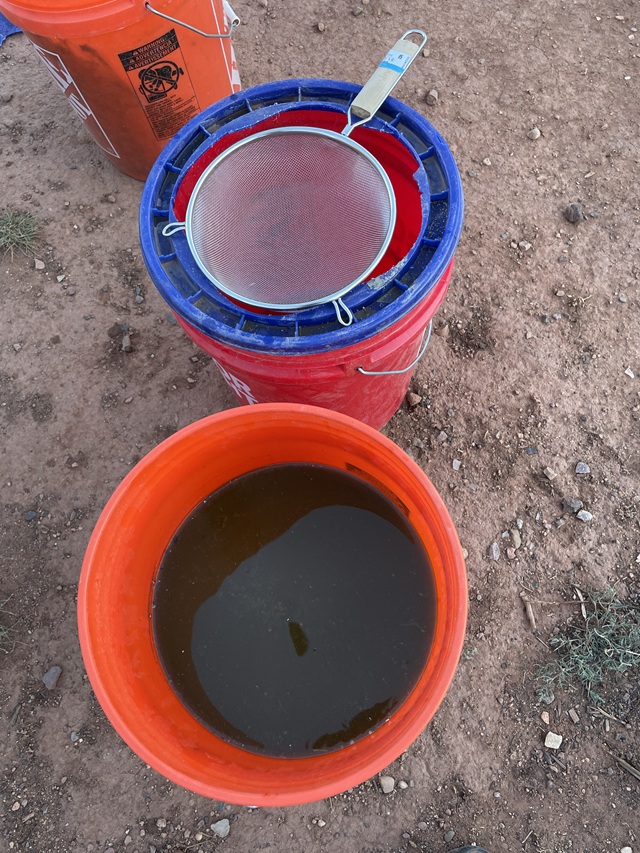
- Once the weeds have broken down, strain out the solids. I think the best tool for that job is a colander first, then a fine mesh kitchen strainer, check with your wife first.
- If the “tea” appears dark or smells strong mix it about 25/75 – 50/50 with water before applying.
- Apply the tea around the drip-edge of plants not touching the plants, and let nature do the rest.
Optional Ingredients –
– Molasses (1–2 tablespoons per 3 gals water):
- provide a sugar source
- encourage microbial activity during fermentation
- potentially make a richer biological brew
– 5-1-1 Fish Fertilizer (1/2 tablespoon of concentrate):
- adding additional nitrogen
- enriching the nutrient profile
- giving the finished tea a little more punch
– Poop:
If you’ve got some cow patties, rabbit pellets, deer or elk scat lying around, don’t toss them…you can add a little to your weed tea for an extra nitrogen boost. Cow manure and deer or elk scat works best if it’s been aged or composted first to reduce any harmful microbes. Rabbit pellets are already concentrated and ready to go. Crush them up, toss them in, and let the tea steep like normal. They won’t magically transform your garden, but they will give your plants a gentle nutrient lift, especially if the soil isn’t already loaded with organic matter.
– Pee:
Before somebody writes me an email…yes, some gardeners add a little urine to their weed tea. Human urine contains nitrogen, along with small amounts of other nutrients that plants can use. Used in moderation, it can provide a surprisingly effective nitrogen boost. The key phrase here is “in moderation.” We are talking about a small addition to a large bucket of water and organic material, not trying to recreate Niagara Falls in a 5-gallon bucket. If this idea makes you uncomfortable, skip it. Your garden will survive just fine without it.
Generally speaking your weed tea would probably include:
Primary plant nutrients
- Nitrogen (N) — especially from young green growth, nettles, grass, etc.
- Phosphorus (P) — probably present, but generally not the star of the show.
- Potassium (K) — likely one of the more significant nutrients because potassium is readily released from plant tissue.
Secondary nutrients
- Calcium
- Magnesium
- Sulfur
Micronutrients / trace minerals
- Iron
- Manganese
- Zinc
- Copper
- Boron and potentially other trace elements, depending entirely on the weeds and soil they grew in.
I use it as an occasional supplement, not as a primary fertilizer program. Think of weed tea as a gentle nutrient boost rather than a complete feeding program. General guidelines:
- Young or nutrient-hungry plants (tomatoes, leafy greens, fast-growing vegetables): every 1–2 weeks is fine as a boost.
- Established plants (perennials, shrubs, fruiting vegetables): once a month or as needed is usually sufficient.
Turn your weeds into garden gold…a little ingenuity, a bucket, and some water is all it takes.
At the end of the day, weed tea is simple, practical, and surprisingly effective. It’s not magic, and it won’t replace healthy soil, sunlight, or consistent watering…those fundamentals always come first. But it does remind us that the things we might toss aside can actually feed our garden…and that a little ingenuity goes a long way.
Chop, steep/ferment, strain, and feed your plants, and watch your garden respond. Your nose may remember it, but your plants will thank you…and you might even find satisfaction in turning what was once “weeds” into something that helps your harvest thrive.
Note #1 – If you’ve pulled rogue bean plants from your garden, don’t toss the roots…they’re packed with nitrogen thanks to the bacteria living in their nodules. Chop them up and add them to your compost or weed tea to give other plants a little extra boost.
Note #2 – Don’t worry too much about seeds ending up in your weed tea. In my experience, seeds have rarely been a problem, many seeds won’t survive the fermentation process, and any that do are usually easy to spot and pull out once they sprout. The easiest precaution is to strain the tea before applying it to your garden…a colander first, then a simple fine-mesh strainer or piece of cheesecloth works perfectly. That way, you get all the nutrients without accidentally planting a few extra weeds in your beds. In practice, it’s rarely a problem, and it shouldn’t keep you from making and using a batch of this surprisingly effective fertilizer.
Note #3 – Do not use human urine if the contributing human is taking medication or is ill.
* – For best results, chop the weeds into smaller pieces before adding them to the bucket. This increases surface area and helps the weeds break down faster. Take your pick; run them over with a mower, chop them with a shovel, cut them with pruning shears, or whack them up with a machete…whatever feels easiest…or the most fun.
Here was my latest Weed Tea journey in all its glory…



Application: For me I want to make sure that I have already watered the garden/plants that I plan on applying the tea to. I never put straight tea on anything. I usually mix it 3 parts water to 1 part tea…or 4 to 1. I apply it “around” the plant at least 4 “- 5” from the stem (drip edge). It works out to about 1 – 2 cups of watered-down tea per plant. For trees I would use about 1 gal. per tree out at the drip edge.
The point to weed tea is to improve the soil…and give the plant a gentle boost of nutrients.
Enjoy Tea Time !
