When you don’t do it right…it keeps coming back to haunt you. Well, haunting me. (pun intended)
About 3 weeks ago our twin 1,100 gallon water tanks ran dry. I got the well running again. The next day they ran dry. I got the well running again. And…well, you guessed it…
After 4 days of monitoring and testing I figured out what the problem was. The wireless float switch between the storage tanks and the well had gone “bad.” By that I mean the system was losing communications between the tank sending unit and wellhead receiving unit. And that means the well pump wasn’t coming on when the storage tanks needed water. And that ran them dry.
Technically, the irrigation ran the tanks dry of water…the well just failed to replenish the tanks. It takes a lot of water to irrigate an orchard, a bunch of young pine trees, 2 gardens, and a melon patch. And that says nothing about the grass in the yard (6900sq’).
This isn’t the first time. Off and on if we have heavy cloud cover there just wouldn’t be enough sun to run the solar pump in the well to fill the tanks. We tried swapping solar panels, adding a 2nd water tank, and an upgrade on the water tank float switch. None of it worked…tanks still would run dry occasionally.
Yeah…not fun.
This time I decided enough was enough…something had to give. I was fed up dealing with this problem…fed up I say!
There was a series of issues involved:
- The wireless float switch system was the main immediate culprit. It has lost the ability to communicate between the water tank sensor unit (sender) and the well pump control unit (receiver). The “wireless” part means it communicates a signal (radio signal) between each unit to start or stop the well pump depending on the level of the water in the storage tanks. Think of your cell phone losing bars and not being able to place or receive a call. The well pump, 700’ away from the tanks, wouldn’t turn on and start pumping water to the tanks.
- The well control box had a wiring issue and wouldn’t function properly. I had to by-pass a critical part of the controls to make it run.
- There wasn’t enough solar panels installed to properly power the pump to its full capacity most of the time.
- The biggest problem of all…and the really main problem was the pump in the well. It just wasn’t the right pump to begin with. It simply wasn’t pumping enough water to keep up with the irrigation or on cloudy days.
Wireless Float Switch – #1
Issue #1 was a problem for the company that sold me the wireless float switch. Late last year I installed the original wireless float switch. Why? Because lightning kept killing the system. Why? Because I had 700’ of signal wire buried in the ground between the tanks and the well. Bad lightning storm comes along and BOOM!
“Transient voltage” would enter the wire, travel to the computer well control box, zap it, and down went the well system. Think of it this way…the 700’ of buried signal wire was like a huge long antenna…attracting any stray voltage from lightning when it hit the ground in the area.

Installing the wireless float switch should have been pretty straight forward and easy…ah, no. That’s another story you can read about when you have time. < click here > Needless to say there was a steep learning curve but I finally got it working and it ran fine…until…it didn’t. That was about 3 weeks ago.
I carefully monitored the operation and problems, documented it thoroughly and sent it off to the vendor/distributor in an email. A couple of days troubleshooting provided nothing in the way of an operational system. It was broke.
I actually forgot that it had a 2-year warranty. I had already started looking for some other wireless option thinking I was just out of luck because the system sucked…and out $700. Lo and behold…the head technician said they would be shipping me out a warranty replacement system. I had it 4 days later. Yea!!
Late last week I installed it without a problem and it started working correctly as soon as I hooked it up and turned it on.
In all reality though, it wasn’t without a hiccup. When the big box with the new system arrived it was missing the 2 batteries, one for each unit. They shipped them out next day air. The system has been running smoothly ever since. Whew…nice.
Well Control Box – #2
I am really embarrassed about this one. I spent a couple weeks designing a control box for the well. It had all the protection in the world built in. Yeah, I was going to protect it from lightning at all costs…almost. I wanted it easy to plug in the generator. And I wanted an easy way to monitor the DC voltage from the solar panels.
You can read about that build here < click here >
Why was I embarrassed? After all the design work…and it was a whole lot…I accidentally mis-wired it in a single spot and didn’t realize it. I had to jury-rig it to make it work.
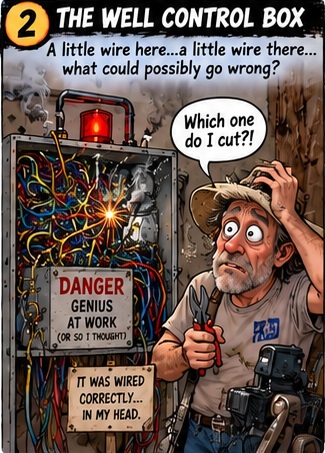
With the work I am doing now on the well, I will re-wire it correctly. And eat a little humble pie along the way.
Another change has to be made to the box as well. The original well solar panel power output would top out well under 300vDC…the new well power set-up could top that 300vDC threshold. So, I have to replace the volt meter monitor. Not a big deal…just another $120 that my wife would rather I didn’t spend.
Oh, and one more upgrade needed. The Midnite Solar Surge Protection Device (SPD) is only rated to 300vDC as well…so it has to be upgraded to the 600vDC rating. And yes, it will protect the AC side as well. Another $115 out the door. Nope, not a happy wife.
Solar Panels – #3
These solar powered well pumps are very efficient and can run on low DC power…the current one runs all the way down to 90vDC. Under full sun the current solar panels produce about 131vDC. In the summer that means by about 7am it is running at low GPM but by about 9am it is running at full capacity. Problem is…I am irrigating by 4:30am when it is daylight.
The new pump will require at least 120vDC. So 131 vs 120 doesn’t give me much margin for error. Meaning…the new pump wouldn’t start at all until later in the morning, probably start about 8:30am and not achieve full power…ah, never at its full GPM capacity at all during the day.
And, if it was cloudy the current pump with the current solar panels suffered from low water production. The current four solar panels are 250w but only 37v each.

Fortunately, I had worked a deal a ways back and I have 12 solar panels sitting on a pallet outside my shop that are 44.4v each, 175w. So, phase 3 will be to modify the current array rack to accommodate 6 of the new panels which will give me as much as 266v…about double the voltage of the current panel set-up.
Then comes next, longer term fix…a second string. Since I have enough panels AND I need more water earlier in the day since I am irrigating earlier in the morning during the summer…I ran the numbers and a second string of solar panels fits the bill nicely. But, even better…I will point them directly east at a summer optimum angle. That gives me power at sunrise about 1.5 hours earlier than currently.
That means I will have one string at due east and another string due south. Late morning I will also have power coming in from both strings…that is no problem whatsoever. The pump’s built-in electronics will simply not draw that extra power (if any)…internal protection.
For you solar energy and equipment nerds…the configuration will be 6S2P. For all of us that aren’t too nerdy…2 strings of 6 panels each connected in parallel. That will give me normal working stats of about 220vDC @ 9.8amps…for 2100 – 2200w.
The problem that does develop is having to replace a number of well control box components. That I had spec’d originally for a max of a 300vDC system. With the new system on a -5degree day in full sun I could theoretically exceed the 300vDC. And it isn’t worth the risk. Also, the volt meter is only rated to 300vDC. So new components will get ordered…under $300 total. Yeah, stuff ain’t cheap.
New Well Pump – #4
Here’s the biggest issue…and the sorest point for me. The current pump in the well is 190’ below the surface of the ground. The pump is a NASTEC/SunPump – HR 750 AC/DC Helical Solar Submersible Pump. It is an incredible pump quality-wise…just top tier high-quality dependable pump.
Did you notice the “750” part of the pump name?
Yeah, that means it is designed for a 750’ well…my well is 220’ deep. The current pump is suited for a well about 3.5 times deeper than my well.
What does that mean in practical terms?

It means the current pump moves about 3 – 5 gallons per minute under optimum sun conditions. When I am irrigating I use 5gpm. Did you do the math there? Yeah, under perfect conditions the well can keep up…but that is rare.
The new pump is a NASTEC/SunPump – HR 12-328 AC/DC Helical Solar Submersible Pump. Same manufacturer and same family of pumps, same quality, same dependability…but notice the “328”?
Yup, it is designed for a 328’ well…only about 50% deeper than mine. But, this is the difference…the new flow rate is 10 – 12gpm. Under normal conditions for me I can expect about 10gpm regularly. Under cloudy conditions…about 4 – 6gpm.
Yeah, did you do the numbers? That’s 2 – 3 times more water flow than I get currently. And that will make all the difference in the world on cloudy or partly cloudy days.
Then you add in the fact I am installing a second solar panel string doubling the available power and providing it sooner/earlier in the day. All of that added together will provide a much more stable well water production situation.
Why do I have the 750 pump in the first place?
Yeah, that’s an article by itself. It was a combination of two things; 1) I had no clue about solar pumps, their designs, their capabilities…nothing. 2) I knew a guy that I thought knew what he was doing…kinda in the business. Yeah, you getting this so far? I told him what the problems were with the last pump, told him about the well, and that I wanted a solution. He sold me one.
Obviously it wasn’t anywhere near the right pump for my situation but it took me over 2 years to figure it out. By then it obviously was too late to do anything about it through him. I nursed the whole situation along trying different solutions but nothing worked. And along the way is also when I had the lightning problems and had to buy a $500 computer control box for the pump…which I also didn’t need. And then had to replace 700’ of signal wire.
I think you have the picture by now.
Summary (for now)
As I mentioned earlier, I already installed the new wireless float switch. It is working just fine. That is a huge relief. Lucky for me I bought a quality product with a great warranty. No additional costs…just about 4 hours of time. Good deal in my book.
Next step is to disassemble the current array, remove the well control box, build the new array rack, install the new solar panels, and do a temporary wiring job to make it all work. That mission is this week.
Once that is done I will rebuild the well control box and put that back into the system.
Then comes the big one…the really big one. I have to pull the old pump, swap it with the new pump, and run it back down hole. That’s where some neighbors will come over and help out. It will take 4 people to do it comfortably.
And then the final phase…when I have nothing else to do this winter…yeah, right…I will build the second array and bring it on-line. Fortunately I don’t have to get it online until next spring when the additional water is needed for irrigation.
Now, let’s talk a minute about the pump…
I was originally going to try using a PV tracker to give me longer sun days with the current panels. But, I didn’t have hard numbers that it would work. But I knew it would cost about $1500 more just to “try it” as a solution. Not smart.
Then when this latest spat of problems showed up I started giving serious thought to replacing the pump. Now, for those of you who appreciate money…the pump ran about $2800 5 years ago. That is no small amount of money for a couple old folks on social security.
Then early last week I got an email from the pump distributor about a “Labor Day Sale” they were having…but there was no mention of what pumps or what prices. I emailed my contact there and lo-and-behold…the 328 pump was on sale for $900. Done! Bought! Paid for!
The new pump is 1/3 the price of a new one. Yeah…66% off! All the wiring is the same, everything pretty much is the same…except it will pump twice the water as the old pump.
I guess there are times when those annoying emails pay off. It sure did this time.
I will keep you updated on the project’s status…maybe even include some pictures along the way as well (pun intended).

Yup ! My goal !
But, don’t you just hate these kinds of days…