
Nobody remembered exactly when the old water tank stopped being useful, but it was a long time ago.
The town of Dry Creek had moved on and become modern. Some thought cosmopolitan, most knew better. The new wells were deeper, the pipes were bigger, and everything was painted pretty with fancy labels.
The old wooden tower at the edge of town had become just another piece of scenery, kind of like a landmark. Kids used to dare each other to climb it, teenagers carved their names into the support beams, and eventually everyone simply stopped noticing it. Well, except the teenagers on Saturday nights.
And except for Eli. Eli remembered. Eli was the kind of person who noticed things that everyone else walked past. He just paid attention.
He noticed when the creek ran three inches lower than the year before. He noticed when the grocery store shelves got a little more bare. He noticed when people started saying, “We’re fine,” with a little less confidence; mostly being polite.
One Saturday morning, while repairing a fence right next to the old tower, he found a rusted metal plate nailed to one of the tower’s weathered support beams.
It said:
DRY CREEK COMMUNITY WATER RESERVE
Built 1912
Maintain even when not needed.
Eli laughed. “Well, that’s a little dramatic,” he said. But he looked up at the empty tank. And he wondered.

For the next few weeks, Eli worked on the old tower. Teenagers laughed, adults chuckled.
“You fixing that museum piece?” a couple folks asked, mostly curious, one mocking.
“No,” Eli said. “I’m fixing something nobody needs today,” and he kept working.
That answer confused people. Most couldn’t understand repairing something nobody needed. Most folks just replace whatever is broken with something newer. No time or skills for repairing much of anything anymore, just get out the credit card and buy a new one.
The tank was never meant to provide all the town’s water. It was meant to provide time. Time for people to think. Time for repairs. Time for decisions. Time between a problem appearing and a crisis arriving.
Eli thought of it as a margin of safety.
Three years later, a summer storm came through Dry Creek one beautiful July afternoon. It wasn’t a hurricane. It wasn’t a disaster anyone would put on the news. But, it was just enough.
The main electrical station flooded. The new pumps shut down. The pretty painted pipes went dry. It got quiet. And the town lost water pressure. People stood in their kitchens turning faucets that produced nothing.
At first, everyone said, “They’ll have it fixed soon.”
A couple days later, “They should have planned for this.”
Then almost a week later, “What are we going to do?”
The mayor called Eli. “Does that old tank still have water and do you know how to run it?”
Eli smiled, “It does and I do.”
Fifteen minutes later Eli opened the old valves. Slowly, almost reluctantly, water began flowing through pipes that had been forgotten for years. It flowed into the fancy painted pipes.

It wasn’t enough for unlimited use. But it was enough for drinking. Enough for people to have time while the city maintenance crew worked on the electrical station and the water plant. The old water tank just kept doing its job.
A week later, after everything had been repaired and water was flowing normally again, the mayor held a town meeting. “We were lucky,” he said.
Eli, sitting a few rows from the front, shook his head. “No sir,” he said. “We weren’t lucky.”
The room got quiet. In a louder and firmer voice, Eli said, “We were prepared.”
Someone in the back asked, “What’s the difference?”
Eli looked toward the window where the old water tower stood. “Luck is when something good happens that you didn’t expect.” He paused, “Preparation is when something bad happens and you already expected it.”
Years later, people still called it the old water tower. It still worked despite its age. They even put a new nameplate on it, all bright and shiny. “Eli’s Water Tower – 2027”
But the younger generation calls it something else…they call it The Time Machine.
Because everyone eventually learned what Eli had known:
The most valuable thing a reserve gives you isn’t the thing stored inside it.
It’s the space between a problem and a disaster.
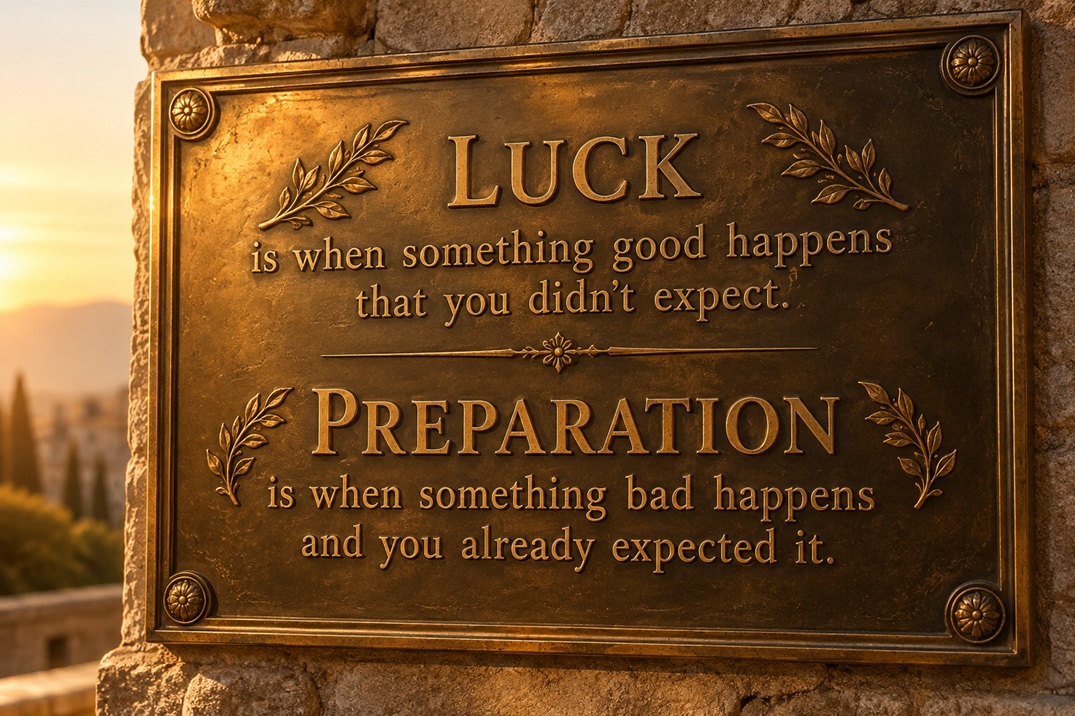
“Every community has its own version of an old water tank — a backup system, a skill, a reserve, or a relationship that seems unnecessary until the day it becomes the thing that buys time. I call that a safety margin.”