by AH Trimble
PART ONE — THE PLAN
– Chapter 4 –
The Plan
1990–2002 | Davos, the three crews, and the machinery of influence
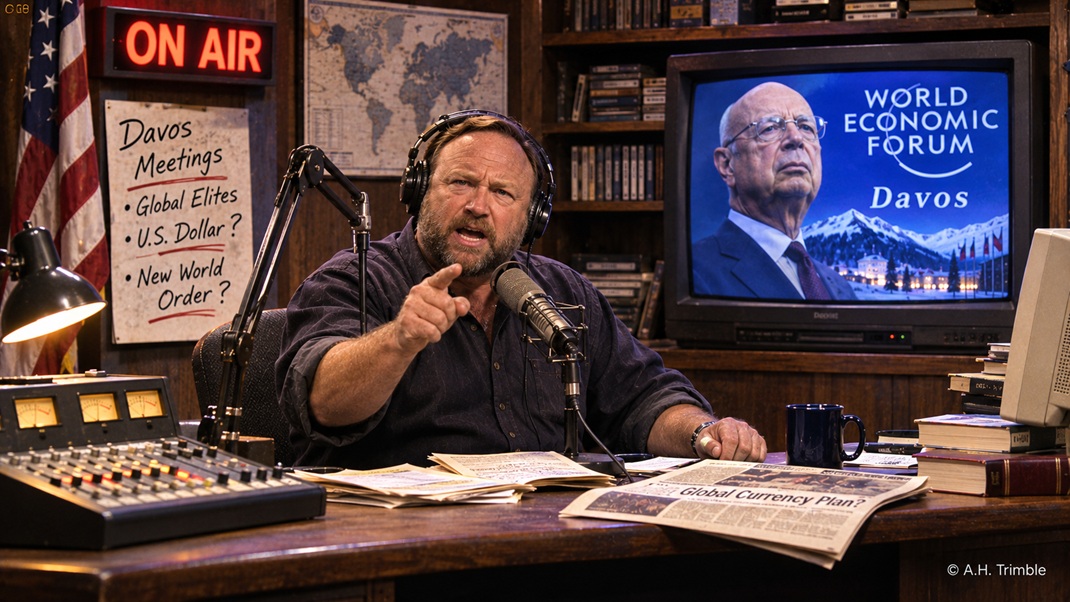
He was called “the conspiracy king,” and “the conspiracy theorist-in-chief” at various times…usually not as a compliment. His on-air mannerisms earned him even fewer compliments and he never had to worry about earning any broadcast awards. His friends called him Al.
But he had it right when he started broadcasting his latest conspiracy theory.
By late 1999 he had come into possession of some handwritten notes from the previous 5 years of Davos meetings. Not the semi-private meetings for the world’s elite. No, his notes allegedly were from the far more secret meetings of “the teams.” And then the notes were sketchy at best, and incomplete as well. They mostly referred to a group of elites working a plan to undermine the US dollar.
Had those notes been taken seriously and had Al not come across as a true tin-foil hat radio host, he might have at least put a dent in the team’s plans. As it was, he was virtually ignored. He was lucky that he lived through it all. If he had any credibility…he would not have.
The first true organizational meeting took place in Davos January 1990. The Americans had actually elected a former CIA director as president in 1988. The initial three men sitting in the Hotel Schatzalp actually laughed, each commenting on the sheer stupidity of American voters. They elected a known CIA agent…a man that ran the CIA…could Americans get any more stupid was their question. The answer that was later proved to be true was undeniably…“yes.”
They dubbed the decade of the 1990s “the great plan” and the decade starting in nine short years would be “the great change.” Their meeting was highly focused, each man taking charge of a specific aspect of the plan; politics, economics, and operations.
The Englishman took charge of politics. Kraus took charge of economics. And Vladimir Kryuchkov took charge of operations. He would only last two years. The man they called the “Gatekeeper” would take over operations in 1993. He was a close trusted friend of the US President and left the CIA to take his full-time responsibilities with the team.
The CIA had its dark tentacles throughout the world…chaos, death, and political turmoil was a testimony to that fact. The Gatekeeper would serve their cause well.
The Gatekeeper had another instrument at his disposal, one that did not require a government appropriation or a signed order. Epstein’s private world had become a place where powerful visitors could be studied at their least guarded. Davos provided the objectives, while cooperating officers within the CIA and Mossad supplied access and protection. The parties involved called it intelligence gathering. Kraus preferred a simpler word: leverage. The law called it human trafficking.
The guests believed the island visits were private. The people running the operation knew otherwise. Cameras and carefully kept records turned indiscretions into obligations, sometimes for years. Some of those exploited were children, a fact the organizers treated not as a reason to stop but as a reason their subjects would be especially desperate to conceal what had happened. No one in the room used the word victim. That omission said as much about the men as any order they gave.
Goldstein entered that orbit as a financier whose influence was already useful to the economics crew. A visit arranged as a favor became a trap. When the Gatekeeper later asked for his cooperation in the coming financial dislocation, Goldstein understood the request was not a negotiation. Kraus wanted him positioned to help inflict the damage and profit from the reconstruction; the records from the island made refusal a risk he would not take.
By 1996 the team’s leadership had picked their respective groups and clarified their operational plans. The meeting in 1997 put all into the record and set the timeline…it would start in 2001. That would be the perfect year…the current President’s son would be president. He was his father’s son, totally committed to the team and their plans.
Ironically he would be the perfect Manchurian Candidate. Wrapped in the American flag, poised as a proud Texan complete with a southern drawl, charismatic with an easy smile and an off-beat sense of humor, he would make the perfect president. But inside the man was a different story. The engaging facade hid an authoritarian ready to do whatever was necessary to make their plans and dreams come true. People needed to be ruled over…for their own good.
* * *
Davos, January 1999. The room was warm enough that someone had opened a window, letting in a blade of mountain air. Kraus had been talking about electronic payments for twenty minutes when the Englishman finally interrupted him. He wanted to know why the economics crew was so interested in credit-card records. Kraus said the cards weren’t the point. The point was that a person’s life was leaving a trail that could be collected, compared, and eventually predicted.
Purchases, telephone calls, travel, employment, debts…all predictable. Every year the trail grew longer, and every year the computers became better at finding meaning in it. The Gatekeeper, who had said very little, asked how soon such a system could be built. Kraus looked across the table at a young technology investor named Peter Seal. Seal said the underlying techniques were already being used to detect fraud. Adapting them to intelligence work would take money, talented people, and access to information nobody in the private sector could obtain on his own.
The Englishman asked what they would call it. Seal had been using the working name VanitarT. The Gatekeeper didn’t care about the name, but he liked what the company might become.
Intelligence agencies had enormous quantities of information and were notoriously bad at making sense of it together. VanitarT would make connections between things that looked unrelated. A bank transfer in one country, a telephone number in another, a name on a passenger manifest somewhere else. The military would see a better way to identify threats. The intelligence services would see something considerably more valuable. By the end of the meeting, the crews had authorized Seal to begin assembling the company. Kraus would arrange the investment. The Gatekeeper would arrange introductions that were not to appear on anyone’s calendar.
Davos, January 2000. Seal returned with diagrams and a confidence that annoyed the Englishman. He showed them how the proposed system could take information from different sources and build a picture of a person’s activities. The presentation concentrated on foreign intelligence, which was the easiest way to justify the expense.
When the presentation was finished, the Gatekeeper asked a question Seal hadn’t expected. Why limit the system to foreigners? Seal replied that there were laws governing the collection of information about Americans, particularly by the CIA. The Gatekeeper smiled. He knew the laws. He also knew that local communities could collect information for reasons that had nothing to do with intelligence operations.
They talked about neighborhood security, stolen cars, and the families of missing children. A homeowners association could install cameras at its entrances because residents wanted to know who was coming and going…and it was private property. Police departments could use the same technology to find stolen vehicles or locate suspects. No one needed to be ordered to participate if the equipment was useful and affordable.
The Englishman suggested that the sales pitch begin with the recovery of abducted children. Who would argue against finding a missing child? Kraus liked the commercial model: start with private neighborhoods, let local law enforcement discover the benefits, and offer financial arrangements that made adoption easy. Seal proposed the name Block Safety Systems for the domestic network. The Gatekeeper required only that the information eventually be available to VanitarT.
Someone asked where they would store that much information. The Gatekeeper said there would be federal facilities capable of handling it in time. They would not have to own the cameras, the roads, or the police departments. They only needed access to the resulting information. He had no interest in explaining how such access would be obtained. The others had learned that when he stopped answering questions, the subject was closed.
* * *
No one had ever seen such legislative efficiency. Within 45 days of the Twin Towers falling the Patriot Act was passed and signed. The Patriot Act was introduced to the House on October 23, 2001. The House passed it: October 24, 2001. The Senate passed on October 25, 2001. The President signed it into law on October 26, 2001.
Some folks were in disbelief that Congress could act that quickly on such a broad bill that gave extraordinary power to significantly expanded federal surveillance, intelligence gathering, and counter-terrorism powers. Later it was used to justify the legality of US torturing prisoners of war, abusing the powers of FISA courts, and a resurrected and changed view of “enemy combatants.”
By November 2001 the president had assumed the power and authority to fight terrorism that no legislation had ever granted. But in the shadows of 9/11 no one questioned that authority…but many paid a high price for being targeted by the CIA, FBI, NSA or any of a dozen other agencies.
* * *
While the political and legislative process was taking place in Washington DC Senior Chief Stan Whitaker and First Sergeant Vince Smith along with their teams were landing in Afghanistan. The mission, code named JAWBREAKER, was clear. At first it was capture or kill anyone responsible for 9/11 and find Osama Bin Laden and bring him back to the US to stand trial.
The high-ranking CIA supervisor of the mission began to voice concern over the tactical directives he was given. The operation was increasingly tasked with neutralizing a long list of targets identified and labeled as “terrorists.” But that list was never accompanied by an intelligence brief on why they were targeted.
When The Gatekeeper was informed of the problem the answer was simple…neutralize the problem. After much discussion with the then CIA Director it was decided to encourage retirement. The leader, code named Gary, put in his retirement papers 10 minutes before stepping onto the helicopter. He was going to tell his men personally that he was retiring…and give them a subtle warning if they would listen.
* * *
The January 2002 World Economic Forum meeting took place in New York to show solidarity with the United States. That was the public face at least. The Gatekeeper was actually impressed with the debris pile. Building 7 had not been their plan…but a nice bonus all the same.
The team’s next day approvals included a decision that received far less attention than the speeches and celebrations. VanitarT would move from a promising development effort to an operational intelligence business. The Gatekeeper committed to obtaining CIA-backed development support and money, and Seal was told to prepare for a Department of Defense contract eventually worth several hundred million dollars. The money was not yet in hand. The expectation of it was enough to attract more investors, hire more engineers, and persuade skeptical people that the company had a future. Kraus would make sure it survived long enough to collect.
The domestic project would take longer. Block Safety Systems was still a plan on paper, not a nationwide network, and even the Gatekeeper understood that Americans would resist a federal program openly designed to track their movements. Better to begin with a camera at the entrance to a subdivision and let each successful use become an argument for the next installation. When the day came that VanitarT could see across the separate systems, and the people who had purchased them would still believe they were simply protecting their neighborhoods. Hundreds of thousands of cameras would track Americans…stupid Americans.
For ten days there were multiple meetings of the team and their sub-groups and “senior leadership only” meetings. Having it in New York made it easy for the US members to travel without drawing attention to themselves. The regular rich elite WEF members would not raise suspicion as they were expected to travel there for the relocated Davos meeting.
Many a conventional cable news and mainstream media talking heads spoke highly of the WEF’s efforts to support the United States in one of their darkest hours. Little did they know the real power, the real authority, the real money behind 9/11…was right there in New York in front of the cameras.
Thousands of protesters let the world know that the WEF was not welcome in the US. But double that number of NYPD law enforcement officers kept the peace. The atmosphere in New York during the WEF meeting was tense, heavily policed, and politically charged, but large-scale violent riots never developed.
Anyone looking in on the team’s executive leadership meeting would have commented on the almost joyful atmosphere and celebration of the 9/11 success. Their plan had succeeded perfectly, beyond their expectations.
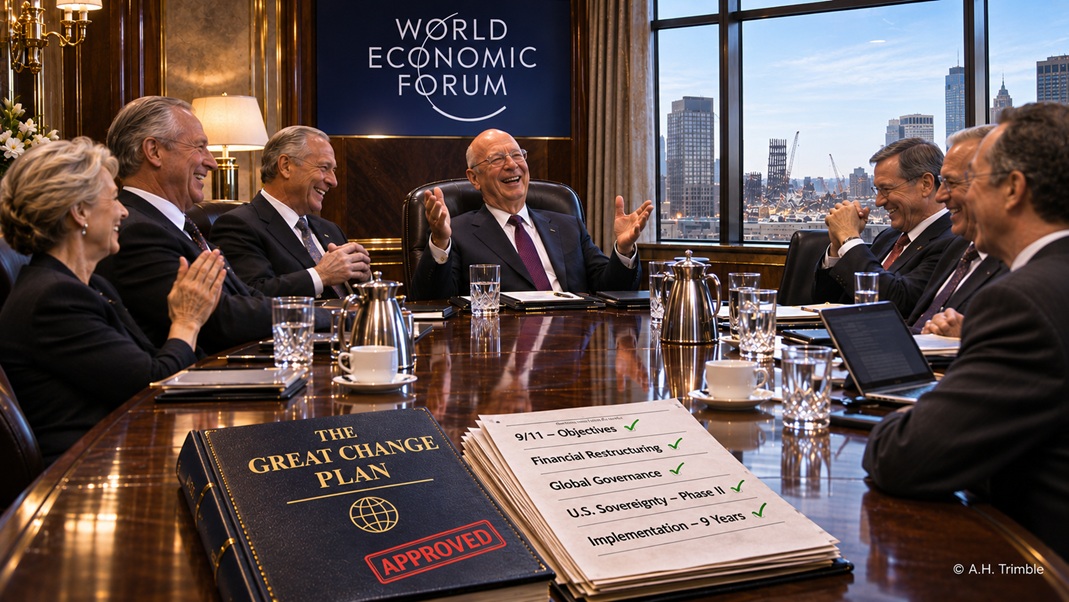
By the end of the final meeting The Great Change plan was green-lighted in whole…the next nine years was set in motion.
Book Chapters –
© 2026 A.H. Trimble. All Rights Reserved.
No portion of this work may be reproduced, republished, distributed, or transmitted without the author’s prior written permission, except as permitted by applicable copyright law.
WORK OF FICTION
This is a work of fiction. Although it draws on actual historical events and refers to real people, organizations, and places, the characters, conversations, motives, and covert activities depicted in the story are fictionalized or invented for dramatic purposes. They should not be understood as factual allegations about any real person or organization.
What do you think? Share your thoughts.