
 I already explained in painful excruciating detail about the ‘needs’, ‘issues’, and ‘resolutions’ of the new battery bank in Part #1. I also explained why the change/upgrade, but for those of you who missed it…
- I thought there was a battery with a problem. Turns out there wasn’t.
- I had already committed to selling my largest LifePo4 battery (230ah) to a good friend.
- I realized that with some trading and selling the remaining 2 existing batteries, the new battery bank would be a net zero 20% increase in power storage at no additional cash outlay.
- I realized that the upgrade would also bring me some added benefits and efficiency in my system overall since the batteries communicate with each other and with the system’s computer “brain.”
What battery did I choose? Let’s hit the “process” first.
I have had lithium (LifePo4) batteries for 3+ years now; 2 Elites and 1 Trophy. The Elite battery manufacturer went out of business so their warranty is useless and no support for them whatsoever. The Trophy battery is awesome but can’t communicate with the Elites or my system’s computer. And since the batteries aren’t matched exactly they do discharge and charge at different rates. When the chance to get a matched set of batteries came along that can all communicate with each other and with the system I couldn’t turn that opportunity down. Especially when it would be a net zero outcome, money wise.
When I started looking for batteries to purchase I came up with a number of features that were important to me:
- Name brand – wanted to be able to trust the brand of a manufacturer that had proven themselves to make quality products.
- Local support – wanted to be able to call on someone locally to help with the batteries if needed.
- Good warranty – no matter how good a battery is, no matter how good the manufacturer is, there is always a possibility that something might go wrong with a battery. And I wanted that to be covered by a warranty that means something.
- Well built – wanted a battery that had quality components, high quality cells, high quality BMS, and protected external terminals.
- Communication – wanted the batteries to be able to talk with each other to coordinate their operations. I also wanted the battery bank ‘master’ battery to be able to talk to my system’s computer ‘brain’ to help with system efficiencies and reporting.
- Price – wanted a battery on the lower end of the retail price scale. However, this wasn’t a truly high priority…more of a ‘want’ vs ‘need’.
- Design – wanted a small profile server rack battery vs wall mount unit since I had limited vertical space available.
Initially I considered the following batteries:
- EG4 LL-S Lithium $1,250
- EG4-LifePower4 $1,142
- Pytes V5 LiFePO4 $1,592
- SOK 48V 100Ah PRO $1,202
- ECO-WORTHY 48V 100Ah LiFePO4 $899
- VATRER POWER 48V 100AH LiFePO4 $899
- ExpertPower 48V 100Ah 5KWh Lithium LiFePO4 $949
- Trophy 48V100E-1 $1,745

I eliminated the ExpertPower and Vatrer pretty quickly after some research due to their short time in business and unknown quality of build. On top of that, the support and warranty aspects were questionable. I have used Eco-Worthy products before and I like them even though they are not at the top of the quality chart. But I eliminated them as well due to support and warranty issues even though the build quality looks pretty good.
I cut the Pytes out due to their price…just way out of my budget. I really like the SOK battery! Great build quality, field serviceable, good warranty, solid communication protocol, and a decent price. On top of all that…SOK has been around for awhile and has a sterling reputation, but no local support for them was their only drawback. I figured I might live with that single negative.
Both EG4 batteries are decent batteries from a well-known company. Decent build quality, good performance, supposedly EMP hardened, comm capable with my system, decent warranty, but no local support. They were still in the running in #2 and #3 slots. I love Trophy batteries!! If I needed internal heaters in the batteries I would choose Trophy hands down. They are great batteries and their customer support is unmatched. However, I don’t need heaters and the price tag put it at the top of the expensive list…out of range for my project  budget.
If I had to choose I would go with the SOK, but…
A buddy of mine owns a solar installation company about 10 miles from where I live. He is a good friend of mine and I’ve bought equipment through him before. Not only that, I previously managed to do a little trading with him when I did my major upgrade almost 2 years ago. Obviously I had to talk with him and see what he thought about my battery upgrade.
He listened to all my reasoning and I asked him for his opinion. He asked me if I had seen the MidNite Solar server rack battery. I had not. He showed me a unit he had in his shop’s showroom…it looked very sharp, clean, and well-built. He told me he had installed about 100 of them so far with no issues, no problems, no warranty claims, nothing but good results. He also personally knew one of the partners/owners of MidNite, even stayed at his house before.
I have used MidNite Solar products for years and installed lots of their equipment but had no idea that they carried a line of batteries. I had 100% confidence in the company and their product quality. I asked him my price per battery and was pleased with what I heard. I had something he wanted and so we agreed to a trade for 2 of the 8 batteries. But…I had to do my research before committing to a purchase.
 ALL of my research showed that these batteries are absolutely Tier 1 products. However, they don’t have an LCD screen on them but that’s okay. Why? Coz…I am over being too much of a tech-head. I don’t need to be monitoring individual cell voltage, 4 different temperatures of the box interior, etc. The best proof that you built a good system is when you don’t want to, and don’t have to, monitor it. Sure, I will monitor it for the first 30 days or so just to ensure that all is working correctly, but after that…forget about it!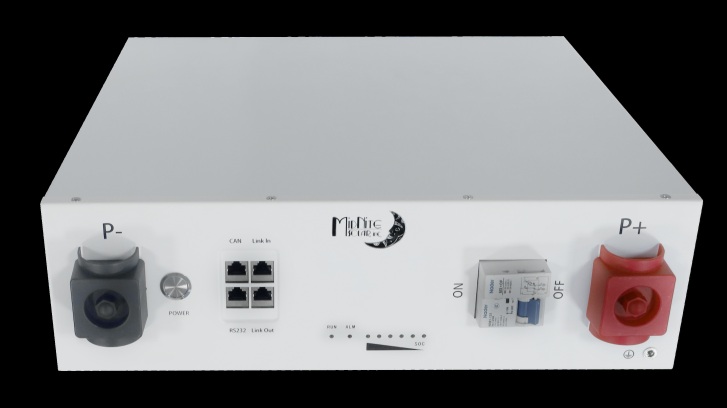
Choice: MidNite Solar MNPowerflo5 $1,099 (retail)
First bonus was the communication capability with my Victron system built in. Second bonus is the rack that comes with the batteries at no additional cost. Third bonus…dark start. When a battery becomes discharged to minimum safe level it is designed to shutdown. Almost all batteries then have to then be charged with an accessory charger or “jump started” to wake them back up; not these batteries. As soon as there is sufficient PV or genset power the battery will wake up on its own and begin to charge…nice! And to be honest…I love the white color vs the traditional black box battery scheme.
Decision made! MidNite Solar MNPowerflo5 was my choice. Order placed…waiting somewhat patiently. (Should be here sometime between March 19 – 21 with any luck.)
Yeah, then came the configuration process…how to group the batteries together for the best, safest, and most efficient configuration. Many folks use a stackable server rack system with a built-in busbar. However, that is not how these batteries stack in this case. So a vertical busbar on each side ( + & – ) is not on the plan. What I worked out though is, in my opinion, a better option. Why? Splitting the batteries into 2 sets and protecting each with a Class T fuse. I cover that in Part #1 < click here to read that >
The entire footprint is only 2’ deep by 3’ wide and approximately 26” tall. That fits well inside the current footprint minimizing the impact on the utility room. The wiring will be very clean and well-organized and mostly hidden.
Let me explain how I replaced the dual vertical busbars mentioned earlier. First off, understand that connecting each battery individually to a busbar is the most efficient way to configure a battery bank. That enables each battery to individually transfer current to and from the system equally among all batteries. While I can’t quite do that, I will be able to configure the system that is probably 99% as good in the transfer of current, but 100% better in protecting each set (½ of the batteries) in the bank from each other. To accomplish that I bought a Victron Lynx PowerIn Class T unit.
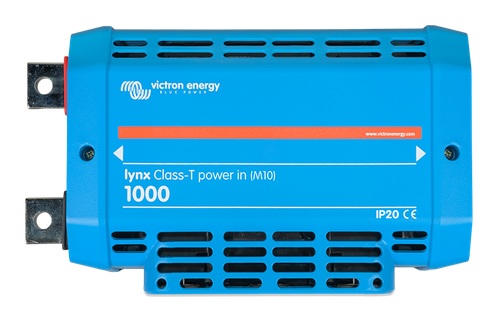 First off, there is an internal 1000amp busbar…plenty of busbar to handle the system’s current. And there are two connections to that busbar…each protected by its own Class T fuse. Why is that important? Should a catastrophic current overload (massive amperage) occur sending current into the battery bank, both sets of batteries are protected with a 225a Class T fuse. Should the current overload originate from a battery, the set’s Class T fuse will isolate the set of batteries from the system and the other battery set.
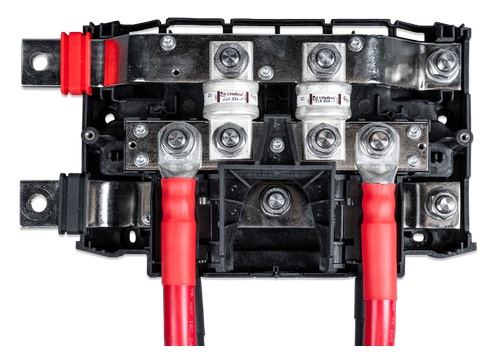 And here is a nice little bonus…the Victron Lynx PowerIn Class T unit, being part of the Victron family of Lynx components, connects seamlessly with the PowerIn unit I am using for ‘distribution’. That makes the system much cleaner, much more professional, and much safer than anything I could engineer. And that my friend is one of the many reasons I love Victron equipment…modular (use only what you need) and everything built to work together…and the best product quality on the market.
Now, there is a hidden bonus to moving to MidNite Solar batteries…removing the Lynx Shunt from the system. Since the battery bank (via the ‘Master’ battery) connects directly to the system’s computer “brain” (Victron Color Control GX unit), it transfers all the required/needed system information, eliminating the need for the shunt unit. And that allows me to sell that shunt unit to help offset costs of the upgrade.
Here is a graphic of what the PowerIn ‘distribution’ unit does…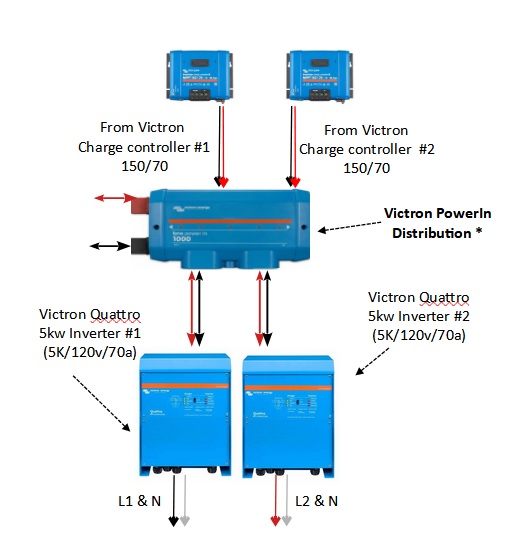 So all-in-all we are getting great batteries from a high-quality company that will work very well with our existing system. Now, let me explain this to you…it takes time to figure this stuff out. And I have 13+ years of building solar systems…and 7 years of building whole-house off-grid solar systems. I spent probably 40 – 60 hours over a couple months to come to the point we are now. But…it was time and effort well spent!
When put together it will look something like this…
 I think at this point I will do a series on the “build” and include video. Watch for it !
Articles in this Series –
SOLAR: New Battery Bank – Part #1
Related Articles –
Q & A Time…Ask me a solar question or send me a message…


 2009 - 2024 Copyright © AHTrimble.com ~ All rights reserved
No reproduction or other use of this content
without expressed written permission from AHTrimble.com
No legal, economic, or financial advice is given, no expertise to be assumed.
See Content Use Policy for more information.</p
 A.H. Trimble - Emergency preparedness information for disasters and grid-down
Pingback: SOLAR: Does it ever end? Is it ever enough? | A.H. Trimble - Emergency preparedness information for disasters and grid-down
Pingback: SOLAR: New Battery Bank – Part #1 | A.H. Trimble - Emergency preparedness information for disasters and grid-down