

Last November I wrote a ‘Tip’ article regarding a fuse of mine that heated up and I had to replace it. Along the way I noticed that the problem was the connections on the fuse holder were not tight. I fixed it and didn’t think another thing of it until I was upgrading our solar system this past spring. Then I found this…

Here is a different angle…
 I had corrected the problem I found originally, back in November, a loose nut on the fuse holder which created resistance. And that led to the fuse overheating and failing. I replaced the fuse and fuse holder, tightened everything to spec and went on with life.
The day the before I started the upgrade I went out to do a final assessment on the system. I wanted to make sure I had all the replacement/upgrade parts, cable, wire, etc. I noticed that the wire from the charge controller to the switch & fuse was once again warm, not hot, warm to the touch. I wasn’t worried because it was only warm and I would be working on it the next day anyways.
As I disassembled the fuse holder, took off the wire terminal, and then removed the switch from the wall it became apparent to me what was going on here. I had already taken the wire off the fuse holder, when I went to take the wire off the switch terminal the nut wasn’t loose…but it sure wasn’t tight. And this is what I saw on the wire terminal…
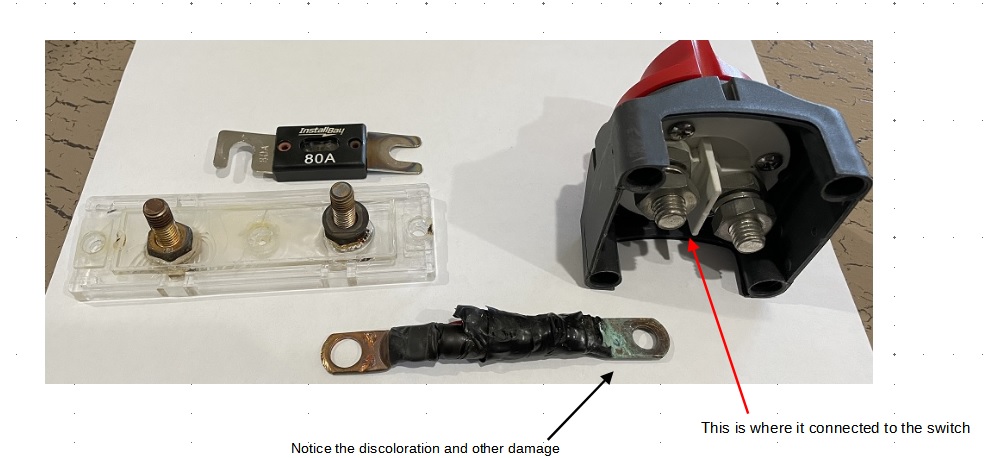
Note: The discoloration and build-up on the terminal is a result of loose nut connection. Not falling off loose, but not tight enough. And that ‘looseness’ created resistance which cased the corrosion and wire to be warm.
What is the bottom line here?
If you look at any quality piece of electrical equipment, it will state the ‘torque’ value that connections are meant to be set at, regardless whether it is a screw or nut/bolt. That setting is there for a reason. Electrical components heat and cool on a regular basis. As it does so, a nut or screw or bolt may loosen over time. If you are going to do the work, do it right with the right equipment. If you don’t have the right equipment then buy it…borrow it…or don’t do the work.
And yes, another reason to use fire resistant backer board behind your electrical equipment.
Follow-up note: The switch you see being used was rated for 275amps, far below the 70amp production capability of the charge controller. However, the switch was also only rated for 48vDC. There was as much as 58vDC running through the circuit. And yes, that means too many volts for the switch. But, the switch showed no signs of degradation of any kind. Manufacturers regularly derate their equipment to ensure safety when used. I was about 20% over rating. But that was not a full-time situation but unsafe all the same.
If you are wondering why I used that switch when I should have used one rated for 58vDC or higher…it was left over from the old 24v system and I didn’t check the rating when I went from 24v – 48v in 2020.
Related Articles –
 2009 - 2023 Copyright © AHTrimble.com ~ All rights reserved
No reproduction or other use of this content
without expressed written permission from AHTrimble.com
See Content Use Policy for more information.
 A.H. Trimble - Emergency preparedness information for disasters and grid-down