Something to think about…


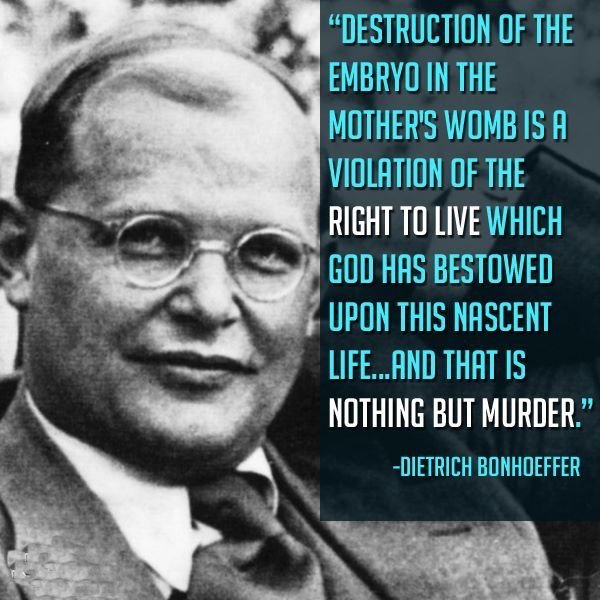
Dietrich Bonhoeffer (1906 – 1945)

Dietrich Bonhoeffer was a Lutheran pastor, theologian, and anti-Nazi dissident. Bonhoeffer was known for his staunch resistance to Nazi dictatorship, including vocal opposition to Hitler’s euthanasia program and genocidal persecution of the Jews. After accused of being associated with the 20 July plot to assassinate Adolf Hitler, he was quickly tried, along with other accused plotters, including former members of the Abwehr (the German Military Intelligence Office), and then hanged on 9 April 1945 as the Nazi regime was collapsing, 21 days before Adolf Hitler committed suicide.


2009 - 2020 Copyright © AHTrimble.com ~ All rights reserved
No reproduction or other use of this content 
without expressed written permission from AHTrimble.com
See Content Use Policy for more information.

Playing the Game…

note: originally posted August 2015 – written by Mike (guest writer)

The politicians are at it again, or I guess I should say “at it some more”, since the political season never ends. More  lies, more promises (that’s redundant), and more finger pointing. Time magazine (which I do not read) called it the “Game of Thrones”. On their cover (August 2015) they have a picture of Bush the Younger juxtaposed with William the Slippery. What a pair of jokers… and the joke has been on “We the People”. The connected class plays the game of thrones and we get to be the serfs.

What does this have to do with prepping? Read on…

Time got one thing right, life is a game, isn’t it? We all want to win, right? To win, or even to play well, we need to know the rules. Do the rules you learned growing up still apply? I’d say not much.

I grew up in the 50’s and 60’s, which was a strange dichotomy. The crazy “free love”, sex, drugs, and Rock n Roll 60’s, colliding with the Ozzie and Harriet 50’s. Worse yet, my parents were shaped by the late 20’s, 30’s, and 40’s. Both parents lived through the Depression, then WW2, and those two events shaped their lives. I was brought up to vote, pay your taxes, work hard, and learn all I could. College was encouraged, but my Dad made it clear he learned more from “the school of hard knocks” than any classroom. I was told things like:

  • “Never be afraid of a little honest dirt and sweat.”
  • “If you say ‘I can’t’, you will always be right”

If you are reading this blog you might have heard the same sort of stuff from your parents and teachers. I heard more of the same from my Marine DI’s:

  • “Second place is last place.”
  • “Pain is weakness leaving the body.”
  • “To err is human, to forgive divine, neither is USMC policy”

Are those still the rules? Is that what is taught in school today? Is that what most parents teach their kids?

Yes, I’m a dinosaur, and if I had a PC bone in my body, I’d break it myself. It seems to me the rules have changed, and not for the better. Today, everyone gets a trophy, teachers can’t grade in red ink, and colleges have free speech zones…except only politically correct speech is authorized. What crap!

Here is where this has lead us…according to data released by the census bureau in the fourth quarter of 2011:

  • 50% percent of Americans received benefits from one or more government programs. That’s 151 million out of 306 million population (2011). Yes, that includes 49,901,000 on Social Security, which they (we) theoretically paid for. Did we really pay for it? Yeah sure, but the money we paid has been squandered by the politicians.
  • Most of these same people are among the 46,440,000 on Medicare. Will I soon find myself forced onto Medicare? Yes. Do I want some money from the Social Security Ponzi fund I’ve paid into for all these years? YOU BET I DO. Will I get it? Maybe.
  • Consider also the 49,073,000 on food stamps.
  • The 23,228,000 in the Women, Infants and Children program.
  • The 20,223,000 getting Supplemental Security Income.
  • There were also 13,433,000 who lived in public or subsidized rental housing.
  • Then the 5,098,000 who got unemployment (all 99+ weeks of it).
  • The figures also include 364,000 who got railroad retirement benefits, which I assume they actually did work for.
  • There were also 3,178,000 who got veterans’ benefits, and as a veteran, I know we really worked, sweated, and sometimes bled for those benefits.

In total, the Census Bureau estimated 151,014,000 Americans (out of a population then estimated to be 306,804,000) received benefits from one or more government programs during the last three months of 2011.

This is only the money spent inside the US, and given to individuals. There are hundreds of billions more dollars spent in corporate welfare and foreign aid. Pay for play, and it will not go away.

Is this sustainable? Hell no, and some of us know it.

The new rules? Money for nothing and your checks for free. (Apologies to Mark Knopfler and Dire Straits)

Free money for the politicians, and free money for the sheeple. Our money.

Do I blame those who receive these benefits? No, because it’s human nature to do what is perceived as in their own best interest. Free stuff is hard to argue with.

Those are the new free money rules, most of which suck, but here is the solution:

Vote for the guy (or gal) with the “R” after their name they will fix everything, right? After all, they said so! Over and over again they’ve said so. “We will restore fiscal responsibility, balance the budget, close the borders, support the troops, follow the Constitution, blah, blah, blah”… Personally, I don’t believe a word of it. It’s all BS. You don’t believe the “R’s” either? Can’t trust them?

How about the other solution?

Vote for the other folks with the “D” after their name and they will ride to the rescue. After all, they said so too! Over and over again they’ve said so. Every year the “D’s” say to their constituents, “Your life sucks, the man is keeping you down, you have no chance, but if you vote for us it will all be better… next year.” How can you hear that from “the man” for 20, 30, 50 or more years, and not catch on to the scam? Free stuff.

Did you buy the line about voting for Hope and Change? That plan has sure worked well, they gave you hope and now what you have left is the small change. What actually changed? The name on the door.

Big government is the rule, so shut up and get back to work, someone has to pay those taxes. If you don’t believe  either the “D’s” or the “R’s” what can you do? Keep voting and expecting something different? Why would people do that? Because for most people, the scam still works, they continue to reflexively vote for the same bunch, D or R, year after year. Different promises, different faces, and all lies. Have any of those promises, other than more free stuff, come to pass? Will any of those promises ever be fulfilled? Is there anyone who will really work to decrease the spending, intrusion, and regulation? Will anyone actually “do the right thing” while increasing our personal Liberty? Not likely. Not without being forced to do so.

It is obvious that the “D’s” or “R’s” are the only parties who have a chance of getting elected, even though there isn’t a dimes worth the difference between them. The new boss is the same as the old boss, AND if you have the correct status, it’s oh so sweet. THOSE are the rules which have NOT changed. These are the same rules we’ve been playing by for at least 70 (or maybe 170) years. “Connected = easy street.”

The Congress as a whole has an approval rating in the neighborhood of 10%, and yet 95% of them get re-elected every time. How does that happen? It happens not only because a lot of people buy into the scam, it happens because so many are bought and paid for by the scam. It’s hard to argue with free stuff.

Here is my solution to the problem, and it’s where the “prepper” part comes in…

If asked, one of the attributes most prepper’s claim is a clearer vision of reality. The ability to see and deal with reality is supposed to make us different than the average sheeple. Part of being prepared is directly related to recognizing that bad things can happen. We have a plan, we have food, a water source, weapons, etc. It’s usually quite a long list. You plan the work, work the plan, to save your ass.

The reality many of us have not recognized is that we are really, really helpless. When it comes to constructive change and influencing the government, there is really almost nothing we can do. Even at the local level it is almost impossible. How many emails have you written? How many politicians have you contacted? Letters to the editor? PTA meetings? Town halls? Donations. Vote, vote, vote… and what has it achieved? Nothing, in fact things are getting worse. So what can we do?

It’s simple, we can stop feeding the beast.

Oh, you can still go to meetings, write the letters, make the calls, and continue to vote, but try doing a few new things as well:

  • Minimize your taxable income.
  • No more political donations.
  • Vote, but NEVER vote for the incumbent.
  • While I would never suggest doing something illegal, I do suggest doing whatever you can to legally cut down on the support you give to government.
  • Let your city, county, state, and the federal government do with less. Can you barter? Can you take Uber instead of a taxed and regulated cab?
  • Can you drive across a border for a lower sales tax? Can you move to another county or state and lower your property taxes?
  • Be creative and find new ways to suck them dry.
  • Can you retire early?
  • Are YOU eligible for some sort of benefits? If so take them! Why not keep as much of your own money as you can, and get some of the free stuff that is being offered?

There are hundreds of ways to stop feeding the beast, and carve a little more off for yourself. Remember, there is no such thing as a “loophole” in the law, the law was written that way for someone’s benefit, and it might as well be you. Living a minimalist lifestyle does not have to mean living in a tent (unless you want to). What I think it should mean is minimizing your contribution. Stop throwing chum in the water! Let the feeding frenzy die from starvation. The cockroaches in the bureaucratic woodwork depend on US. We can’t fumigate them, we can’t step on them, and they won’t just go away, so my alternative is to starve them.

By some estimates the government at all levels wastes as much as 30% of what it takes in. THAT IS OUR MONEY THEY ARE WASTING! Paying your “fair share” means paying not one dime more than you absolutely must. Keep your money in your family, and use it wisely. I believe the most likely SHTF scenario is for an economic Armageddon. If I’m right, the sooner the economy resets, the less pain we will all feel.

Could this “depression” lead to war, famine, plague and a more complicated SHTF scenario? You damn well know it. Play their game to your benefit. Play the game of selfish preservation NOW, before the SHTF. You know you can’t feed all the starving masses in an SHTF situation, so why endanger your survival by doing it now?

STARVE THE BEAST!

By starving the beast and carving off more for you and yours, you can better prepare and maybe make things come to a head sooner.

Sooner begun, sooner done.

2009 - 2020 Copyright © AHTrimble.com ~ All rights reserved
No reproduction or other use of this content 
without expressed written permission from AHTrimble.com
See Content Use Poli for more information.

Something to think about…


Dietrich Bonhoeffer (1906 – 1945)

Dietrich Bonhoeffer was a Lutheran pastor, theologian, and anti-Nazi dissident. Bonhoeffer was known for his staunch resistance to Nazi dictatorship, including vocal opposition to Hitler’s euthanasia program and genocidal persecution of the Jews. After accused of being associated with the 20 July plot to assassinate Adolf Hitler, he was quickly tried, along with other accused plotters, including former members of the Abwehr (the German Military Intelligence Office), and then hanged on 9 April 1945 as the Nazi regime was collapsing, 21 days before Adolf Hitler committed suicide.


2009 - 2020 Copyright © AHTrimble.com ~ All rights reserved
No reproduction or other use of this content 
without expressed written permission from AHTrimble.com
See Content Use Policy for more information.

Glenn Beck, Destination, Prepping, & Gardening

note: originally posted April 2016

I was listening to Glenn Beck on the way into work the other morning. He was talking about something, not sure what the overall subject was, but he spent a few minutes talking about “destination” in regards to politics and the country. He made some really great points, but I am not here to talk about politics.

I started thinking about destination as it relates to prepping. Then I related “life” to prepping and “destination.” Yeah, you can tell I was on a real philosophical kick that morning. Probably due to too much Pepsi. But, it did really get me thinking about a few things. And I want to share a little of that today.  

Is there a “destination” to prepping?

No. Prepping is a process whereby you are getting ready for some future emergency, disaster, or grid-down event. And, by being prepared you are able to help those in need…that is called service. My physical therapist who helped with the healing of my shoulder told me once, “Service is the highest form of worship.” My religion also preaches that, “When ye are in the service of your fellow beings ye are only in the service of your God.”

Preppers exist to give service.

We never know for sure that our prepping will ever be used in serving those needs. However, that is our goal…or, should be.

That being said, there is no destination because we don’t know if, or how many times, our prepping will be called upon to help or serve others. Hence, no destination. If prepping were a destination there would be a point where we could say something along the lines of, “I’m done! I’ve acquired every single thing I need to be prepared.” Or, “I am done, my preps are all gone, I can do no more!” And we know that neither point will ever be reached. Hence, no destination.

But, it is not important that there is no destination. Similar to life, prepping is a journey. A special journey to be sure, but a journey all the same. Some of us have been prepping for decades, others for only weeks. The length of time a person, or family, has been preparing is also not important. It is the mere fact that they are preparing. Why? Because we don’t know exactly what will be needed. Or when it will be needed, when it comes right down to the emergency, disaster, or grid-down we’ve prepared for.

Sure, I have given an outline, tips, advice, reviews, lists, etc. for most aspects of preparing but just the fact you are doing something, anything, is the main thing here. You have acquired the mindset of being prepared…and that is priceless.

Why do we prepare?

I could give long rambling answers to that question all day, plenty enough to bore you to tears. But, we prepare because something inside of us tells us to. That voice whispers to us it is important that we do these things. Yes, that little voice in our head; some would say that “still small voice” that whispers through our soul.

Now, there are those individuals, that after listening to them for a while, I think they prepare to tell people “I told you so!” once calamity strikes. And I must admit, there have been occasions when that thought has crossed my mind. But, I try to avoid ego driven thoughts such as those.

For those of us that are LDS we have a further reason to be preppers…we are told it is the right thing to do. In “The Family – a Proclamation to the World” we are told that fathers are “responsible to provide the necessities of life and protection for their families.” Which falls right in line with the goals and purposes of prepping.

For those of us that believe in the Bible… 1 Timothy 5:8 –

“But if any provide not for his own, and especially for those of his own house, he hath denied the faith, and is worse than an infidel.”

So there are whole lot of reasons to be a prepper…and they all make sense, common sense.

Is prepping like gardening?

Last year I wrote about taking the time to gather onion seeds from my heirloom onions that I had grown that season. Yes, it was a little tedious and time consuming. I could have easily spent about $4 or less and bought my seeds for this year. But, what would it have gained me?

Last winter I planted a bunch of those seeds not really knowing if they would grow or not. I put them in freshly tilled, fertilized, and mulched ground. I watered them regularly and kept invasive weeds from choking out the tiny little plants. This spring I was rewarded with a whole lot of tiny onion plants. In years past I had always purchased my onion “sets” from the store for about $4. Those store bought onion sets were planted, opinions harvested and enjoyed. But, the store was in the supply chain. However, this year…the process was mine from start to finish. My onion sets are now growing into real onions!

My harvesting of the seed, starting the little onion set plants, replanting them into an opinion patch, and soon harvesting the onions to enjoy in our meals is almost complete. Well, not really…

This summer I will not harvest all my onions, I will leave three of them in the ground to develop seed heads. In the late summer I will once again harvest the seed heads, pick out the tiny seeds, and then secure them for planting later to grow next year’s onions. In reality gardening is never complete…it is a journey.

So now what?

You simply keep on doing what you are doing. And you do it knowing that you are doing the right thing for the right reasons. For one day, maybe soon, you will use your preps in service to others. Maybe service to your family, maybe to your neighbors, or your congregation, maybe your community…but you will serve. That is what you were placed here for…that is who you are. That is your journey…not your destination. Enjoy it!

I am thankful I have good people like you to share this journey with.


2009 - 2020 Copyright © AHTrimble.com ~ All rights reserved
No reproduction or other use of this content 
without expressed written permission from AHTrimble.com
See Content Use Policy for more information.

Situational Awareness: Part 8 – Summary

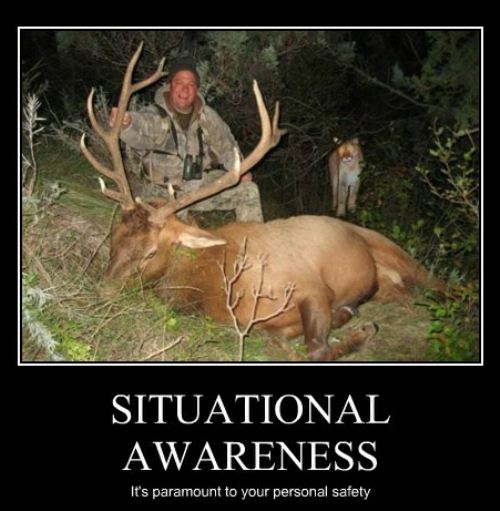
Situational AwarenessA lot has been written in the academic world about Situational Awareness (SA) and most of it would make your eyes glaze over.  The exception would be when the academics fight over what SA actually is, that can be kinda fun to watch.  I am not going to get into the academics of SA because it is mind numbing to say the least.  What I shared with you is practical and how to use it.

SA is the ability to recognize and understand what is happening around you, how it will affect you, and how you use it for a positive outcome.  Well, at least to me, that is my definition of SA.  There is a lot of material, some of it quite good, scattered about the Internet so there is no lack of sources for learning.  But what I want to do is summarize a down-to-earth practical understanding and application of SA from the previous 7 parts of this series.

In any “high-speed, low-drag” situation (high-speed = complex and high stress) there is always a large amount of activity taking place around you.  The key is to acquire, assess applicability, understand the impact incoming information…and then accurately predict the result and then act on it.  That is the SA process.  The successful “outcome” to the SA process is sufficiently manipulating your actions for a positive result for you and your team.

The history of SA goes back 100+ years when aviation was first becoming a tool of war.  Thinking in a three-dimensional world wasn’t really used much prior to WWI because man really didn’t get off the ground very often.  But with the advent of powered flight in a wartime setting SA became a necessity for man if he wanted to stay alive.  Those early pilots had to keep aware of where their fellow pilots and planes were in normal flight operations.  And when they engaged the enemy in aerial combat they had to keep track of multiple enemy aircraft as well.  And not only keep track of them but anticipate what they might do next, where they would be and then act to counter the enemy pilot’s maneuver…then shoot them down before they themselves got shot down. A daunting task! WWII saw SA turned into a formal process for fighter pilots.

In an emergency or disaster situation, and especially in “grid-down”, SA is absolutely imperative.  Good SA will help keep you alive, poor SA will assure failure and potentially bring about injury or death.  What I am saying is SA in normal everyday life can relax a little bit so you are not “on edge” all the time.  The exception would be SA for personal and family safety.  However, when something goes wrong in your world (i.e. emergency, disaster, grid-down) then your SA must be turned up full throttle.  You must maintain that “edge” all the time.

To qualify as good SA you must first be able to “see” what is happening around you.  You must use all your senses to take in all that is happening.  And most importantly you must be able to see these indicators in reality NOT your interpretation of reality.

Example:  Many times during WWII as Jews were being rounded-up they were told it was for their own good/safety and they would be fed when the train stopped.  Unfortunately, the reality was imprisonment and death.

One “sense” I am going to strongly suggest that you always listen to is your “gut”, your instinct, your feelings; whatever you want to call it.  Often your subconscious can discern indicators of danger that escape your normal senses, especially your consciousness.  At times your conscious mind can not properly process certain subtle danger indicators or articulate it so you have the opportunity to think about it.

Also, for those of us that are “believers”, listen to that still small voice that will come to you at times.  That voice will steer you in the direction God feels is appropriate for you at that time.

A good example of that “gut feeling” occurs when you feel something isn’t right and you turn around and someone is staring at you.  Women especially have that instinct…normally used when judging males it is known as the “creep factor.”

So you have all these information inputs coming in, now you must decide which are the most important.  I would suggest you read my post on LIPS  to understand how to determine “priorities” in a preparedness situation.

Example:  Your family is being stalked by a gang of bad guys who want to take your food and daughter.  Your Grid Down Chaos and violence against people are threat and risk to familyinformational inputs are: it is cloudy, it might rain, your feet hurt, you have a small hole in your pants leg, your wife has slung her AR15, the bad guys are gaining on you, your youngest son says he’s hungry, its been 3 days since you had a full nights sleep, your water is running low, and your tooth hurts.  All of these things contribute to SA.  But what are the highest priority information inputs?

To properly absorb SA inputs you have to establish a “baseline” and that baseline will change and continue to change often.

Example:  You are hiking through a wooded area that you think is abandoned.  So you know the smell of the area which might be damp leaves.  And you know the sound of the area which is birds chirping with an occasional squirrel barking and scampering away.  And the area is basically green in color with evergreens being predominant.  Then you notice the birds take wing, a faint waft of smoke smell and a brownish/grayish patch in the trees 100 yards in front of you.  DANGER!!  Your SA just acquired the indicators of a camp where people are now moving around.  What you now do with that change in SA is the key.

Team SA (TSA) can be exponentially more effective that individual SA.  However, it can also be exponentially Team based Situational Awareness - Team SAworse as well.  Keeping track of everything going on with multiple people is virtually impossible for one person, especially in a high-speed situation.  Let me explain…

For TSA to be effective a few things need to be in-place and clearly understood by each team member:

  1. Leader’s Intent
  2. Responsibility of each member
  3. Great communications, specific & assertive
  4. Good individual SA

Basically each team member is using their own individual SA to guide their own actions and assist the other team members in carrying out their respective responsibilities.  Team members must not wait to speak up when they see a problem, or potential problem.  They must deliver that information to the team in short, clear, assertive terms.  That must be done BEFORE the problem affects the team’s successful mission accomplishment.  Probably the best aspect of TSA is the saying “the whole is greater than the sum of its parts.”  While the origination of that phrase is debatable, it is no less applicable to a key aspect of Team Situational Awareness.

There are barriers to effective SA, they are:Barriers to team situational awareness.

  1. Normalcy Bias
  2. Competency Bias
  3. Too much motivation
  4. Information/mental overload
  5. Physical/mental fatigue
  6. Distorted reality
  7. False information intake
  8. Poor communications

Barriers to individual SA are items #1 – #7.

The ability to have great SA is a learned skill.  You learn it through training and experience.  With great SA you are far more likely to succeed.  With poor or non-existent SA you are almost certainly doomed to failure…and maybe not even know why you failed.

And during an emergency, disaster, or grid-down…failure is not a valid option. It is all your choice…learn and use SA…or fail. Yes, it is that simple.


Article in this Series –


2009 - 2020 Copyright © AHTrimble.com ~ All rights reserved
No reproduction or other use of this content 
without expressed written permission from AHTrimble.com
See Content Use Policy for more information.

Situational Awareness: Part 7 – OODA (Out of the Loop)

I am out of the loopnote: I think this is one of the single most valuable pieces of information you will ever read for a grid-down event. When the violence is knocking at your door you better understand this concept or you will get killed. Yes, it is that important and I am that serious.

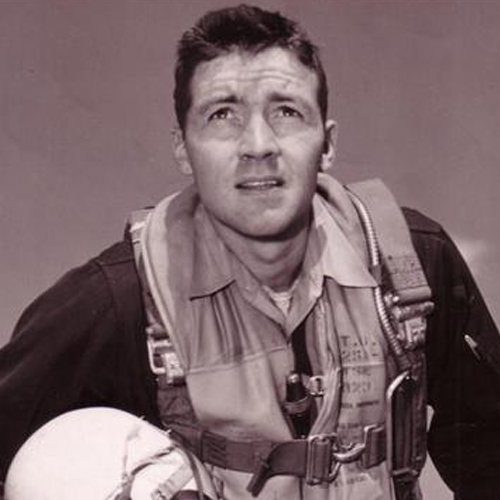
I am sure everyone has heard the saying “I was out of the loop on that” or some variant. Generally it is meant that a person wasn’t aware of something that was going on. However, the origins of the saying is a fascinating story itself. It goes back to the early Col John Boyd OODA Loop air force jet planes fighterdays of the Air Force and a man by the name of John Boyd, a Colonel.

Col. Boyd developed this model to assist the training of military pilots. Dogfights occur at a very high speed in a three-dimensional environment. A pilot must not only have lightning fast physical reflexes, he must be able to out-think his opponent as well. To win a dogfight a pilot must be able to get his plane inside the decision loop of his opponent to line-up a kill shot…and do so without himself being shot down. It is a daunting task in the best of circumstances. And the speeds at which this occurs is unrealistic and unfathomable to most of us mere mortals.

Any high-stress, high-risk environment tends to be high-speed as well, or at least at critical points in time. A person must be able to function in that environment to the point of success. Failure to function successfully in these types of situations can lead to injury or death of yourself or someone else. Boyd developed a system that trains a person Col John Boyd developed the OODA loopon success under stress, in high-risk environments, at high rates of speed. That system is all about acquiring information, processing that information, making a decision, and then acting on that decision.

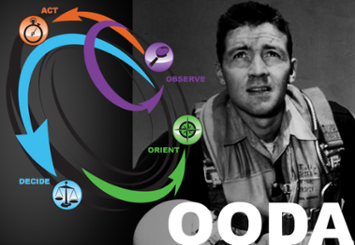
The decision making model he developed is called OODA.

That is an acronym for; Observe, Orient, Decide, Act.


Broken down it means –

  • Observation of the raw information on which decisions and actions are based.
  • Orient the information to your situation and environment.
  • Decide a course of action.
  • Act quickly and decisively.

While it would be convenient to allow those brief explanations to stand on their own, it is impossible if you want to truly understand how it all works together for success.

One of the best explanations of the complete OODA cycle was by Harry Hillaker –

“The key is to obscure your intentions and make them unpredictable to your opponent while you simultaneously clarify his intentions. That is, operate at a faster tempo to generate rapidly changing conditions that inhibit your opponent from adapting or reacting to those changes and that suppress or destroy his awareness. Thus, a hodgepodge of confusion and disorder occur to cause him to over- or under- react to conditions or activities that appear to be uncertain, ambiguous, or incomprehensible.”

What I am understanding Hillaker to say is fairly simple – Embrace the confusion and use it to your advantage to defeat your enemy. I think I have that understood pretty clearly but that explanation is purely for a military or tactical situation.

What about when there is no person as an enemy?

How do you even describe “enemy” is these terms?

For this discussion I will revert back to our discussion on “objectives” as the enemy. We must “win” in terms of meeting the objective. If we can’t claim a “win” then we “lose.” Losing means that our objective was not met. And success in this arena is based on achieving our objectives, hence “losing” is the enemy.

Based on the foundation I just laid out where there is no person as an enemy, there is no option to turn confusion against our enemy. Confusion in this sense only hurts our team and hinders the successful accomplishment of our objective. However, we can easily state with certainty that seeing through, and/or eliminating, any confusion would make attaining our objective far easier. We can now agree that we only need to go half way on the confusion issue, remove it vs. install it on our non-person enemy.

In retrospect haven’t we already started down the path of confusion elimination?

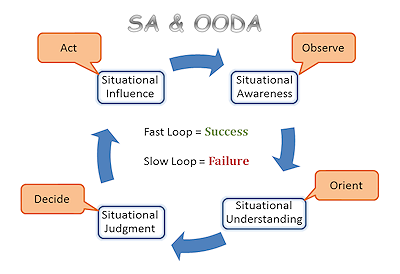
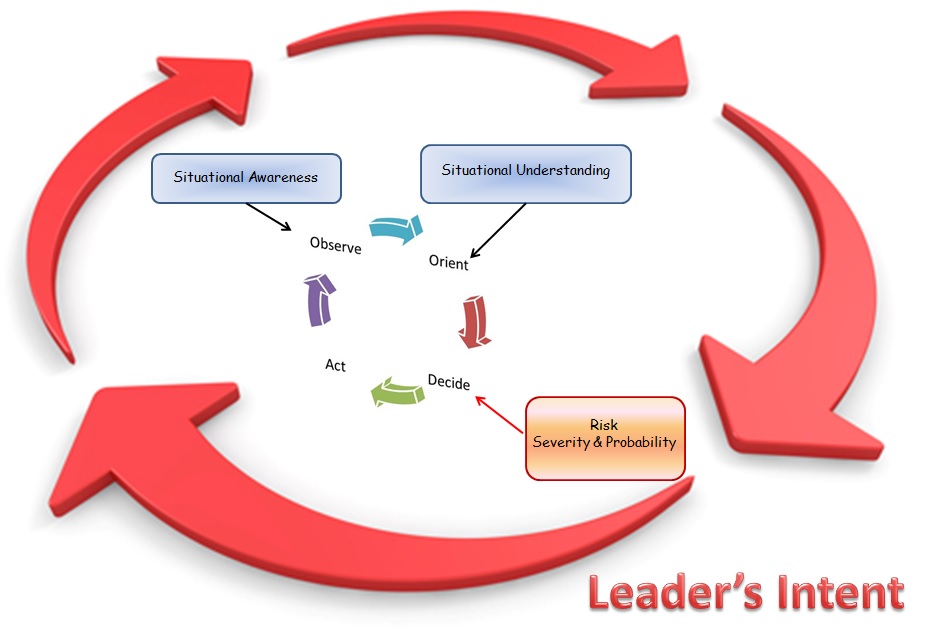
When I wrote about Objectives and Priorities I presented the topic of Leader’s Intent we can/did ask for clarification to ensure a solid foundation of understanding. On the other hand, if we are the one delivering Leader’s Intent we used the SMART model to clarify the task. So exactly what confusion is left to clear-up?ColJohnBoydOODA-003If you look closely at the OODA Loop you will notice that there is a very close relationship between the “OO” and the Situational Awareness. In plain English the “Observe” and “Orient” matches perfectly with the concept of Situational Awareness (SA). If your SA is good, your OO is functioning correctly as well.

Situational Awareness & OODASo why the need for both models?

There is a vital need, the OODA loop outlines the entire process along with explaining the “why.” The “why” being defeating your enemy, or accomplishing your objective(s). I see the OODA loop as a bridge between two more detailed systems –

  1. Situational Awareness
  2. Risk Management

If you go back to Hillaker’s explanation there is a key part “…operate at a faster tempo to generate rapidly changing conditions…” That integrates a true sense of urgency into the overall process. The need to move at a sufficient pace to outperform your enemy. Is it not reasonable to assume that if you outperform your enemy that you win?

Col John Boyd OODA loop jet fightersBut, what about dealing with an objective as the enemy?

When you consider the different aspects of an inanimate foe, the process can be both more difficult, and yet easier. When dealing with a person as a foe you have to assume many things about that person and hope you are right. A smart foe can do things entirely unpredictable which subsequently disrupts your SA and hence, the outcome. However, an inanimate objective can be almost as unpredictable, but that same inanimate objective is lacking the ability to purposely be unpredictable. The end result is there are pluses and minuses to both situations, an animate vs. an inanimate foe. For this discussion we will focus on the inanimate foe, an objective.

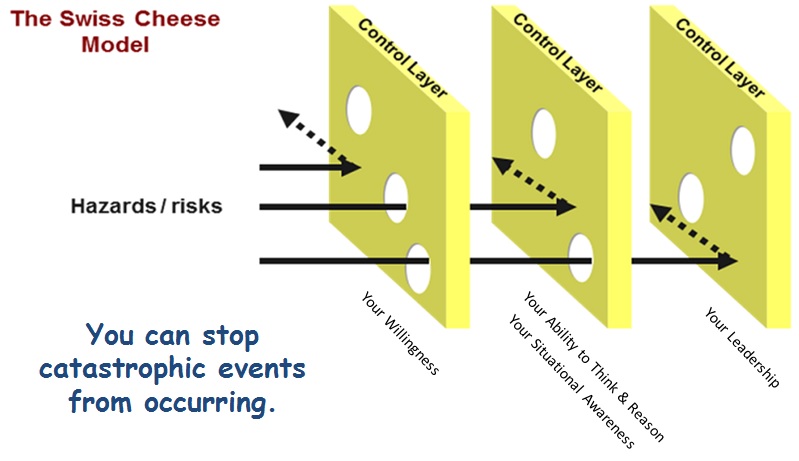
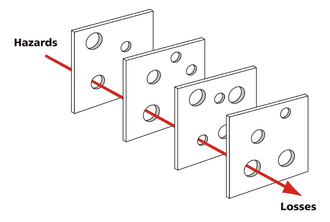
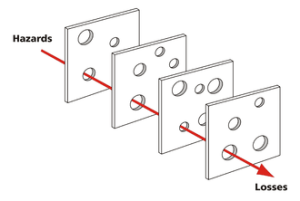
Let’s review what the Swiss Cheese model of risk management looks like –

Swiss Cheese Risk Management You have any number of opportunities to stop a negative incident from occurring. Plugging just a single hole in any slice of cheese prevents the incident from ever occurring.

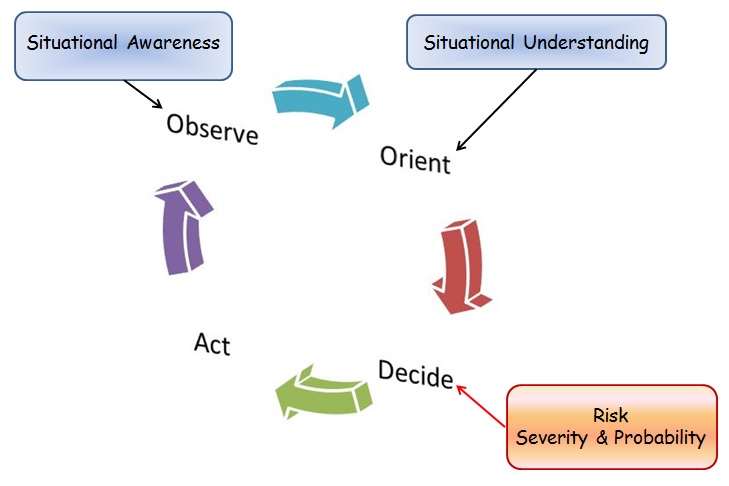
If you were to chart the OODA Loop process as consisting of a combination of Situational Awareness and Risk Management it would something like this.

Adding in Situational Awareness

Adding in Situational Awareness

Then adding in calculating the probability & severity aspect of the risk.

Then adding in calculating the probability & severity aspect of the risk.

Here we see the OODA loop link two systems that were previously envisioned as “stand alone.” While both of those systems were valuable and applicable, they did form a complete picture for our purposes. However, there is a third system that is still missing that carries considerable influence, if not total control, over everything – Leader’s Intent.

While some could argue that Leader’s Intent would be one of the “filters” of the SA process I would disagree. I think Leader’s Intent drives all of the systems from the very beginning. Thus, I propose the proper graphic representation of the system should look more like this.

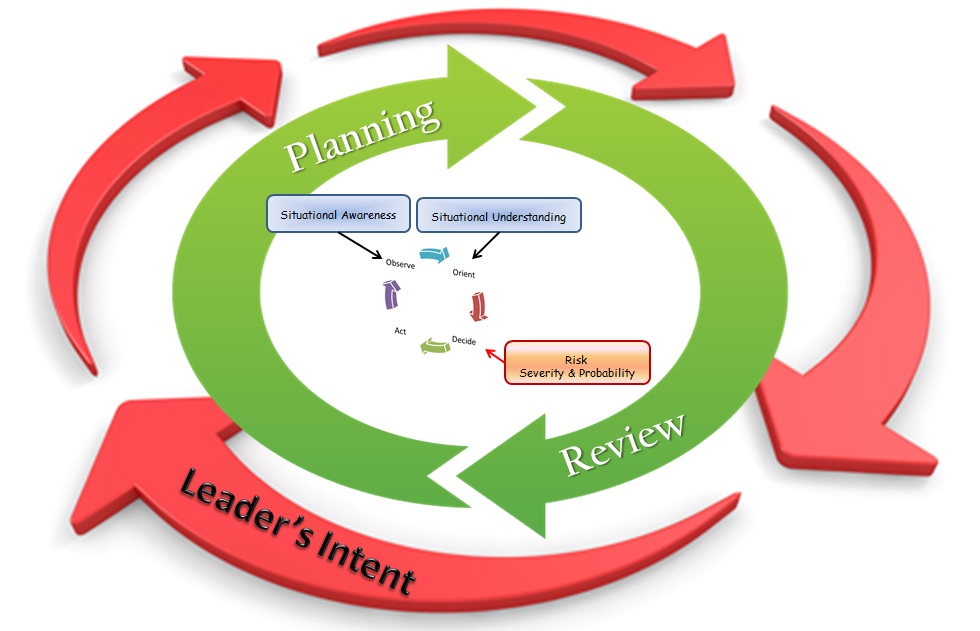
Leaders Intent OODA Situational AwarenessNonetheless I still maintain that the graphic reorientation is still lacking a key piece. No doubt that you would accomplish the object, but in the graphic it is implied, not explicit. And, depending on the situation you may or may not be able to undertake the planning process formally, it may have to be done “on the fly” and not in written form. I am of course referring to planning as a key element.

In my way of thinking Situational Awareness is a more complete system/process to define and accomplish the observe and orient of the OODA loop. And, Risk Management encompasses the decide and act aspect of the OODA loop. Clear Leaders’ Intent drives the whole loop in harmony. How does planning work into the process?

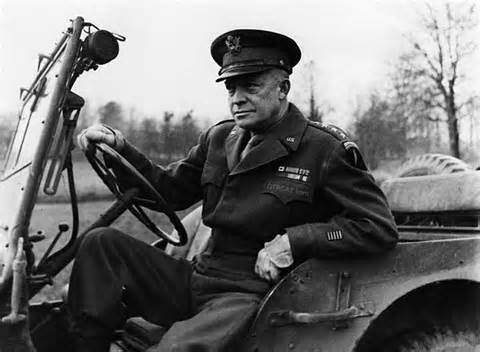
Planning is actually a combination of orient and act parts of the OODA loop with a heavy influence of leader’s general eisenhowerintent. Have no doubt that planning will be a key element of any success in accomplishment of an objective. However, General Eisenhower said, 

“In preparing for battle I have always found that plans are useless, but planning is indispensable.”

What he was trying to get across through that statement was the fact that though the planning process we find the weaknesses, strengths, and alternatives to the environment in which we will operate. A good example of that is “combat loading” of ships. If you loaded a ship for an invasion such as D-Day the same way you would load a normal cargo ship, you would be doomed to failure.

Why? All the ammo would be loaded together in one area, all the trucks loaded in another, tanks in another, Humvees it yet another area, etc.

As the invasion takes place do you need all the Humvees at one time? No. How about needing all the trucks at one time? No. And the same is true for tanks, ammo, medical supplies, etc. The military loads ships in a manner that the supplies come off in the order in which they are needed. You may only need 20 trucks at first, but you need 10 tanks before that, and 15 Humvees along with the tanks and trucks. But a sufficient amount of fuel, ammo, and medical supplies need to off-loaded with the appropriate vehicles. The planning process allows for the discovery of such issues and making the appropriate adjustments.

Another example would be the same situation of the actual invasion. The leader’s intent would be to secure town “x.” While in the planning process it becomes obvious which beach is the best to land on due to any number of factors. But, good planning demands that you have multiple alternatives. The same would be true for routes to get off the beach and to the town you are supposed to secure. Once again, in the planning process you are looking at maps that show the best/fastest way to reach the town. And yet again, you must have multiple alternatives in case your run into resistance or other obstacles with the primary route.

As the invasion unfolds different invading units run into problems getting off the beach for any number of reasons. However, since the planning process revealed multiple routes to the town, the local (on the ground) unit leaders can pick alternative routes as the battle unfolds. And, those choices can be made without running it up the chain of command because the optional routes are already in the plan…and approved. Hence, the local leader on the ground is still operating within the authorization given through leader’s intent.

Had there been no formal planning, the alternative routes would not have been identified ahead of time…and previously approved. The leader on the ground would have to discover the optional routes causing loss of time and jeopardizing successful completion of the objective.

Yet another revision of the entire process would look something like this…

LeadersIntent-004Do I have you confused by now?

How about…do I have your eyes glazed over yet?

That is obviously not my intention or my objective.

What I do what you to think about is how to be successful when it comes to surviving after “grid-down” when all your prepping comes into play. But, surviving is a whole lot more than just beans, bullets, and band-aids! It is about how you become a successful prepper to become a successful survivor. And success depends on skills. No, not skill…SKILLS !

And you need to understand how to use systems such as OODA Loop, Situational Awareness, and Risk Management to improve your odds of success. If you can improve your odds of success in a grid-down situation, then it will be much easier for less serious emergencies and disasters as well. But it all takes time, effort, and commitment to develop such skills. Might as well start learning and developing…now.

Success or failure is the outcome of your situational awareness.

Two Potential Outcomes…make your choice!


Article in this Series –
2009 - 2020 Copyright © AHTrimble.com ~ All rights reserved
No reproduction or other use of this content 
without expressed written permission from AHTrimble.com
See Content Use Policy for more information.

Situational Awareness: Part 6 – Dig It !

SItuational awareness during grid-down, learning to dig for teh real truth. Freddie Gray's death and who killed him.note: originally posted in the fall of 2015 as a standalone article.

OK, so “Dig It !”, really? Yup!

But more specifically when you are done reading this rather long post in regards to Situation Awareness (SA) I hope to have helped you to learn two things; 1) how to overcome Normalcy Bias , 2) learn how to investigate (dig into) events/information to know what is pertinent information and why. In other words, understand the “root” below the surface vs. what is above ground and what they want you to see.

In accomplishing those two objectives, as a “prepper” you will better be able to recognize “the big one” when it happens, accept what is happening. and take steps to deal with it.

But, let me clarify something first and assure you of a fact…most SA input will be in the field and come at you quickly. And then there will the most subdued situations with information that is larger in scope, slower to emerge, and just as important to the OODA loop.

I want to go into #2 first because I think it will greatly assist in accomplishing #1, making it much easier.

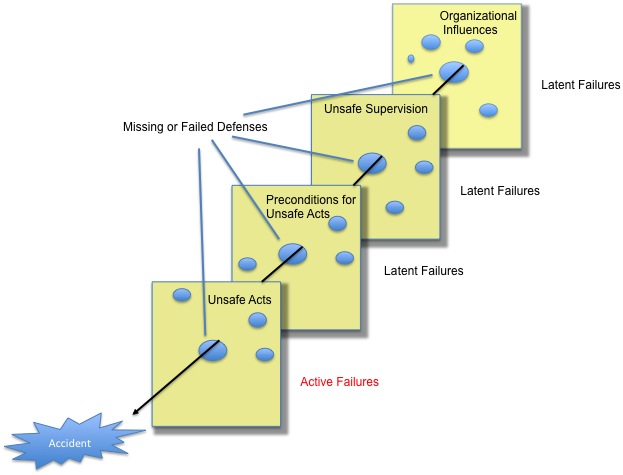
There is a model that exists in analyzing accidents and what causes them, it is called the Swiss Cheese model Swiss Cheese model of accident causation is a model used in risk analysis and risk management(a.k.a. “Cumulative Act Effect”). It is also used in things such as:
  • risk analysis,
  • risk management,
  • the principle behind layered security,
  • defense in depth.

Simply put it looks at human-based systems as a block of Swiss cheese made up of slices where each slice represents an act of a human as part of the system. The point is – every person will make a mistake (a hole in the slice of cheese) from time to time in any system. The trick is to keep from the holes in the individual slices and making itself all the way through the block of cheese. Because when that happens a catastrophic event occurs.

In this model every attempt is made to ensure enough qualified and competent people in a high-quality system to keep those “holes” to one or two slices.

Layered Security” example: To protect a forward operating base you have multiple layers of security that consists of outside perimeter patrols, an outer perimeter made up of mines, an inner perimeter of razor wire, barricades on the entry road to slow traffic, armed guards, guard towers, blast walls, etc. Each layer is meant to keep the bad guys outside of the wire and the people inside safe.

So how exactly does this work? Well, I want to touch on one other principle first; it will really help. There is a set of “best practices” out there called a High Reliability Operation (HRO). The principles are used to run high-risk operations where there could be catastrophic outcomes. US Navy uses it for its nuclear program, its aircraft carrier flight deck operations, Special Operations uses a variant of it, and the list goes on. There are five basic concepts to HRO:

  1. Preoccupation with failure
  2. Reluctance to simplify
  3. Sensitivity to operations
  4. Commitment to resilience
  5. Deference to expertise

I won’t go into detail because it would be a whole book by itself, but #2 is the important one. It means that when looking at the causal factors of failure you don’t simplify. In other words, the reason(s) something fails is usually far more complex than simple.
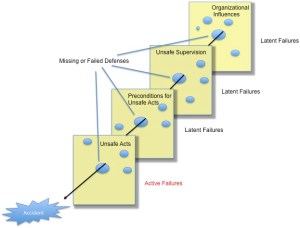
Swiss Cheese model of accident causation is a model used in risk analysis and risk management

click to enlarge

When you combine the Swiss Cheese model with #2 above you avoid reasoning such as “the last decision” caused the failure. Yes, the last decision might have been a bad one, but it not the worst one, it is just one of many bad decisions that started long before the outcome occurred. That means there has been a history of poor/bad decision making in the “organization” and in the “process” that led up to the last bad decision.

Looking at the visual of the Swiss Cheese model, the bad decisions are the holes and they all lined up to have a bad outcome, usually a catastrophic outcome. No person in the organization or process prevented the bad decision from proceeding; there was no slice of cheese blocking the way of the event occurring.

Microcosm

And to bring this SA concept to the point of more easily being understood I am going to use the death of Freddie Grey in Baltimore that has been in the news lately.

So, let me ask the question, “Did the police kill Freddie Grey?” Yes, I consider that a catastrophic event, death is catastrophic in my way of thinking. So, again, “Did the police kill Freddie Grey?”

I have heard two lines of thought given; 1) he was a criminal, resisted arrest, and died by his own hand in the police van, 2) murdered by police officers.

Which is right?

Let’s review what we knew early on as fact from the incident:

  • The cops’ own words for what Grey did, “He made eye contact and then ran.”
  • He was never charged with a crime, the cops never said a crime occurred.
  • He did run, cops chased him.
  • Witnesses and video said the cops were very rough with him, he appeared to be injured at the time he was placed in the police transport van.
  • The van stopped multiple times.
  • Grey was eventually placed in leg restraints.
  • Grey was never properly secured in a seat in the transport van.
  • Grey was alive before he went into police custody.
  • He died while he in police custody.
  • He died of a crushed larynx and a severed spine.

So how did he die? Is that even the right question? Maybe it should be, “Who killed him?” or, “Why did someone kill him?”

Why the different questions? Why not accept one of the two original explanations of, “Did the police kill Freddie Grey?”

Wait, why does any of this even matter?

In emergencies, disasters and especially during a “grid-down” situation there is always always bad information. Sometimes the information is “bad” because it is intentionally so. Yes, the government has lied to us before during events and will continue to do so. No matter the reasons behind it, we just know they do. Actually, we know they intentionally lie to use every day, all day, day in and day out.

We must be able to see through the lies and dis-information and understand what is actually happening. Because without a hard understanding, a true understanding of what is happening, how in the world would you ever be able to make the right decision for you and your family? You must be able to be Situationally Aware and not suffer from Normalcy Bias; anything less will result in poor decision making.

Back to the example – Let’s start by asking a couple of truly basic but insightful questions:

  1. Why would a person crush his own larynx?
  2. Why would a person sever their own spine?

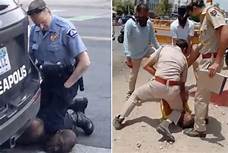
Yes, there are a lot of people commit suicide each year; many in weird and unusual ways. So let’s apply Occam’s Razor problem-Chokehold by police can crush a larynx and sever a spine - Freddie Graysolving principle to this specific question. To do so let’s look at a two common police practices; 1) choke hold, 2) suspect restraint while handcuffing. Both practices being widely taught and used by police officers in the last couple of decades to restrain suspects before and after handcuffing.

So which is the most likely event to have occurred causing Grey’s larynx to be crushed and his spine to be severed?

To me, reality (based on Occam’s Razor) the cops are far more likely to have caused the injury vs. self-inflicted. But that alone is not enough to convince me so let’s continue.

There were six police officers involved in the incident, five of which eventually gave statements after conferring with union representatives and lawyers. The sixth officer pleaded the “5th Amendment” and didn’t provide a statement. To refresh you on the 5th Amendment, a suspect “…nor shall be compelled in any criminal case to be a witness against himself…” In other words…a person can refuse to make a statement that would be an admission of guilt.

That pretty much says one of the cops knows he committed a serious crime and refused to make a statement because he would either admit he committed that crime or would have to make a false statement which is a felony. Reality once again speaks rather clearly based on this reasoning, a cop caused the death of Freddie Grey.

Then the medical examiner ruled Grey’s death a “homicide” not a “suicide.” Which means that Grey died at the hands of another person not at his own hands. Tie that back into the fact that the multiple injuries occurred while in police custody and no one but police had access to him during the time frame in which he injuries occurred.

In the previously mentioned statements of the five police officers they all failed to mention a stop that the transport van made. Officers knew of the stop but intentionally failed to mention it. If one or two had failed to mention it you could view it as a mere oversight, a lapse in memory. But when all the officers failed to mention the same stop it is called collusion.

Now let’s throw in another piece of the puzzle, Baltimore Sun News had done an extensive and thorough investigation into allegation of extreme abuse and violence against citizens by the Baltimore Police Department (BPD). It was proven through valid and reliable statistics that BPD has a very long, decades long, history of brutality and abuse against its own citizens. To substantiate the statistics…millions upon millions of dollars were paid out in abuse cases making it clear that the BPD had a systemic culture of violence by police against citizens.

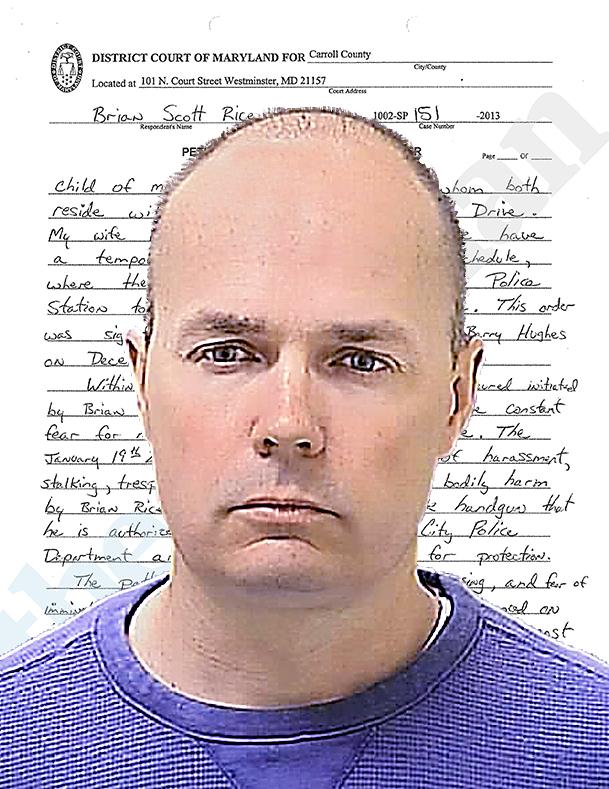
Then later in the week the AP broke a story that was verified to be true, Lt. Brian Rice, the initial cop that went after Grey had extensive mental problems. His mental state had become so mentally unstable in 2012 that he had his guns confiscated and had been admitted to a mental hospital. The record showed there were deep “…concerns about self-control and judgment…” and these significant mental problems were still evident in 2013. But less than two years later we see a cop with significant mental problems, who was determined by a court to be so dangerous to himself and others that his guns were legally confiscated, is now back on the street with weapons and supervising other cops. Really? Tell me how, in anyone’s mind that this is possible. Once again this shows a significant breakdown in the BPD.

But what was the BPD doing while all this information was coming to light? They “leaked” information that Gray had a criminal record. The police union went on a dis-information program. Another report was “leaked” by BPD that said a bolt in the van matched the injury on Gray’s head proving that Gray killed himself. A statement was “leaked” that the other prisoner in the van “heard” Gray trying to hurt himself while in the van.

But no one was asking, “How does the ‘bolt’ injury explain the severed spine and crushed larynx?”

And little coverage was given to the CNN interview where the other prisoner in the van stated on TV that he never made that statement, or any statement, concerning Gray to police. And that he now feared for his life because of police threats against him.

So you start to line up the slices of Swiss cheese and what do you get? A very clear picture that Freddie Gray died at the hands of police. And his only crime was “eye contact” with a police officer, a police supervisor, who by all accounts is, or at least was, actually mentally ill.

So what is the most likely story of who killed Freddie Gray? Remember the principle of SA that says you only need about 40 – 70% of information to make a valid decision. You don’t have to have to wait for 100% of the information to make quality decisions. So in this case of Freddie Gray, cops killed him plain and simple.

Note: This was just revealed on Friday 5/1 that all six officers have been charged with various crimes including second degree murder in the death of Freddie Gray. It was also revealed that Freddie Gray was a confidential informant for the BPD and had done extensive work for them in helping to solve some serious crimes in Baltimore.

Now why again is this important?

Here are my answers and guiding principles:
  1. In a “grid-down” or other disaster situation you must keep your SA intact and at a high operational level.
  2. You must not be blind to the obvious, and you must be able to filter out the “dis-information” that is doled out.
  3. Use common sense.
  4. Use Occam’s Razor problem-solving principle.
  5. Use the HRO principle of reluctance to simplify.
  6. And remember the two primary motivations of those in authority; money & power.

Before I close this section of the article I want to create a visual of the Swiss Cheese model of the BPD’s murder of Freddie Gray. Hopefully through this visual you will be able to see how this model can be used to research, solve and represent catastrophic events. Then you can use it within the realm of your “prepping” activities to make you and your family less prone to catastrophic events during emergencies and disasters.

At any point had a decision would have been made differently, had a different choice been made, had inappropriate behavior and culture been corrected then Freddie Gray would be alive and the city of Baltimore would not have experienced the riots when and where and to the extent that they occurred. A CVS store would still be providing goods and services to the residents of a neighborhood that needed them badly. There wouldn’t be a bunch of burned out buildings. The Ruling Class wouldn’t be more entrenched and more powerful. And the nation wouldn’t be one step closer to a National Police Force.

I painted how the “microcosm” looks in this situation but there is a bigger, far bigger, picture that needs to be painted. And that is the focus of this next section.

Macro-environment

Those Baltimore Police Department officers didn’t just wake up that morning and decide to put such a beat-down on Freddie Gray that they would kill him. I actually doubt, to some degree, that they actually intended to kill him at all. But what is very clear is that there was a “culture” within the BPD that taught and tolerated this kind of conduct on the part of officers; probably even encouraged it. The BPD had a very long history of this kind of officer conduct. The BPD leadership didn’t stop it, the city leadership didn’t stop it and the citizens didn’t (or maybe couldn’t) stop it. Hence, the cultural-based conduct became the accepted “norm.”

But this didn’t develop in a vacuum either. The Baltimore officers didn’t just somehow dream this up all on their own. This kind of brutal and violent behavior can’t simply develop and exist in such a close-knit community such as law enforcement, other officers from other agencies knew about it. And since they didn’t do anything to stop it, it can only be logically assumed that they too participated in and advocated such brutality…or at least tolerated it.

So how does that happen and how wide-spread is it?

All you have to do is read the newspapers, the news websites, specialty/focused websites, this website or any other long list of media outlets, including books, that have documented the rampant and widespread vicious behavior that has developed in our law enforcement agencies at all levels.

Three excellent books that clear outline and expose the problems are:

A Government of Wolves by John W. Whitehead

Police State U.S.A. by Sheryl K. Chumley

Battlefield America by John W. Whitehead

AT all levels of law enforcement from the smallest town to the largest county, from state to the federal level, many  have become extremist in their brutal and anti-Constitutional treatment of citizens. Those agencies exists from border to border and coast to coast. It is pervasive, the impact is devastating and the very Constitution is in jeopardy.

So how did it happen and how is continuing?

I take you back to the HRO principle of “Reluctance to simplify” clearly sharing with you there is no single reason that it has happened but a myriad of reasons great and small. But you can chart it out via the Swiss Cheese model to understand it better by seeing the visual representation. Let me share with you my idea on “outcomes” vs. “intent” philosophy.

Intent is what someone wants to happen as a result of their effort. Outcome is what really happens when the person is done with their actions.

Example: Sixteen year old boy receives his driver’s license. He borrows his dad’s Mustang and picks up his friends. He intends to have a great night with his friends, driving around and having fun. Sounds great, yes? However, part way through the evening his friends egg him on to drive faster and faster since the car is made for speed. The young driver does so, hurling down the Interstate at speeds of well over 120mph. While going this fast, a deer jumps out, the young drive makes a futile attempt to serve to miss the deer and goes off the road and rolls over multiple times. His driver-side airbags inflate and he is severely banged up but two of his three friends are dead.

His intentions were to have a nice fun night with his friends. The outcome is a horrible wreck and he is now guilty of homicide having killed two people. But it doesn’t stop there. The parents of the two dead children file lawsuits in court and the driver’s family is decimated financially as well as emotionally. The fateful driver can no longer afford to go to college, nor his three brothers and sisters as well.

So regardless of the intent, the outcome ruins multiple lives forever from what they were on-track to become. Same is true with everything in life.

Back to the BPD and their culture of extreme violence and brutality towards citizens; and their disregard and disdain for the Constitution. It was obvious their conduct, culture, and decisions of street level officers, BPD leadership, as well as city and citizen leadership all allowed such a culture to exist. But what about Freddie himself? If he hadn’t made eye contact with the police officers and/or hadn’t run from them he might still be alive today. While that is a highly suspect assumption we will go with it for now. So how did Freddie fail?

Well, we identified his last two failed decisions, but is there more. Yes of course, logic dictates that there must be more. And there is plenty more. But the BPD officers that were involved in the homicide of Freddie didn’t act in isolation and they didn’t come up with original conduct. All the court records and investigative work done by the Baltimore Sun News shows that this conduct was wide-spread throughout the department and obviously tolerated, maybe even encouraged, at all levels. Just as that is true, the same is true of Freddie. Freddie Gray was not unique.

Let’s look at the average black inter-city male in America. The average person fitting that description according to provable statistical facts tends to be:

  • Less educated
  • Unemployed or under employed
  • Those that are employed are paid far less on the average
  • They will have criminal records
  • Come from single-parent families

What part of that recipe for disaster don’t we understand! Now don’t confuse my relating the “average” profile of a generic Freddie with a statement saying that young, black, inter-city, males can’t succeed. They can. And don’t think I am making some blanket statement excusing Freddie or any other young, black, inter-city, male of making terribly poor life choices. Ultimately we are all responsible for our own actions. But “trends” are reality, they do speak truth and they do explain what is happening. Then it is up to us to research “why” it is happening. Let me take a stab at it.

Here are the latent causal factors to “Freddie” failing to succeed (in no particular order):

  • Politics and politicians
  • Public school system
  • Economic policy
  • Social state
  • Police
  • Family

Politics and politicians – As I have maintained and I believe proven, politicians are interested in only two things, money and power. Whichever they have, they leverage it anyway they can to gain more of the other. And their only desire is to acquire all of both.

Simply look at our government today, any level of government today. The various levels of government and the politicians exist to serve themselves as much power and money as they can possible acquire. And service or benefit to their constituents is a distant by-product of their actual intent. I will include “race-pimps” in this group as well; the likes of Sharpton, Jackson and others. Their only desire is self-serving of power and money. So no politician and level of government is going to save “Freddie.” Why? It makes no sense to them to do so. All you have to do is look at the outcomes of politicians and politics:

  • Since the War of Poverty began poverty has actually grown far worse, the middle class is rapidly disappearing and the income gap is widening. The War on Poverty is an utter failure.
  • Any and ALL other government program enacted by politicians to combat poverty or in any real way help “Freddie” have all failed, failed on an epic scale. Food stamps, housing assistance, welfare and every other program has failed miserably. How? Just look at the exponentially increasing number of people depending on those programs to simply survive. All have failed.
  • Take a look at all the major cities where poverty is the worst, where “Freddie” is the most unemployed, the most uneducated, the most in poverty, the most devastated. They are all run by liberals, Democrats or Progressives. Their politics and their politicians all have failed “outcomes.”

Politics and politicians have failed “Freddie.”

Public school system – As all the statistics show the public education system in the United States is an utter failure and getting worse. It is almost that students are succeeding in spite of the education system. The teachers are run by Communist/Socialist unions. The school districts are run by politicians that are far left extremists that do not believe in a Constitutional Republic. Parents are apathetic at best when it comes to how their children are doing. You have lunch Nazis dictating what parents can feed their children. You have a legal system that forces children to attend school. You have “home school” families that are in jeopardy of losing that freedom. You have an educational system that no longer teaches the most basic of civics and losing all sense of history. And the same system passes on students to the next grade and even graduate them when they can barely read and write. You have huge amounts of money being spent on students and those amounts go up each year but student performance gets worse and worse as each year goes by. And worse of all, you have an educational system that doesn’t require and doesn’t teach discipline or respect. And this is exponentially true in the inner-cities. The public education system failed “Freddie.”

Economic policy – Once again, the statistics and facts all show that our economic policy is an utter and undeniable failure. For decades we entered into trade deals that moved millions upon millions of middle-class jobs. And both political parties gladly and willingly participated in that. At every turn we bailed out banks, investment bankers and insurance companies. Allowing criminal management and owners to walk away from their failures richer than ever while the American taxpayer pays the bill. We have a President who without regard for law, and in direct violation of the Constitution, moved 10’s of billions of dollars from legitimate bond owners to his crony union thugs. And if that wasn’t enough he also gave the union huge percentages of companies with them paying a single dime, while legal stock owners where robed of their ownership rights. In one statistical fact alone it shows where the system has failed, that is the income gap and loss of household income. The average person’s income in American is plummeting and it is at the hands of our politicians making policy that directly hurt each and every American with the exception of the richest 10%. That segment of Americans is seeing their wealth grow at a staggering pace. More people than ever in the history of our country are on food stamps. More people than ever in the history of our country are receiving government housing assistance. More people than ever in the history of our country are on Social Security disability. Over half of the country is receiving some form of government welfare. Over half the citizens in America pay no federal income tax. Our country’s economic policy failed “Freddie.”

Social state – Never in the history of our country has society been in this pathetic of shape as we find ourselves in. Every possible statistic shows that the quality of life in America is plummeting. Our society idolizes gangster rappers, professional athletes, and movie stars. All the while there is a growing persecution of Christians. Society loves to watch an NFL football game or Dancing With The Stars, but they can’t identify their own Congressmen, the Vice-President or understand even the most basic tenants of the Constitution. We legal legalize drugs while outlawing Christmas celebrations. We praise those that kill millions of unborn babies each year, while forcing Christians to violate their faith. The list goes on and on with the problems that face society, and those problems are simply getting worse and worse by the day. Single mothers now give birth to more than half of all children born in the US. All the while every single statistic in existence shows that single-parent homes have the worst problems for their children. And that includes substance abuse, violence, gang membership, criminal behavior and prison incarceration. Society utterly failed “Freddie.”

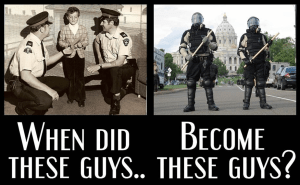
Police – Law enforcement agencies and individuals have become militarized. They inflict military tactics on civilians. Cops kill at will and most of the time with impunity. Police unions are strong and demand rights for cops that the average citizen can’t even dream of. Police now use military armored vehicles against unarmed civilians. Whendid these guys become these guys?Police agencies have acquired military hardware such as machine guns and grenade launchers to use against civilians. Police no longer honor the Constitution and perform no-knock raids at will. They kill unarmed citizens, kill people’s pets for no reason, and even mutilate infants in their cribs during such illegal raids with absolute impunity. People are subjected to the most unthinkable and unconstitutional acts at the hands of police and yet the only thing that changes is that it gets worse and worse each and every day. We see corruption at every level of law enforcement with the worst of it at the federal level. We see ourselves solidly in a fascist police state with no hope of turning it around. The police have utterly failed “Freddie” even to the point of murdering him. And he is not alone, hundreds of unarmed people a year are murdered by cops who are rarely held accountable.
Family – Families are becoming extinct and being replaced with “relationships.” Every single statistic shows that children raised in a hoe with a female mother and a male father fair far better at life in every single category than those who are not raised as such. Yet, society, politicians and government are doing everything they possibly can to continue to destroy the family. The breakdown and disintegration of the family failed “Freddie.”

I hope I have made the case clear enough that people like Freddie Gray (and millions upon millions) more just like him never had much of a chance to begin with. Virtually every aspect of society today is designed to make people fail. And the weakest, most needful, among us…it fails the most.

Could Freddie have made better choices? Of course he could. Could he have pulled himself out of the conditions he was living his life in? Of course he could.

So many “Freddies” never had or have a legitimate chance in life because everyone and everything has failed them, including themselves.

How does this apply back to “prepping” or Situational Awareness in any way?

Simple really, you have to be able to truly analyze a problem, really dig into the root causes and go beyond the “last bad decision” to understand what is happening. Until you do, you will not have good SA and you may well be working from false information that you yourself developed and put into your head. And then you too will fail…along with your family.

Don’t say I didn’t warn you.

And maybe with this warning you can now have even more motivation to prepare, prepare for when the grid goes down. And the grid will go down. The question is…

“Will you be prepared for it?”


Article in this Series –


2009 - 2020 Copyright © AHTrimble.com ~ All rights reserved
No reproduction or other use of this content 
without expressed written permission from AHTrimble.com
See Content Use Policy for more information.


Something to think about…

Dietrich Bonhoeffer (1906 – 1945)

Dietrich Bonhoeffer was a Lutheran pastor, theologian, and anti-Nazi dissident. Bonhoeffer was known for his staunch resistance to Nazi dictatorship, including vocal opposition to Hitler’s euthanasia program and genocidal persecution of the Jews. After accused of being associated with the 20 July plot to assassinate Adolf Hitler, he was quickly tried, along with other accused plotters, including former members of the Abwehr (the German Military Intelligence Office), and then hanged on 9 April 1945 as the Nazi regime was collapsing, 21 days before Adolf Hitler committed suicide.


2009 - 2020 Copyright © AHTrimble.com ~ All rights reserved
No reproduction or other use of this content 
without expressed written permission from AHTrimble.com
See Content Use Policy for more information.
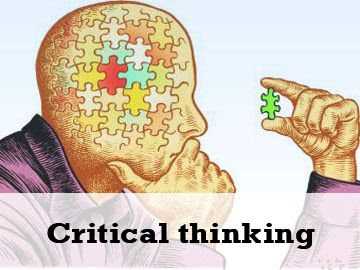
Situational Awareness: Part 5 – Critical Thinking

Part of good Situational Awareness (SA) requires the ability to recognize valid (i.e. true) information. We already know that your SA requires you to establish a baseline and then watch for deviations from that baseline. When you start to see deviations from the baseline then you have to pay particular attention to those events/activities as compared to the baseline.  Once those deviations have been assessed then you have to decide what action is required, if any, to mitigate the potential increased risk or threat.

Without a baseline and the ability to appropriately assess deviations you can be considered “clueless.” Yes, that is a technical term in the SA world! In the world of emergency preparedness, clueless can be fatal. But just as important as part of SA is the ability to take action based on the baseline and deviations thereof. Without being able to take the appropriate action in a timely manner you are not only clueless, but probably dead or badly injured. All parts of SA must work together in synchronization.

The very beginning of the SA process requires a baseline as mentioned. Our baseline in anything will come from a combination of factors; training, experience, culture, and bias just to name a few. All of these, and more, work together in your brain to form a baseline regardless of the situation or environment.

Next comes the ability to correctly recognize and assess sensory input. Sensory input can come in a variety of forms; smell, sight, or words to name a few. For this discussion I want to focus on words. More aptly stated I want to work on discerning messages and evaluating their truthfulness.

A good example would be a statement by a government official…is it true or false…or worse, a deliberate lie. It is vitally important to know the difference between false information and a lie. Both are not “truth” in any possible sense of the word. However, false information and a lie are not equal in weight when it comes to SA. Specifically, it is absolutely significant in terms of action to be taken. The degree of the underlying lack of truth will determine the degree, or severity, that your action will be.

By that I mean that in an emergency, disaster, or grid-down event false information can simply be a mistake in knowing or understanding the facts. A lie however, is a deliberate and intentional statement to misdirect and control you.

Another way to look at it, false information can be seen as ignorance (not knowing the facts). There are also some that would call false information as an attempt to withhold pertinent information while not specifically lying, and yet not being ignorant.

While confusing, it might be easier to look at it in this fashion; lying is done with malice. However, false information is usually as a result of ignorance or simply wanting to gain an advantage without the intention of malice. And malice, for this discussion is meant in terms of doing harm against the message recipient (i.e. stealing, injury, death. Control, etc.).

If I don’t have you completely confused by now, let me try harder. Example: Mohamed Saeed al-Sahhaf was the Iraqi Information Minister under Iraqi president Saddam Hussein. He was comically referred to as “Baghdad Bob” during the US invasion of Iraq in 2003. Bob would hold press conferences that spoke eloquently of how Iraqi forces where decimating US and Allied troops. This would go on day after day, sometimes multiple times per day. Why did he garner his nickname? Because everything that Mohamed was utterly untrue, simply nowhere near reality.

For anyone in the US it was easy to know that what he was saying was silly and absurd. Was this false information or a lie?

Here is where the real discussion takes place. The information was without question absolutely false. There is no wiggle room in that point. Once we know it was false information now we have to know his intention. For that you ask, “Why was he doing it?”

I doubt seriously that he was trying to trick the US. But, if not us, then who? I propose it was meant to trick and mislead the Iraqi military forces. If they felt they were wining they would fight and do so with confidence. If they knew they were losing, and were getting no information to the contrary, then morale would sag and troops would give up. If the troops gave up then Iraq loses the war, and that leads to Saddam Hussein losing power.  But…we are not done yet.

Let’s for the sake of this discussion assume that the troops believed what he was saying and fought on. Would more troops die than if they had given up right then and there? The answer is obviously yes, more troops would die on both sides. Therefore, what Baghdad Bob was doing was lying. His intention, implicit or explicit, was more death and carnage. He lied, and people died.

That is a real-life example of the difference between false information and lying…it is called intention.

Well, if that is the difference, how do you tell the difference between lying and false information?

Bingo! That is the point.. However, to truly drive the point home, to bring it to full light I feel I have to raise emotions. If not, the full understanding will be missed. So please bear with me. I am going to take a hot button subject and use it to show the difference between false information and lying. I am going to use examples, two of which are going to be in regards to Islam.

Now, for those whose blood pressure just went up, relax. This is not going to be an argument whether Islam is this or that, I will just use arguments on both sides to show false information vs. lies. And to use reason, logic, and facts in the process.

Islamic Terrorist hit again!

The United States suffered another terrorist attack, this time in San Bernardino in 2015. The terrorists who attacked a Christmas party were Muslim. That is an established fact, it is 100% truth. So the term “Muslim terrorist” is also 100% true. That is Philosophy 101 level logic based statement.

However, you have some that say Islam is a religion of violence, hate, terrorism.  They will then say that Islam itself is “terrorist” because all terrorism appears to be coming from Muslims.

The FBI defines “International terrorism” as activities with the following three characteristics:

  1. Involves violent acts or acts dangerous to human life that violate federal or state law;
  2. Appear to be intended (i) to intimidate or coerce a civilian population; (ii) to influence the policy of a government by intimidation or coercion; or (iii) to affect the conduct of a government by mass destruction, assassination, or kidnapping; and
  3. Occur primarily outside the territorial jurisdiction of the U.S., or transcend national boundaries in terms of the means by which they are accomplished, the persons they appear intended to intimidate or coerce, or the locale in which their perpetrators operate or seek asylum.

We will use that definition and refer to it as simply “terrorism” for this discussion. And I am sure we can agree that the San Bernardino attack was terrorism.

Back to our Muslim terrorist statement, let’s test that for truth.

  1. Are all terrorists Islamic? Currently, the answer for some would be a resounding yes in as much as by statistics the largest number of terrorist attacks in the world right now are being committed by Muslims, and San Bernardino was for sure.
  2. Therefore, since all (or at least the vast majority) terrorism is being committed by members of Islam, and all members of Islam are Muslims, then all Muslims are terrorists.

Is that a true, or accurate, resulting statement? Let’s not worry about the answer just yet. Let’s test the statement itself, “Therefore, since all (or at least the vast majority) terrorism is being committed by members of Islam, and all members of Islam are Muslims, then all Muslims are terrorists.”

We can test that easily enough, do all Muslims commit terrorist acts? The answer is obviously no. Therefore, Islam by default is not a terrorist organization. I will even take it a step further and say that some Muslims are good people, but that is simply opinion since that is a subjective statement relative to my baseline. However, that also can’t produce a statement of truth, “Since some Muslims are good, then Islam is good.”

Where am I going with all of this? We need to have the tools to assess not just the truth of statements but what it means in relationship to ourselves. In other words, how does it impact us.

Let’s take the two opposing sides in one aspect of the Islam is bad argument:

  • Islam is bad, evil, and satanic creating terror around the world. Muslims are evil people and we must punish them.
  • Islam is a religion of peace and love. The terrorists are, and violence is being committed by, Muslims that are not practicing their faith. They are just evil people not Muslims.

So which is true?

I could by-pass a lot of discussion and ask a simple question, “What does each side gain by their position?”

  • The “Islam is bad” crowd probably wants war and a scapegoat for all the problems in the world.
  • The “Islam is peace” Muslim crowd wants the focus off themselves and their entire religion to not be held accountable.
  • The extremely vocal “Islam is peace” non-Muslim crowd is usually just full of vanity and self-aggrandizing.

All three sides have a lot to gain, all have significant self-interest. However, that self-interest must be considered in determining “truth.” And that doesn’t even begin to cover things such as bias.

So let’s test some more details of each side’s arguments.

  1. One side says Mohammad was a pedophile.
  2. The other side says that is not true and become enraged at the accusation.

Now, here is where it can get ugly…

A person trying to make Islam to be evil would say something like, “If the founder of Islam was evil because he was a pedophile, then the religion of Islam is evil. And if Islam is evil then Muslims must be evil.”

However, once again, that is an untrue statement using logic and fact. For it to be true, all Muslims must also be pedophiles. And we know that isn’t true, by anecdotal evidence and also Muslim religious and judicial guidelines in-place today saying that they cannot marry until a girl is at least in puberty.

Therefore that proves that not all Muslims are evil. Do some Muslims qualify as pedophiles? Are some Muslims criminals because they commit sexual abuse of pre-pubescent children? I cannot provide evidence or statistics to prove that point. Regardless of Mohammad’s standing as a pedophile or not, that alone does not make Islam or all Muslims pedophiles.

So when you hear statements, such as #1 & #2 above, you can’t simply make a snap decision and be assured of your accuracy. You must actually research the issue and know what you are talking about. Or you risk using false information or lies in your SA process. Doing so in emergencies, disasters, or grid-down events can then easily lead to making poor, maybe fatal, decisions based on faulty assumptions which was based on false information or lies.

But we still have the “action” aspect of the SA process I’ve been talking about. If you then take action, what are you taking action on…or for what reasons?

Based on the example statements, what action would or should you take?

My suggestions would be…virtually no action needs to be taken. And that is based on the amount of risk or threat to you if either statement is true or false.

What do I mean by that?

Statement #1 (One side says Mohammad was a pedophile.), even if it is true, so what? Does it require any action on your part? No. Plain and simple, no.

Statement #2 (The other side says that is not true and become enraged at the accusation.), if it was proven to be a lie, what threat or risk is there to you or your family? None. Plain and simple, none.

But, what it does mean to me (or you) is…if a person tries to advocate for Statement #2. I need to be cautious. Why? If a person is perpetuating that lie, they are then a liar and not to be trusted.

There is an exception to that conclusion. If statement #1 was true in your mind but a person can provide sufficient evidence that a reasonable person would believe that Mohammad wasn’t a pedophile, then you need to change your opinion. But, the evidence provided must pass a simple test – it must negate all the evidence you used proving to yourself that Mohammad was a pedophile.

An example of that would be definitive proof that A’isha lied when she said she was 6 when married to Mahmoud, then 9 when forced to have sex with him. That might be difficult, remember her own story in her own words was recorded by eleven authorities. Or, the writings/narrations, written in their holy book must be proven to have been fraudulently recorded. OK, you get the idea on that burden of proof.

But here is a problem, A’isha herself told the story of her and Mohammad, and that story was recorded as truth many times in their holy books. If someone in present day claims that it isn’t true, you would have to naturally ask, “How can a person 1400 years after the fact claim to know more than actual written history recorded multiple times by multiple people who lived it?”

And then you have to bring into the equation that no recognized or credible Islamic scholar or historian raised any red flag over the story of A’isha prior to some modern-day claim of fraud. Why would that be? If it was a lie and a fraudulent story, wouldn’t someone have objected to it being in their holy books in the first 100, 500, or 1000 years after it was written? Why would someone just bring it up in modern times and expect to have any credibility?

Now, there is a more actionable point. If a person tries to claim a different truth, a different factual history, now…ask yourself “Why now and why him?” That is far more important question to answer before you delve into the truthfulness of his claims. You must know “intent” first.

Until you can be convinced otherwise you would be well suited to view that person who is making the claim to be either providing false information due to ignorance, or lying for more malevolent purposes. And you maintain that position until he can prove to you otherwise.

Personal note: I don’t care who Mohammad was or is. Yes,I feel sorry for that little girl, but it happened a long time ago. I don’t judge Islam or Muslims based on Mohammad’s pedophile status or what he did to that little girl. I don’t judge, or at least I shouldn’t judge, one Muslim based on what another Muslim does. What I do care about it the content of a person’s character. If a Muslim, like any other person, lives a decent life and doesn’t hurt others, then they are okay in my book. In today’s world it is easy to be calloused about Muslims and view them as a single group. I urge you not to. Sure, logic and prudence does whisper some caution, but it doesn’t justify bias, prejudice, or bigotry.

Good SA requires the ability to think through all informational input. And you must be able to analyze it with facts and logic. Then, act only if the outcome, or potential outcome, requires it.

And beware of arguments filled with emotions. A solid position based on fact and logic needs no emotion. Emotion is meant to win an argument with little or no fact, without logic, and mostly upon the art of persuasion touching a person’s feelings.

Should that fail, some weak minded people may use “deflection” as a tactic. This is most often used when a person knows their position is without merit, wholly or partially, and uses something else to draw away attention. Example: Christians killed more people than Muslims.

In that argument they are trying to use a moral equivalent to justify their position. But use reason in relationship to your baseline…Christians killing people in the name of their religion or their god is just as evil as Muslims killing people in the name of their religion or their god. They are trying to justify or overshadow one evil act with another. When in fact, both acts are evil. But the person that makes that argument is unable to see the difference, approves of both, or simply can’t make the mental effort to understand the fallacy of the argument they are making.

You will also see some individuals that will use emotion, and when that attempt fails the person will then sometimes fall back to attacking the opposing person personally without the use of facts, reasoning, and logic. It becomes a personal attack vs. a discussion or debate.  Those tactics can be read about in a book called Rules for Radical by Sal Alinsky. The book ironically enough is dedicated to Satan.

Concluding…SA is essential to emergency preparedness. You must be able to recognize truth, false statements, and lies. If you don’t develop that skill set you will not be able to accurately assess information that you are receiving. And that will lead to poor decision making. And poor decision making could easily lead to injury or death through bad actions or lack of action. Us critical thinking skills…think it through…test all statements for logic and reason…and most of all, intent.


Article in this Series –


2009 - 2018 Copyright © AHTrimble.com ~ All rights reserved
No reproduction or other use of this content 
without expressed written permission from AHTrimble.com
See Content Use Policy for more information.

Situational Awareness: Part 4 – Team SA

Team Situational AwarenessIn this post I will go over what Team Situational Awareness is, barriers, mitigation and touch on how it relates to a High Reliability Organization. I will focus on communications as an important, the most important, aspect of Team SA.

In the previous post I went over what the barriers are to SA, specifically individual SA. Along with identifying those barriers I also provided ways to overcome them and breakthrough bias.

Team SA is defined as every team member’s situational awareness integrated with every other team member and fully related to, and integrated with, the team leader. That’s a mouthful for the following:

  • Each team member has a specific responsibility/task for a particular mission.
  • Each team member must have a high level of SA for their area of responsibility.
  • Each team member must relay key pieces of their SA to all other team members, especially the team leader.
  • The team leader must keep overall mission SA based on input from team members

Team based Situational Awareness - Team SAThe success of the team mission is based on each team member having good SA. Conversely, if a single team member has poor SA the team’s mission performance can suffer…or fail completely. Consequently each team member must have a high level of SA regarding their aspect of the mission that they are responsible for. And here is the rub; all team members must share critical information with all other team members. If the person who needs Team SA depends almost entirely on good communications among team members.critical information for their SA is not made aware of that information, then the team’s SA is poor and successful mission completion is jeopardized. High quality communications, especially verbal, is essential for the exchange of information and building situational knowledge and the processing of that knowledge.

Knowing everything that is going on all the time is very difficult for any one person, especially during complex high stress operations.  Sharing of mission/task responsibilities is essential.  The same applies to the sharing of SA responsibilities. Shared high quality SA characteristics in teams:

  1. Refers to the overlap between the SA requirements of the team members.All team members help each team member.
  2. In a high performing team, each team member has an understanding of what is happening based on those SA elements that are common to the mission.
  3. When changes are noted that could pose a problem, team members must first take action by speaking up.
  4. All team members are tasked to identify problems before they affect mission accomplishment…hopefully before the mission in the planning phase prior to action starting in the field.
  5. Team members don’t wait to be asked. When you have information critical to team performance, speak up!
  6. Recognize and make others aware when the team deviates from standard procedures.
  7. Monitor the performance of other team members.
  8. The best feedback of your performance comes from others.

Examples of good communications skills of team members:Assertive Communications

  • Assertive
  • Specific & clear
  • No fear of speaking up
  • Realistic & Clear Expectations
  • Not waiting to be askedRealistic & Clear Expectations.
  • Receptive not defensive
  • Share intended actions
  • Identify and share problems before they affect the mission
  • Make expectations of self and others clear
  • Don’t assume someone already knows

High quality communications among team members is the heart of high performing Team SA. High quality communications begins with a thorough pre-mission briefing. Elements of that briefing must include:Mission or event briefing outline

  • Clearly defined mission.
  • Leader’s intent (what success looks like).
  • Each individual must know their responsibilities within the mission.
  • Each individual must know every other team members’ roles and responsibilities.

Barriers to team situational awareness.Barriers to quality Team SA include all the same barriers to individual SA plus:

  • When you start hearing or saying “He thinks he knows everything.”
  • Agreement to, or suggestion of, “mission creep” begins to take place.
  • One or more individuals exhibit a barrier to SA without it being corrected.
  • Communication among team members begins to breakdown, especially verbal, and that breakdown is not immediately corrected.
  • Performance of one or more team members degrades and can’t be compensated for by other team members.

Ways to prevent, or correct, barriers to high quality Team SA are:Overcoming barriers to team situational awareness.

  1. Monitor the performance of other team members.
  2. Identify potential or existing problems; provide a solution in assertive terms.
  3. Recognize and make others aware when the team deviates from standard procedures.
  4. Effectively communicate on a regular basis during non-mission time to set the communication standard.
HRO Pillar - Preoccupation With Failure!

Preoccupation With Failure!

There is a direct relationship between great Team SA and fostering a High Reliability Organization (HRO). HRO is an organizational model that is used in high-speed, high-stress, high-risk, high-hazard, complex environments.

Examples: aircraft carrier flight deck operations, US Navy nuclear operations, air traffic control operations, Special Forces, etc. HRO’s have proven to be very effective at mitigating probability and severity of catastrophic accidents.

The five pillars of HRO’s are:

  1. Preoccupation with failure
  2. Reluctance to simplify interpretations of events or situations
  3. Sensitivity to operations
  4. Commitment to resilience
  5. Deference to expertise

These five pillars of HRO’s work hand-in-hand with Team SA. I will write more about HRO’s and their effectiveness at another time, but for now, know that Team SA is the #1 tool to promote the #1 pillar of an HRO. A team must be preoccupied with failure in order to prevent those failures from happening. Team SA anticipates and/or sees the failures coming before they occur and then take the necessary steps to avoid those failures. But, we will save this juicy tidbit for another day.

As you read through this article on Team SA you now understand that the #1 Good Communicationsway to avoid poor Team SA is through high-quality communicating among team members. Without great communications your team is doomed to failure. And failure can be fatal. Learn and practice great Team SA.


Success comes from the ICS incident command system for preppers during grid-down

Your Choice!


Article in this Series –
2009 - 2020 Copyright © AHTrimble.com ~ All rights reserved
No reproduction or other use of this content 
without expressed written permission from AHTrimble.com
See Content Use Policy for more information.