 note: originally written in early 2015, updated in 2018, edited/updated again in 2020.
Several years ago I began writing a series of posts about Situational Awareness (SA). I believe SA is the single skill that will both motivate you to be prepared for emergencies and keep you alive during one. And for this conversation I refer to “emergencies” as any emergency, disaster, or even “grid-down.” And I mean all the way to “Zombie Apocalypse” or “TEOTWAWKI” kind of grid-down.
How is it so important and why does it rate so high in my estimation?
Hey wait, you forgot to ask what happened to all the material that I started writing several years ago. Well, I spent several hours writing a great first post. Then I went back and read it. Boring!
No, seriously, it was incredibly boring. However, it was filled with an amazing amount of terrific information, examples, and great advice. But it was “stick-in-your-eye” painfully boring. So I will write it a little more like I would want to read it. So on with the article…
Why is Situational Awareness important again? Come on, think about it. If you can’t accurately observe and understand the things taking place around you, then you can’t use that information to make decisions and then take appropriate action. What other skill or training matters if you are clueless to what is happening around you during critically important times?
You must be able to: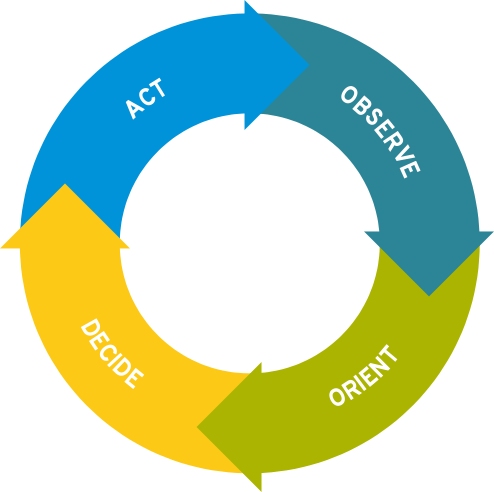
- Observe
- Orient
- Decide
- Act
The above is referred to as OODA.
So before I present any more SA information let’s take just a second and review preparedness goals and priorities: L.I.P.S.
Life Safety – You and your family/team must stay fully functional. That means no fatalities, no injuries, and no sickness. You stay as safe and as healthy as possible.
Incident Stabilization – Don’t make a bad situation worse. There is already a problem going on (emergency or disaster) so don’t do things that would make the problem worse than it already is.
Property Conservation – Don’t destroy anything you don’t have to. Resources are valuable, don’t destroy or use resources unnecessarily. You might need them later.
Societal Restoration – Do those things that puts society/family/community back the way it was (maybe even better) before the emergency or disaster.
So L.I.P.S. give us a solid commonsense method of setting priorities and making decisions. <click here for more info on LIPS> Now that we can make good decisions and set the correct priorities we must be able to understand what is going on around us in real terms. That is one part of SA, but there is more.
Purists would describe SA in the strictest of terms as a “state of knowledge.” In other words we have realistic knowledge of the things taking place around us in our environment. Further, Situational Assessment is being able to correctly assess that knowledge. And then there is the whole “action” part of the cycle, etc. If you are a student of “OODA” then you already have an idea of what I am talking about. But, for this conversation we are going to define Situational Awareness as the acquisition of, the processing of, a state of, and taking action on knowledge. That knowledge comes from the environment around you.
When dealing with all things preparedness, there is the “tangible” and then there is the “intangible”. The tangible is easy to identify; if you can eat it, drink it, hold it in your hand, or at least see it, then it is considered tangible. But in many respects that is the easy part of emergency preparedness. The toughest part of prepping may be that which you can’t touch, see, drink or eat…the intangible.
“How so?” you might ask.
Well, that is a great question and one that may raise some debate among all of us in the prepper world. But let me make my case for the “intangibles” being the greatest challenge and potentially the most fatal threat if disregarded.
Let me regress for a minute and talk about the “tangibles”, a complex but not-so-difficult subject to understand. You set a goal based on priorities (i.e. one year supply of food), then you work hard to add tangibles to your supply until you have met your stated goal. The food you acquired can be held in your hand, seen on the shelf, eaten when needed, and therefore it is tangible.
SA is an intangible and can’t be held in your hand. And so we must be able to clearly define it to be able to learn about it.
So what is the true value of Situational Awareness? Well, that depends – Do you want to live or die?
Sorry, I didn’t mean to be overly melodramatic but I do want to make a point. If you wish to make high-quality, informed and timely decisions you must be able to acquire, process and use information of your surroundings. Without that capability you are simply spitting into the wind and depending on blind luck not to get any backsplash on you. Don’t laugh, many people live every aspect of their daily life doing just that…you probably know a few.
Now let me share what the overall steps are when it comes to SA in emergency, disaster or “grid-down” situations.
First, you must understand the environment that you will be operating it; establish a baseline or what is normal and therefor expected in that environment. Hence, anything that occurs that is outside of that baseline is not normal and to be noted. You do that by observing what is happening around you – Situational Awareness.
Second, you then must identify the key cues that will indicate that something is sufficiently abnormal (i.e. different) that it would represent an increased threat or risk. And you must monitor those identified environment elements for any change or deviation from the baseline, recognize when they occur and their relative importance – Situational Understanding.
Third, you project the outcome of the events that are taking place that are deemed a threat or risk to determine the effect it will have on your situation. You then decide on an option to mitigate that threat or risk – Situational Judgement.
Fourth, take timely and decisive corrective action if required. Yes, I believe that SA without “action” is a waste of time and energy. But that also makes me outside of the mainstream advocating that SA includes an element of action – Situational Influence.
What exactly must you be observing in your environment? The environment that I am speaking of comes in two forms, “micro” and “macro”. And that is the focus of the next article in this series.

Article in this Series –
- Situational Awareness: Introduction
- Situational Awareness: Part 2 – Micro & Macro
- Situational Awareness: Part 3 – Barriers to SA
- Situational Awareness: Part 4 – Team SA
- Situational Awareness: Part 5 – Critical Thinking
- Situational Awareness: Part 6 – Dig It !
- Situational Awareness: Part 7 – OODA (Out of the Loop)
- Situational Awareness: Part 8 – Summary