Camouflage Clothing…to stay alive! : Part #3

note: article first appeared in October 2015

In the first article of this series I explained how humans “see” things, talked about what stands out, and where humans naturally don’t look. I also went into a couple examples of “narrative” and how that factors into humans’ ability to spot other humans.

If you haven’t read that first article that was posted day before yesterday I would suggest that you do. It will make reading this article easier for you.

In the second article of this series I began to show how different camo clothing really make a man harder to see. No, not invisible or some movie set fantasy land stuff, but real-life staying alive stuff. I ended that article with a picture of the guy from the back. And I pointed out how even a plain strap could draw the eye in to “seeing” something outside of the “narrative.”

If you haven’t read that second article that appeared yesterday I would suggest that you do. It will make reading this article with the continuation of the adding different gear easier to understand.

I am a big fan of the 5.11 Tactical Multicam TDU Rapid Assault Shirt. I will be doing a review on the shirt in the coming weeks so I won’t go into the details here. But I want to show the difference between that shirt and a regular BDU shirt.

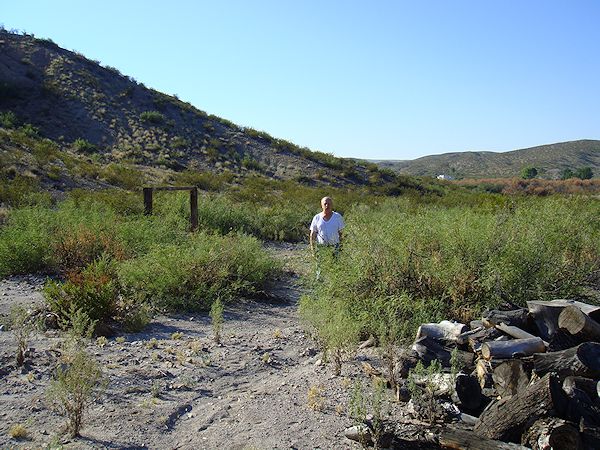
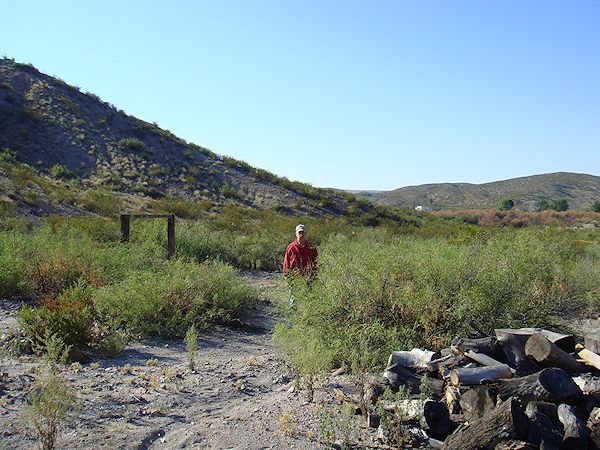
Example #1 –

DSC02786Example #2 –

DSC02790Did you eye pick up on anything? Did your mind say something is different, more noticeable?

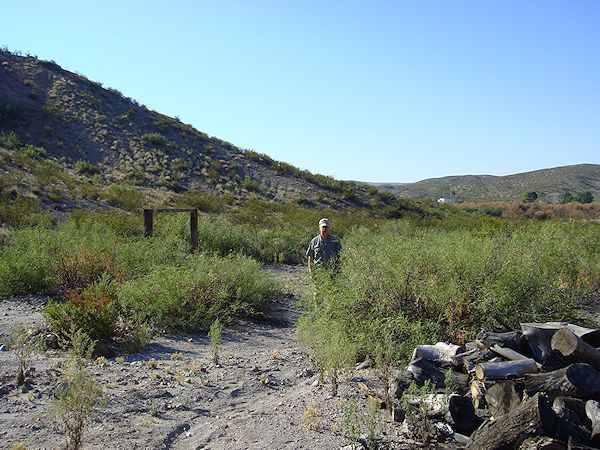
Camo104The guy is wearing a 5.11 Tactical Multicam TDU Rapid Assault Shirt. The shirt has a material that helps the torso stay cooler. But there is no camo pattern in that part of the shirt, just a plain dark earth colored material. While it may make the person marginally easier to see, don’t worry about it. That area of the shirt is normally covered up with the tactical vest as seen in the picture below.

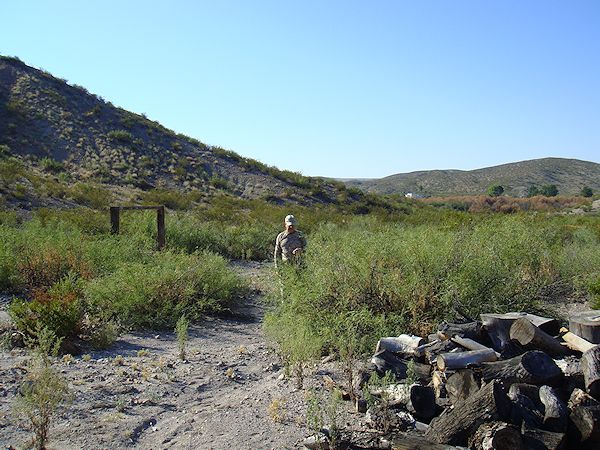
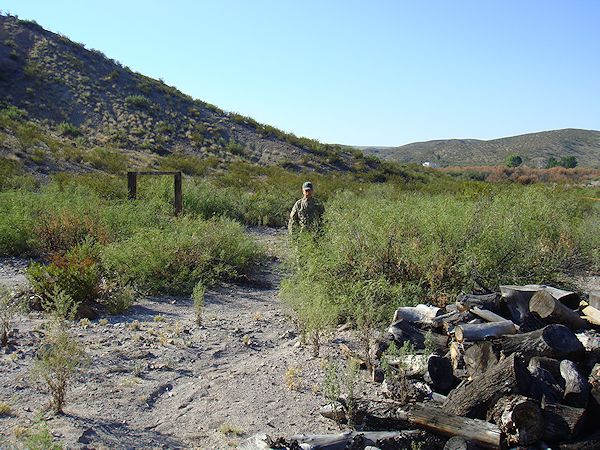
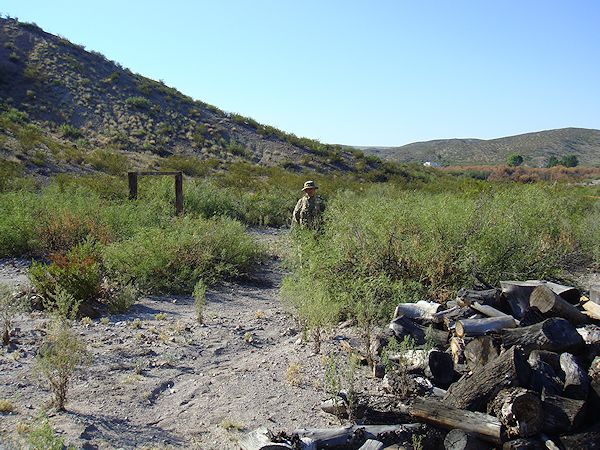
DSC02791In the next set of pictures there is another very subtle change that took place. Can you spot it? Don’t look too closely. Look away for a second and then look back and allow your eye to quickly assess what it is.

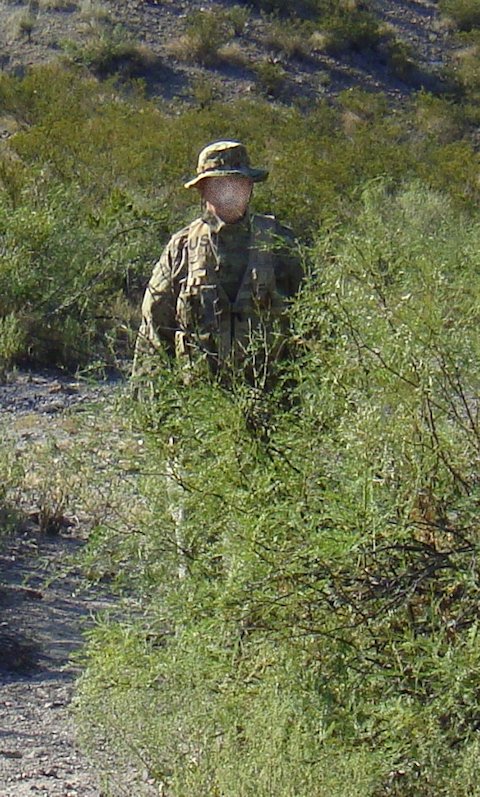
camouflage clothing includes gloves tooCamo105b


Did your eye pick up on anything?Camo105cHow about the man’s gloves? In the first picture (left) he is wearing black gloves with tan trim. In the second picture (right) he is wearing the same brand of gloves but in a multicam pattern. Every little bit helps.

In the next picture the guy now has an AR-15 slung on his front. I won’t show you a “before” vs. an “after” picture of this. Why? I want you to really understand all the details as to “why.” But first, why do you think it is very hard to see his “black gun” (AR-15) with his camo on?
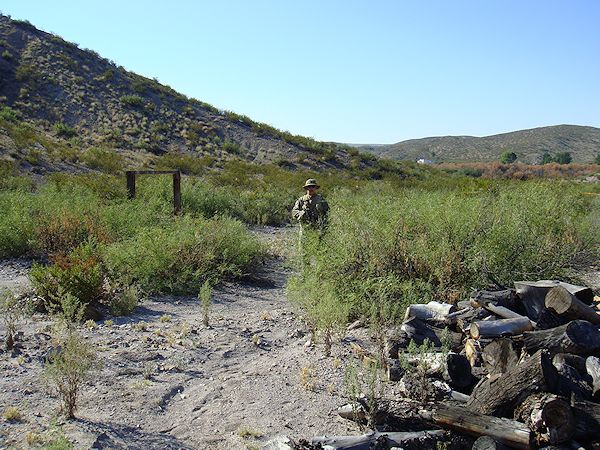
DSC02798Well, you would know the answer if you had read my article titled “Looks Do Matter” that appeared about a week ago. The article goes into great detail why you don’t want your gun “black.” Take the time to read the article and you will then understand why you don’t see this guys AR-15.

Clothing Details –A-tacs UR Organic camo clothing
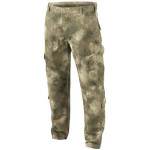
First – The pants. They are A-Tacs (UR). They show no distinct pattern, are lighter colored with plenty of slight variations. They look much like the rocky, sandy ground in the desert.


Camo ACU multicam military surplusSecond – The shirt. It is a multicam pattern. Look at the bushes that populate the various pictures. Notice the colors and the shapes of those colors? Does the multicam pattern mimic the environment?


Hat Boonie MulticamThird – The hat. It is mutlicam as well. Does it look like the tops of the bushes? Do the colors match the bushes? The shapes of the colors match the bushes as well? Does the shape of the hat change the shape, or profile, of the head?


Gloves Multicam

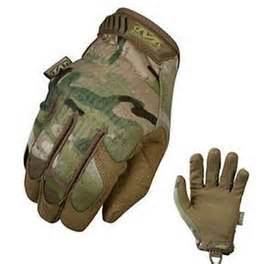
Fourth – The Gloves. Also multicam. In all the cop shows and movies when a cop is trying to arrest a bad guy what do they most often yell? “Show me your hands!” We naturally want to see a person’s hands; it is in a person’s hands that weapons reside.
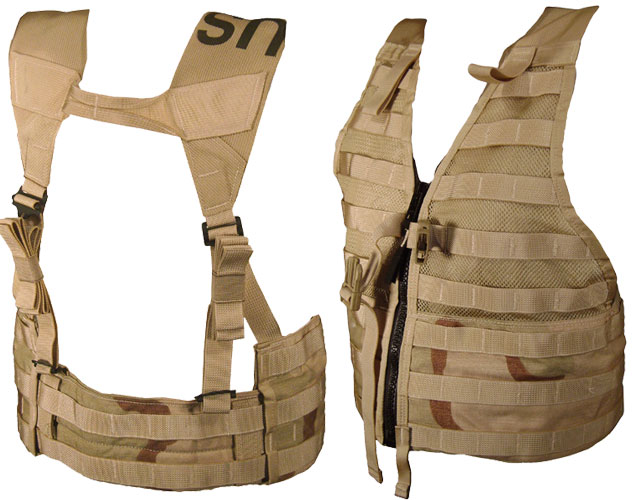


TactilcalVests-07Fifth – Tactical vest. What color do you think it is? If you guessed that it has multiple colors you are right. The basic vest is a 3-color desert pattern. The pouches are varies patterns but mostly multicam. What does that add to the overall situation?

 

Gun Cammo

Sixth – The weapon. read more about that…


All the camo clothing you wear and the camo weapon you carry won’t make a bit of difference if you are stupid. And part of being stupid is not knowing how to not be seen. So far we’ve only talked about clothing, then just a little bit on weapon color. In the fist article I did mention shadows. And in the second article I talk about bushes, etc. So let me touch on that just as we are closing out this series of articles so you can see it all coming together.

But let me make it really clear, this is for the grid-down, non-special forces, ordinary guy. If you have any kind of advanced training you will chuckle at this next section. But I am including it to give the average person a potential advantage over the untrained guy.

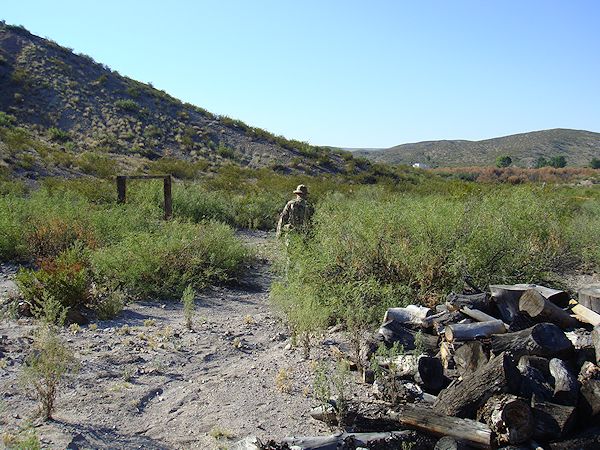
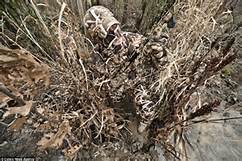
Where is the man in the picture below?
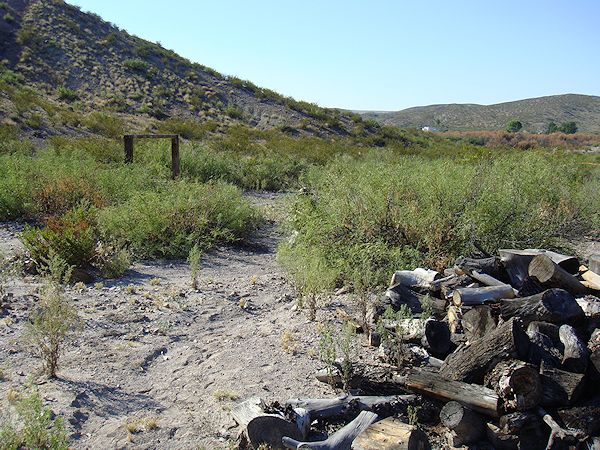
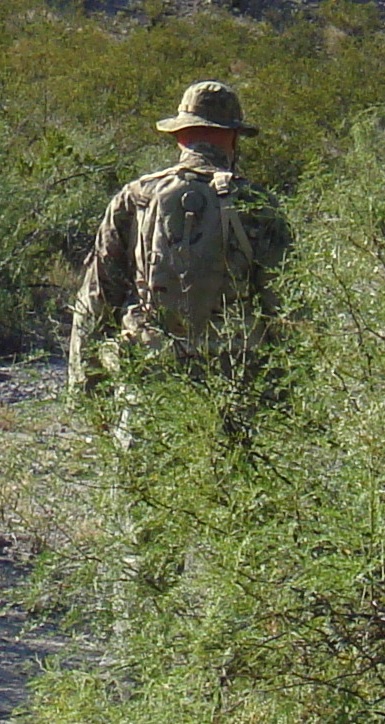
DSC02804Here he is. All he did was kneel down for the previous picture.

DSC02803The idea is to blend in with the environment. The mind’s narrative is seeing a desert environment with sand, rocks, cactus, brush, etc. Great! Your job is to not interrupt that narrative, play into it. You want to give nothing for his “Foveal vision” to pick up on. So you must learn to use your camo clothing and gear combined with the environment.

Even with your mind trying to pick out the bad guy it is hard to do. You are trying to force your mind to spot bad guys. But what is your mind subconsciously trying to do? Your mind is trying its best to create the narrative that you are in the desert southwest, there is sandy soil with occasional rocks present, along with bushes that have green leaves on them.

That being said, quite naturally, anything that blends into the narrative, the mind will try and accept as normal and not a threat.

That is where you want to be if you are the guy in camo clothing trying your hardest to not be seen.

If you are the guy trying to not get ambushed you are trying to force your mind to spot anything, anything at all, that might be out of place that could pose a threat. Even the smallest thing such as shoes.

This is the same guy, same location, but from only 10′ feet away…

DSC02805Now, only 5 feet away…

DSC02806Now, here is a 15′ view but from different angle, only 45 degrees different.

DSC02807Huge difference! But, why?

Now continue to add another 45 degree change in viewing angle…

DSC02808Would the people in the cabin in the background be able to spot him?

How about now? Same guy, same location see from about 50 yards away.  Can you see the guy at all? He is in the same exact location as the picture above.
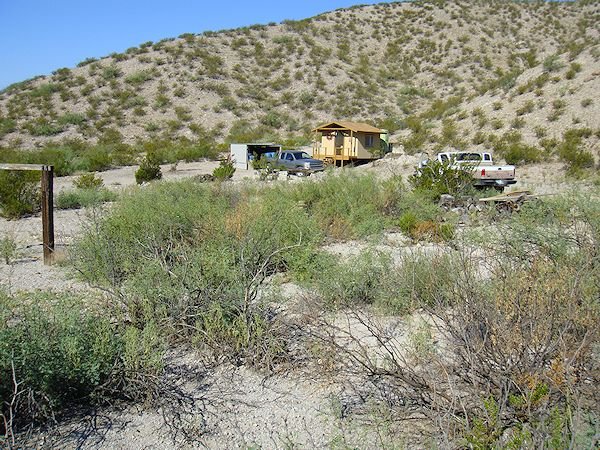
DSC02809Let me point him out to you…

Camo106Here is another before and after view

DSC02814DSC02813

Avoid becoming prey –

Let’s go back to the original mission of camouflage clothing…

“To stay alive.”

And you stay alive in one of two ways…

  1. Defensive – To remain undetected so animals can’t kill you while avoiding contact with said animals.
  2. Offensive – To remain undetected so you can render said animals lifeless.

OK, now I really want to shift directions on you for a moment. Let’s put you into the position of not wanting to be ambushed by the guy above. Here is a little info that might well save your life.

But I do want to touch on “instinct” as it applies to overcoming camo clothing and ambushes.

Ask anyone who has walked “point” in combat. Ask anyone who has stalked game in the wild. Even ask those that have played airsoft or paintball outdoors. Ask women who had been “hit on” in nightclubs. Ask them about instinct.

Your senses are on full alert, you are walking along watching for an ambush (or game) and you just “feel” something isn’t right. You know that you are being watched, or there is danger nearby. That can be your instinct as work; a “sixth sense” if you will.

Now, I won’t dispute that people can have a sixth sense. I also won’t argue against the existence of that “still small voice.” What I will refer to in this case is your subconscious.

Your subconscious can process information approximately 500,000 times faster than the conscious part of your mind. As you are moving along trying to avoid that ambush the ability of your subconscious mind to gather and process subtle clues can be the most valuable part of SA in a situation like that.

But, since it is the subconscious and you aren’t actually thinking it through, the danger impulse will come through as a “feeling” vs. “knowing”. The feeling will come through much faster than you trying to consciously process visual clues. Your brain won’t tell you, “Hey, there are five guys over there dressed in camo clothing all holding an M4 or AR-15 with 30round mags. And they are all pointing their weapons at you. And if you don’t avoid them they will click off their safeties, apply pressure to the triggers till their weapons fire, and then bullets will enter your body creating sufficient wound channels to terminate your life.”

Instead, you will simply get that prompting, that feeling, that life threatening danger is close by. You will feel like prey. Then it is up to your training as to what comes next. Hopefully your muscle memory will come into play and you will react with sufficient aggression to terminate the threat. Or, if that fails, maybe your “fight or flight” instinct will kick in sufficiently to help you survive by fleeing.

Let your instinct work for you. Train to allow your subconscious to process your incoming SA clues. An advantage by a factor of 500,000 is a pretty good benefit to have on your side.

< click here to read more about Situational Awareness >

Avoid acting like a predator –

Working against you is you “staring” at someone while trying to remain hidden, camo clothing or not.

You can have all the best camo clothing, have a great shadow to hide in, but if you are staring directly as someone you are trying to avoid, chances are they might pick up on that as well. Why?

Go back to the “instinct” advantage I mentioned just a minute ago. And now tie that back into our genetic wiring to avoid being prey. Most predators, just before they pounce, will do what? Stare at their prey to calculate how fast to run, how far to jump, where to bite to make the kill. Same thing in the field…with humans.

If you are laying in an ambush for the guys walking down the trail, you might not want to stare intently right at them. Why? Remember, they too are wired to avoid becoming prey. And, if they are well trained, their subconscious is processing all their incoming SA clues 500,000 times faster than you can think about what you are doing and what you are waiting for them to do.

Their subconscious may pick up on a subtle disturbance in the dirt on the trail. And their eyes may pick up a minor variation in the coloration of a bush, or a leaf pattern. But as they are scanning the area around them, their subconscious may allow their eye to see your eyes staring at them. And that final subconscious clue is all it takes for the red flag to go up, the warning bell to sound, and they counter your ambush. Don’t stare right at people you are trying to avoid.

Ask any woman that has been to a bar, a nightclub, or anywhere; if a guy is staring at her intently (even across a large room) does it set off her “alarm.” That is true even if it is a guy staring at her from behind. And if the guy has a “creep factor” to him, they are doubly aware.

And I am sure you have probably had that feeling as well, of being watched. Ask those that have been in a combat area, they will tell you of similar feelings of being watched.

Listen to that “feeling”, pay attention to your “instinct” and act on it. If you are the person trying to remain invisible, remember what can trip their subconscious into alerting them to your presence. Then don’t do those things!

Summary-

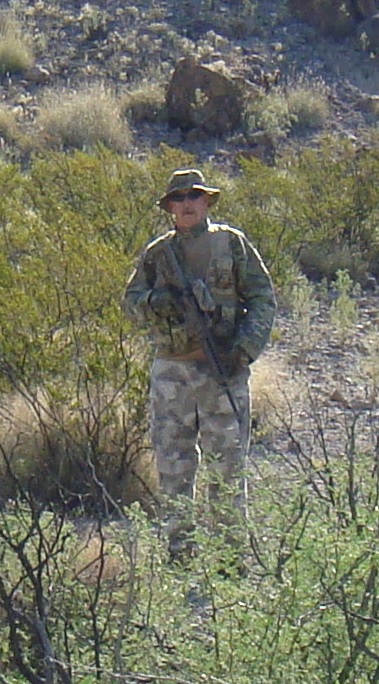
Under normal every-day life this information is of virtually no worth at all to you. Who is going to be camo’d out like this going around trying to avoid bad guys? And even hunting in most states require you to wear something that is blaze orange. But, when the time comes that the grid goes down and the bad guys are roaming around looking for their next victim…you don’t have to be that victim. You can be this guy..or way better!
Camo107


2009 - 2019 Copyright © AHTrimble.com ~ All rights reserved
No reproduction or other use of this content 
without expressed written permission from AHTrimble.com
See Content Use Policy for more information.

Camouflage Clothing…to stay alive! : Part #2

campuflage clothing part 1note: article first appeared in October 2015

In the first article of this series I explained how humans “see” things, talked about what stands out, and where humans naturally don’t look. I also went into a couple examples of “narrative” and how that factors into humans’ ability to spot other humans.

If you haven’t read that first article from yesterday I would suggest that you do. It will make reading this article easier for you.

I ended the first article with the following pictures and asked a couple of questions. Review time…

So let me use visual examples as reference. Below is an example of the environment around where I live. And there is a man standing in that environment about 30 yards away from the camera.He is wearing a typical t-shirt.

White t-shirt in the desertWhere do your eyes naturally go to? Where does your gaze come to rest almost immediately?

Based on what I talked about in the last article, why does you gaze come to rest in that location?

If you are like the vast majority of people your eyes came to rest on the white t-shirt or the glare of white spot just above and to the right of the man. What didn’t hold your gaze at all?

Now he is dressed in rather normal street clothes with a baseball cap. How does that work out for him?

Street clothes in the desert

Given the surrounding environment in the picture, what did you mind expect to see? In which picture was the man easier to see and why?

Remember what I said earlier about narrative and bright areas?

Your mind is trying to create a story about what the desert southwest should look like. And along comes a guy in a red shirt in the desert. Your mind immediately senses the situation and identifies him. In a grid-down this would be called “threat recognition.”

Is the guy truly a threat? Who knows. But until everyone is proven to not be a threat, anyone is considered a threat.

Now let’s put a plain neutral shade of green Columbia PFG short sleeve shirt on him…

DSC02780So why does he blend in more now with the simple addition of a green shirt?

Now, we put a CADPAT-AR long-sleeve shirt on him. And you think?

DSC02782Notice he is now looking down, does that make any difference?

What sticks out the most on him now?  Why?

Now we change the color of his hat, same style hat, just a different color…

DSC02783Any difference?

Now we put a multicam BDU shirt on him with the Mandarin collar up.

DSC02785So now what sticks out the most and catches your eye in the picture above?

Did you focus on his head…were your eyes drawn to his head? Why?

In the next picture all we did was change the style of hat. We put a multicam “boonie” hat on him. Look closely at the picture and identify what changed in your mind.

DSC02786Notice how changing the style of the hat breaks up the shape of the head? Humans are genetically predisposed to noticing the shape of a human head, eyes as well. It is a defensive response to avoid becoming prey of a human predator.

Remember what I had written in the last article about “shadows” and the affect it had on how humans see things? So what is the major problem here?

Yup, the sun is glaring on one side of the man. And that creates a shadow on one side…it is unbalanced and out of place, plus it creates definition.

So, now we are ready to put some “battle rattle” on the man. Let’s see what affect that has.

DSC02787Did all of that equipment, pouches, etc. make a big difference in how easy it is to see the man?

Let me give you a closer-up view for you to review…

Camo100If you want to know more about why his vest blends in so well you can read my article on Tactical Vests. < click here to read the tactical vest article >

How easily can you see his legs? Any thoughts to why?

They are A-TACS pants in the AU “Organic” pattern.

A-tacs UR Organic camo clothingSo why not use the same camo pattern for shirt and pants? Well, look at the pants in the environment that they were designed for. Now, look at the shirt. Pretty impressive, yes?Camo102But, does the environment in the above picture look like the same as the environment that I am using for my example? No. The desert environment that I am using has brush, some trees, cactus with green foliage on it. That foliage is more conducive to multicam. However, there is still the various shades of tan for the desert floor. That is conducive to the A-TACS AU Organic pattern. One camo pattern might be best for pants, another pattern for the shirt. It all depends on the environment you expect to operate in.

We’ve seen the front of our camo’d man, how does he look from the back?

DSC02788Still appears to be blending it quite well. But, let’s take a closer look at his gear…

Camo desert 3-colorThe man is now wearing a hydration back with his tactical vest. The hydration pack is a Desert 3-color pattern. Does it work as camo? Does it blend in?

So why did I go with a Desert 3-color and not multicam for a hydration pack? Practicality is the only answer I have for you. The surplus 3-color hydration pack costs less than half of a new multicam hydration pack. The 3-color works just fine…for less money

Note: Look at the picture above again. What stands out the most? Don’t look too long, don’t over analyze it. Most people says the plan khaki colored straps stick out the most. If that is the case, what could you do to reduce the prominence of those straps?

In the next post I will continue working on this guy’s camouflage clothing to see just how effective it can be. Patience…tomorrow will come soon enough.


2009 - 2019 Copyright © AHTrimble.com ~ All rights reserved
No reproduction or other use of this content 
without expressed written permission from AHTrimble.com
See Content Use Policy for more information.
Camouflage Clothing…to stay alive! : Part #1

camouflage clothing article for preppersnote: article first appeared in October 2015

I have read many purposes and definitions of camouflage, but I think they miss the mark, the “real” mission. Obviously you can tell the various explanations for camouflage were written by some very intelligent folks, a few PhDs in there for sure. And undoubtedly more than a couple generals made their contributions to the official definitions. But I don’t agree with any of them.


So here is my mission for camouflage –

“To stay alive.”

Sorry if that is a bit let down to you, but I am sincere in that mission statement. Now, in all fairness, let me explain the next part of that. There are only two functions that come out of that mission statement.

  1. Defensive – To remain undetected so animals can’t kill you while avoiding contact with said animals.
  2. Offensive – To remain undetected so you can render said animals lifeless.Tacti-Cool

Yup, no other reason or purpose for camo than that. Right?

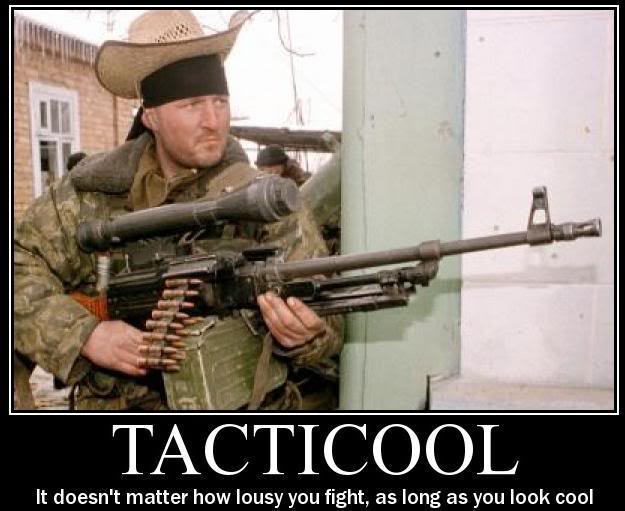
OK, maybe one other reason…”tacti-cool.” Yeah, you want to look really cool so you wear a camo hat, t-shirt, or your truck is painted camo. Hence, now you are a cool kid if any of that applies to you…tacti-cool.

But, back to a more serious note…what is the true purpose of camouflage? It is to keep you alive. If the animals can’t see you, they probably can’t kill you.

Oh, “animals” can apply to whatever you wish to define it as. I am talking about bad guys being animals. You may wish to modify that to whatever makes you happy and your situation applicable, 2-legged or 4-legged.

Background –

There is a whole lot of information available to how camo works and how it applies to humans. But let me boil it down for you to make it a lot easier to understand.

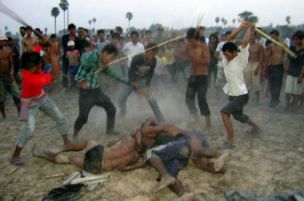
Vigilante Mob - humans are both prey and predatorHumans are both prey and predator in the animal kingdom. We both hunt and we are hunted. Over the generational history of humans we have experienced gene perfection as both prey and predator. One obvious sign is the placement of our eyes, facing forward. Simple eye placement gives us the ability to have depth perception. Don’t discount our peripheral vision though, it’s pretty dang good as well.

There have been studies done that test how our brains “look” at scenes. Basically, humans search for bright colors and movement. We also have built into our genes a predisposition to recognize certain shapes. Not surprisingly, the shapes that catch our attention the most are those associate with other predators. And at the top of that short list of predators are the shapes associated with humans. Yes, that means that humans are the most common predator of other humans.Foveal vision

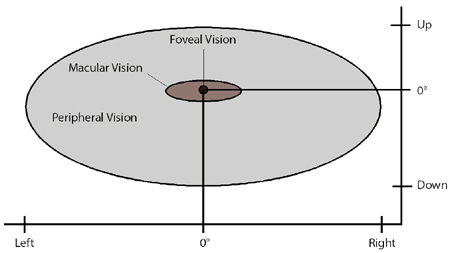
“Foveal vision” is the human eye looking for fine details. That process occurs in the center of our gaze. Details get lost in our peripheral vision the further away from the center of our gaze. Our gaze jumps around more than you think. And eventually is drawn to the most detail-rich areas within our field of vision. That occurs because it is simply the most interesting area to look at. But our eyes will scan the areas that attempt to put together a “story” of what is happening. We’re instinctively looking for a narrative.

Sound a little like Situational Awareness (SA) stuff?

Let’s put that to the test for a moment –

Example #1 – We are in downtown New York City, Wall Street to be exact. It is 8:30am on a Tuesday. What would Camo NYC people on the streetyou expect to see?

Now, you are told to look for threats. Would you be able to “see” every man and woman walking the streets around Camo004you?

Now, what if you saw a man dressed head to toe in camouflage clothing carrying a back M-16 rifle? Would they stand out? Would your eye be drawn to him pretty quickly? What if he were standing in a crowd of say 50 people waiting to cross a street?

Why would he stand out? I mean, come on, he’s dressed in camo, right…when everyone else is dressed in civilian clothes. He would be the most “interesting” to gaze upon.Camo005

Example #2 – We are out in the forest in Colorado. It is 8:30am on a Tuesday. What would you expect to see?

Now, you are told to look for threats. Would you be able to see every hunter in the forest? Now, what if you saw a man dressed head to toe in a $1,000 suit, white shirt, yellow tie and carrying a black M-16 rifle? Would they stand out? Would your eye be drawn to him pretty quickly? What if he were standing in a crowd of say 50 people waiting to cross a stream? Why?

Think “narrative.” In NYC you expect to see people dressed for business. In the forest you expect to see people dressed for hunting. Your mind will try to create a story based on where you are and what you expect.

So how do you defeat, or more appropriately, overcome, how a person commonly Camo006“sees”?

Well, before we get to that let me mention one more thing…shadows. In testing associated with how people view pictures, art, and scenes around them, it is pretty conclusive that people look in shadows last and not for very long. Why? It is boring. Yup, it’s not very detail-rich so the human eye tends to simply skip those areas.


Defeat being spotted –

OK, so back to how we defeat being spotted. Remember, in our scenario being spotted is also dying.

Yeah, I forgot to tell you, I am talking today about the most extreme of examples…grid-down.

So, how do we avoid being spotted?

It goes back to Situational Awareness (SA) and the OODA Loop (Observer-Orient-Decide-Act). Having good SA and staying inside of your opponent’s OODA Loop is how you win (i.e. you don’t die). < click here to read more about Situational Awareness >

Here is the set-up…

  1. It is grid-down. Society is a mess, lawlessness in the rule of the day.
  2. You are out looking for places to set your snares (24-hour hunters).
  3. You are in the woods and by yourself. You are armed with standard battle-rattle, but you are alone.
  4. bad guys stalking man in forestYou hear people coming. You are sure that they haven’t seen you yet.
  5. They are heavily armed and you have no doubt they are bad guys.
  6. They are looking intensely around the area, appear to be on a recon mission.
  7. You want to avoid all contact, at all cost.

How do you do that?

You use the principles of camouflage and how people “see” what is around them.

That being the case, their narrative (their mission/task) is to:

  1. Avoid being ambushed.
  2. Find people and/or food.

You apply the principles you’ve learned so far to stay outside of their narrative. Your narrative (your mission/task) is:

  1. You don’t try to be a predator and you don’t try to ambush them. So you don’t take a predator posture.
  2. You also want to avoid looking like prey. They are predators looking for prey. So you don’t run, that creates movement, which is easy for them to spot.

So, now that you have that part under control, what are some more things to do, or not to do?

  1. You stay out of their “Foveal Vision.”
  2. Camo008As slowly as possible, meld into shadows as much as possible.
  3. You don’t have any noticeable fine details for their eyes to focus on. Yes, that means you are wearing camo clothing.
  4. You stay motionless.

And the whole no “fine details” thing is where camouflage clothing comes into play. So what does camo clothing accomplish?

  1. Breaks up any human shapes and forms by applying random non-detail patterns to your normal human form.
  2. Further breaks up your shape by introducing shadows.
  3. Continues to break up your shape by adding random applicable colors to your shape as well.

Right about now you should be thinking that wearing the appropriate camo clothing should be a pretty high priority. And you would be 100% right in thinking that. But make sure we are talking the same thing…I am talking real camo clothing.

What is “real” camo clothing? Or more entertainingly, what is “fake” camo clothing?

I am going to take the easy way out and tell you, “It is whatever camo clothing that is appropriate and applicable to your situation and environment.”

Yeah, a cop-out to be sure, right? Well, maybe not.

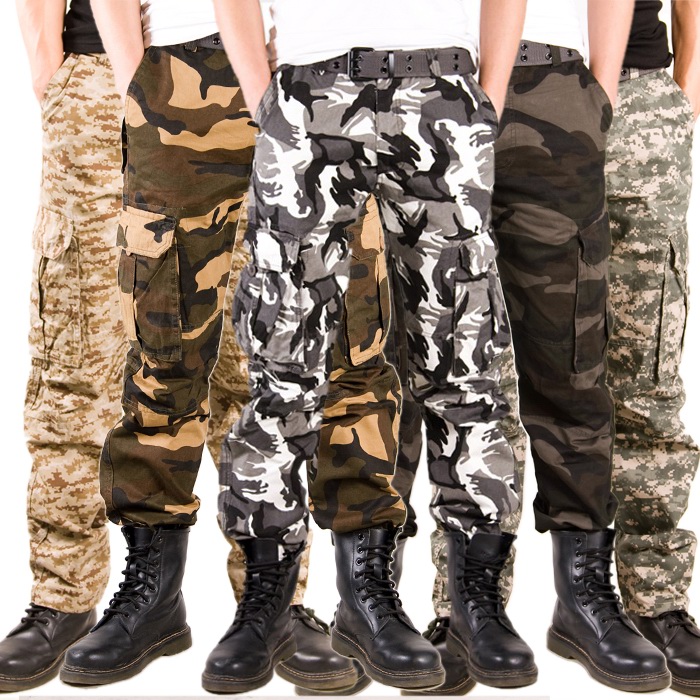
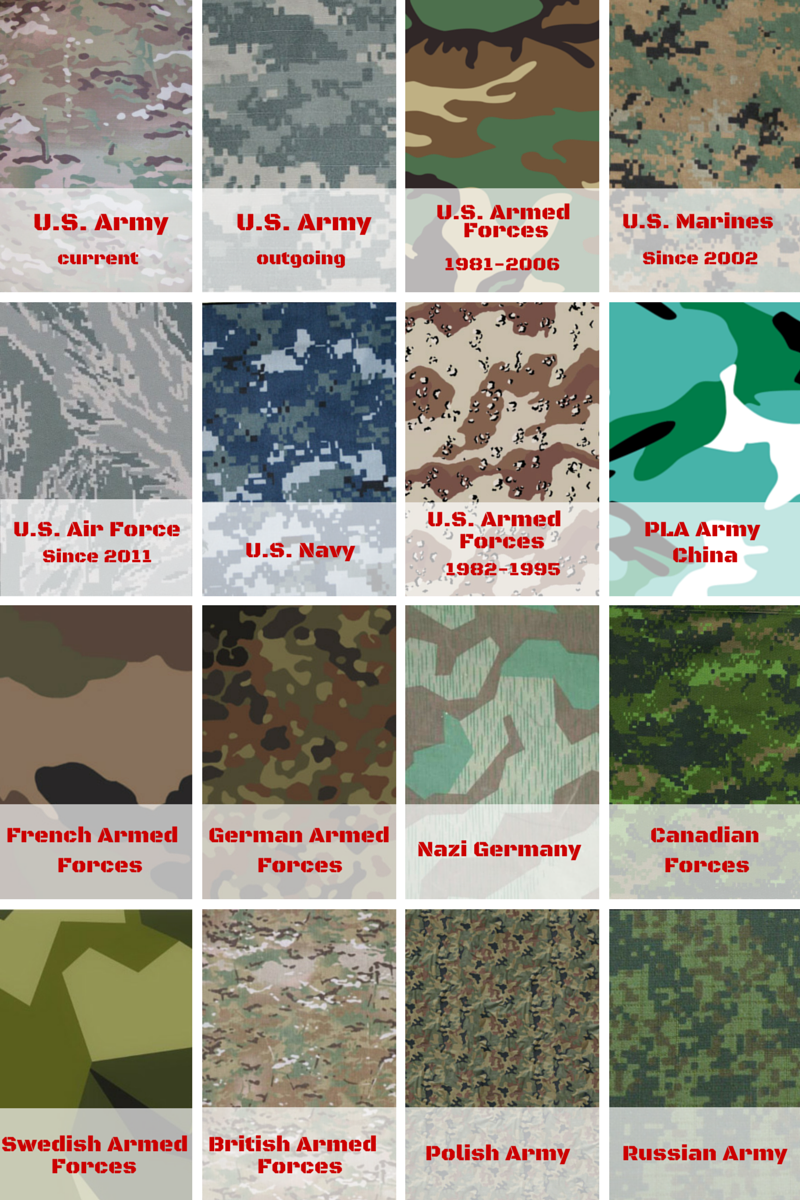
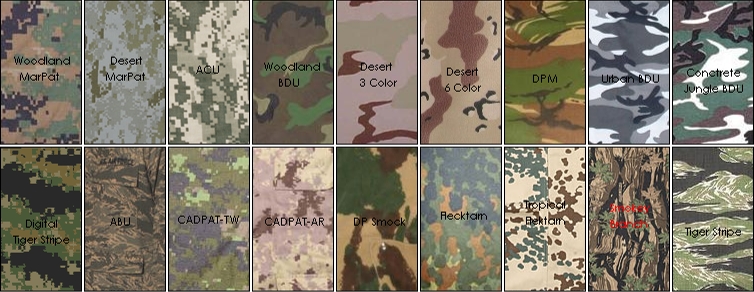
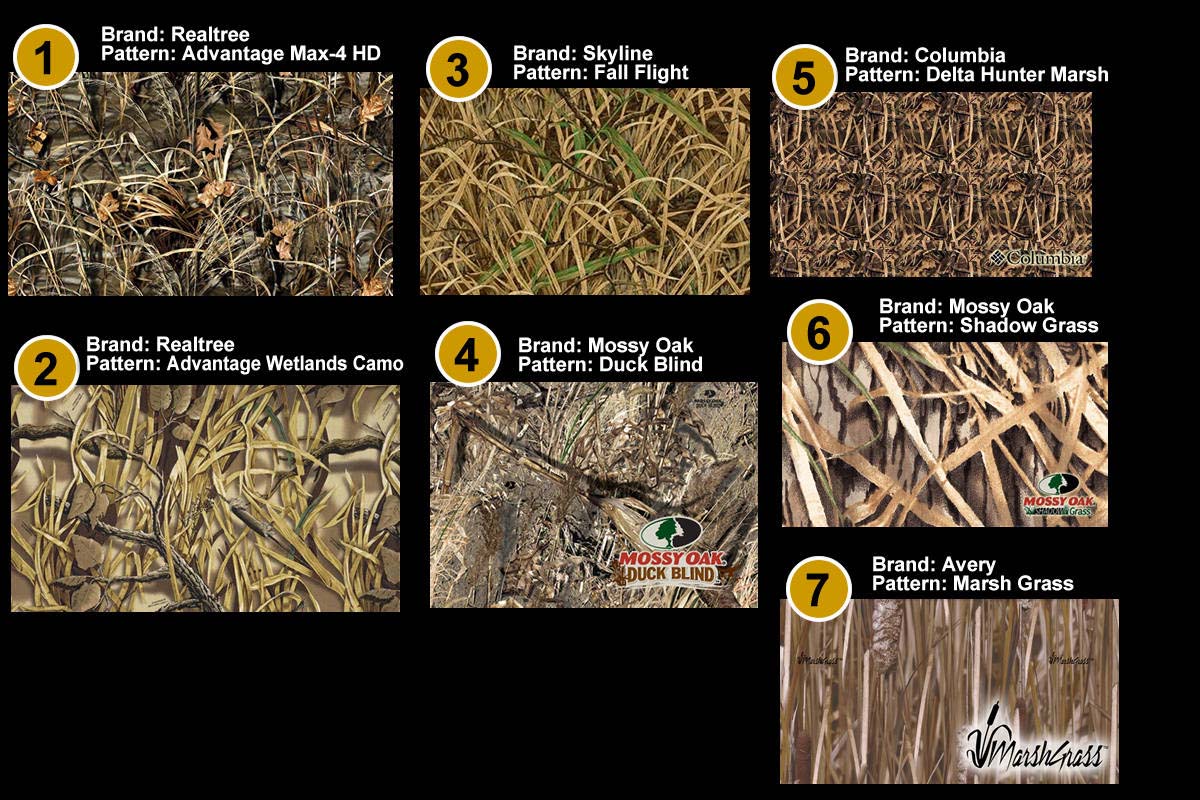
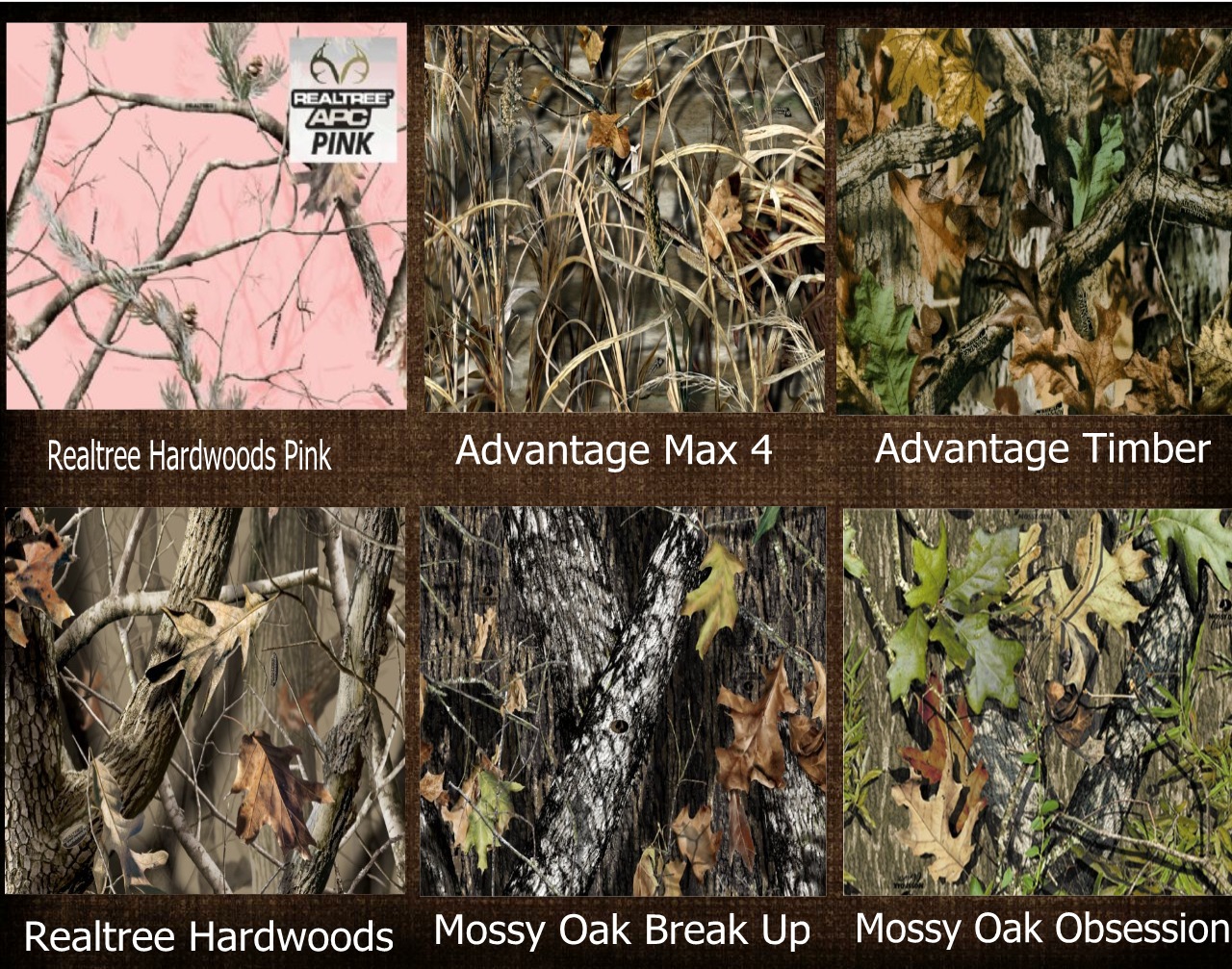
Here are some of the most popular camo patterns…

Military –

popular Military camouflage camopopular Military camouflage camoHunting patterns…

popular Civilian camouflage patterspopular hunting camouflage patters

The actual “how To” –

What I can do is go through the process that I used for choosing the right camo clothing for my situation and my environment. When you are done reading, and if I have done my job correctly, you will know how to figure out what is the right camo clothing for your situation/environment. You will have learned the assessment process.

So let me use visual examples as reference. Below is an example of the environment around where I live. And there is a man standing in that environment about 30 yards away from the camera. He is dressed in rather normal street clothes. How does that work out for him?

Street clothes in the desertHow about with the typical t-shirt?

White t-shirt in the desertGiven the surrounding environment in the picture, what did you mind expect to see?

Now, why is the man so easy to spot?

Tomorrow I will go into detail on how to turn this man from easy-to-spot prey into………


2009 - 2019 Copyright © AHTrimble.com ~ All rights reserved
No reproduction or other use of this content 
without expressed written permission from AHTrimble.com
See Content Use Policy for more information.
Vehicle Emergency Bag/Box (VEB)

Vehicle emergency box bagnote: first appeared in July 2015

Yeah, another bag/box of emergency equipment. Go ahead…laugh at me if you want to. I probably would if I was you. But hey, my job is to provide you with information that is both practical and useful for emergencies, disasters and grid-down. And having a vehicle breakdown in the middle of nowhere is an emergency in my book.

The scenario that I saw that is driving the need for a Vehicle Emergency Bag/Box (VEB) is simple. You or a family member is in a vehicle out in the middle of nowhere, no communications capability, and the vehicle breaks down. The threats remain the same for this scenario as with any other; violence, injury/sickness, etc.

So we have to meet those threats with solutions.

Having 20 years of experience responding to traffic accidents I have come to the conclusion that the number one threat to being broken down on the side of the road are idiot drivers. And I want to emphasize IDIOT drivers. I could tell you story after story of how stupid people are when it comes to driving, but I will spare you. Just understand that I believe the #1 threat to your safety if you are broken down are other drivers. They will take every opportunity to run you over or smash into your vehicle. And they can be very creative in doing so. Take nothing for granted, err on the side of caution.

The mission of the VEB is:

Ability to recover from a flat tire or stuck vehicle, or survive overnight from the stranding of vehicle in a remote location.

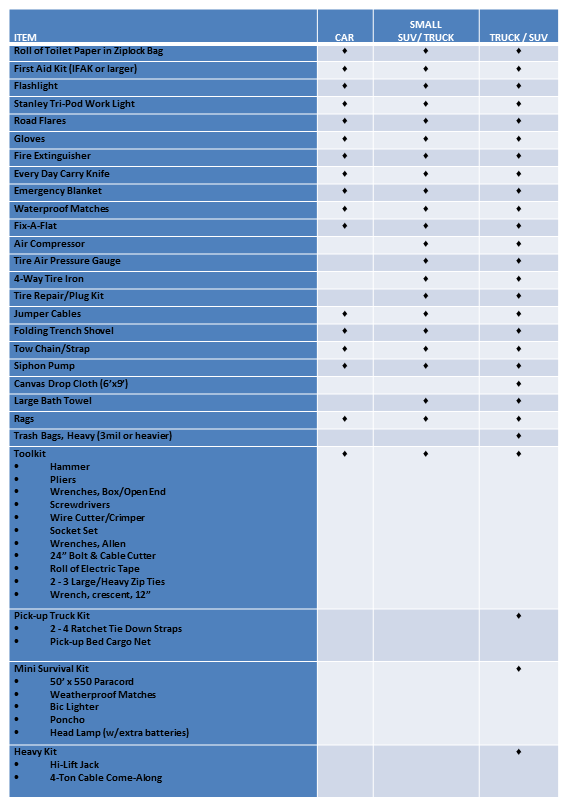
Here is a list of VEB contents. I will get into the explanation of each at the end of the list. The contents are:

{ click to enlarge and print }

{ click to enlarge and print }

Why didn’t I address the threat of violence? It is a matter of security. I can’t in good conscious recommend that you leave a firearm in the vehicle at all times. It simply wouldn’t be secure enough. Over the years I have had my personal vehicle broken into three times. It was bad enough that one of the times the low-life criminals stole the mechanics tools that my Dad had left to me after his death. But to have a gun stolen would have been even worse. Criminals have access to enough guns, I don’t want to make that worse.

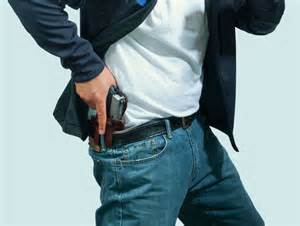
How do I address the self-defense aspect as it applies to a VEB? You bring it with each time you get in the vehicle. Man should always conceal carryI am a huge advocate of conceal carry. I believe that every prepper should conceal carry. I feel it is part of each prepper’s responsibility. However, if you don’t conceal carry that is your choice. But I would suggest that whenever you are going to be gone for any length or time or going more than just a short distance, take a firearm.

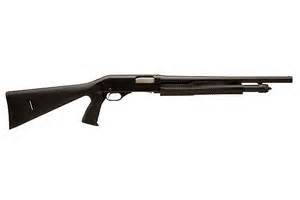
There are two options that I consider; 1) my conceal carry pistol, 2) a Stevens 12ga shotgun. Actually, I guess that technically there are three options, the two above and both Shotgun Stevens Model 320 by Savage Armscombined.

When I would consider having both would be when I am headed into territory that I consider to have the potential to be dangerous. Yes, I know that means just about anywhere today but I am thinking more along the lines of southern New Mexico, southern Arizona, southern Texas, or any longer road trip.

That about covers the threat of violence issue pretty well. I do know a person or two that have installed law enforcement grade weapon retainers to lock down a shotgun and/or an AR. I am not a big fan of those because normally the retention hardware makes the long guns easily visible. I prefer to have my guns out of sight.

Here are the details of the VEB:

  1. Toilet Paper – This is a “must have” item. Just take a roll from your supply at the house and place it in a freezer Ziplock bag.IFAK
  1. First Aid Kit – I would suggest an IFAK for most situations. If you are going on a trip as a family then I would suggest adding a TBAK.
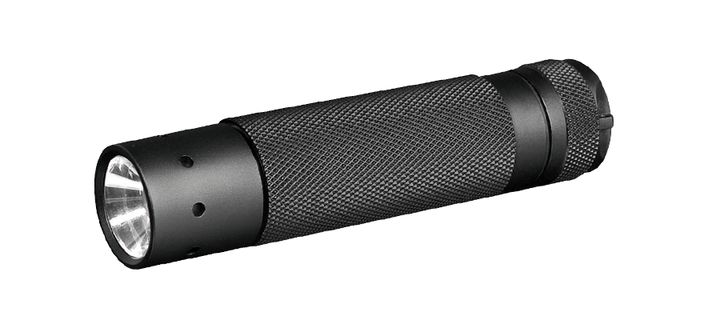
  1. Flashlight – If you can’t see what you are doing the rest of this stuff doesn’t matter LED Lenser Flashlight V2much. I would suggest you use the same tactical light that you use for everything else. Yes, standardization is a good thing. I personally use and recommend the LED Lenser. Always have a spare set of batteries. If you store your flashlight in a “box” I would suggest that you not have batteries in the flashlight, they will corrode. Keep them in a baggie with the flashlight and the spare set of batteries. Yes, always have a spare set of batteries.
  1. Stanley Tri-Pod Work Light - Stanley MaxLife 369 Tripod LED FlashlightStanley Tri-Pod Work Light – This is a fantastic working light. It can operate off of 3, 6 or 9 AA batteries. The light is very bright, the head is adjustable and the legs make it capable of standing alone on the road berm leaving both hands free to work on whatever is needed.
  1. Road Flares – There are two reasons for road flares in my opinion; 1) visual warning to other drivers that a breakdown or accident has occurred, 2) a weapon. Yup, a weapon.
  1. Gloves – I would suggest a really decent pair of gloves, something along the lines of work gloves that can handle rough treatment. Thin cloth gloves are almost as bad as having no gloves. I like Mechanix brand gloves.
  1. Fire Extinguisher – You can use one of those small 5lb extinguishers if you want to. Something is better than nothing. But I like a 20lb myself. In my years as a firefighter I’ve seen those 5lb’ers do little more than make a mess before the vehicle burned down.Gerber paraframe knife
  1. Emergency Carry Knife – This can be a blade of your choice. I wouldn’t go with anything expensive. A Gerber “paraframe” model for $18 works just fine.
  1. The Original Space Brand Emergency BagEmergency Blanket – This can be either the “space” blanket or an actual emergency blanket, either will work. You just want something to help you stay warm wrapped around you, or reflect the heat if you build a fire.
  1. Waterproof Matches – You always gotta have a way to make fire; stay warm, signal, or defense.
  1. Fix-A-Flat – I recommend two cans of the good stuff, large cans. Don’t skimp and buy the cheap stuff it won’t work when you need it to.
  1. Air Compressor – A 12vDC model, plugs into your cigarette lighter. Sometimes the Fix-A-Flat just won’t be enough air.
  1. Tire Air Pressure Gauge – This is a no-brainer. Again, don’t get the cheapest one. Get the one that will work for you when you need it to.
  1. Tire Repair/Plug Kit – This is the little kit that has the two tools, one to clean the hole, and the other tool pushes the plug through. There is also some sealant cement to help hold the plug in place and prevent air from escaping.

slime power spair kit slime spair kit NOTE: Slime Tire Spair Kit has all of the following –

  • 24oz. Slime Tire Sealant (TPMS safe).
  • Heavy-duty 12V tire inflator with LED light.
  • Adapters for any battery.
  • Key valve core removal tool.
  • Valve caps and valve cores.
  • Air adapters for inflatables.
  • Alligator clips.
  • Pencil tire gauge.
  • 30 tire plugs.
  • T-handle reamer and plugger tools.
  • Convenient zippered case.

It is all high-quality gear in a great carry bag. The kit will run you less than $60.00 and well worth every single penny.

  1. 4-Way Tire Iron – Your regular tire iron is probably shaped like an “L” and will work the majority of the time. But with a 4-way you will be able to get a whole lot more leverage when taking the lug nuts off. And you can spin it to get the nuts on and off a whole lot faster.
  1. Jumper Cables – Here is another area not to skimp. You can get the good 4guage cables that are 20’ long and have much more power to jump your car. Or you can get the pathetic 10gauge and get a fraction of the power coming through the cable. Go for quality!

Booster cable size application chart

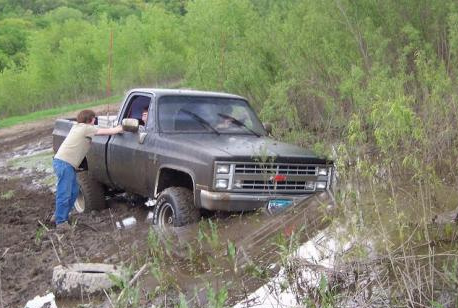
  1. Shovel Military folding militaryFolding Trench Shovel – These are hard to beat, they can get you out of a snow bank or the sand. And they can be a pretty lethal weapon as well.
  1. Tow Chain/Strap – I actually carry both a chain and a strap. Both are 20’ long. That gives me options when it comes to how close the tow vehicle is relative to the stuck vehicle. Also, if I am stuck and I have to use the come-along to get myself out I use the strap around a tree, rock, etc. and then use the chain hooked to the truck.fuel siphon pump kit
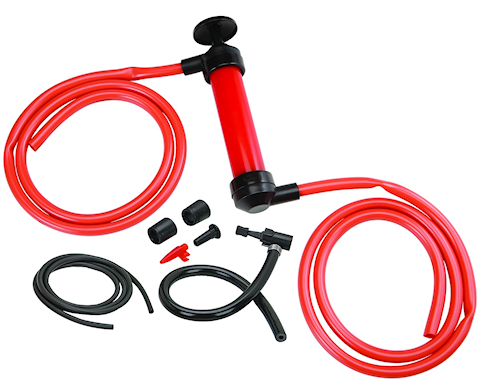
  1. Siphon Pump – This is purely to get gas from some other container (or vehicle) into my truck.
  1. Canvas Drop Cloth (6’x9’) – This has a number of uses; cover, shelter, shade, etc.
  1. Large Bath Towel – This is simply to dry myself off if I get wet.
  1. Rags – Yup, to clean my hands with.
  1. Trash Bags, Heavy (3mil or heavier) – These will be used for a couple different purposes; 1) trash, 2) makeshift ponchos for a number of folks, 3) collect water, etc. I like the Hefty SteelSak brand.
  1. Tool Kit – Check the chart above for a list of the minimum tools you should have. You are not trying to have complete repair capability, just enough to get you moving again.
  1. Pick-up Truck Kit – These are to help secure a load that you put on the truck or to improve your existing load security.
  1. Mini-Survival Kit – This is not to replace your GHB or a GOOD BOB. These items are to use instead of your GBH or GOOD BOB items. If you end up with another person with you, they can use these items if it turns into a get home situation.
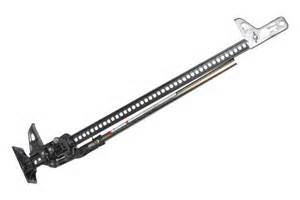
  1. High Lift Jack for emergenciesHeavy Kit – Notice the inclusion of a HighLift jack. If you haven’t been trained on how to use a HighLift jack…don’t use it! Man folks have come away with broken teeth and fractured faces because they try to use a HighLift jack and don’t know what they are doing.


2009 - 2019 Copyright © AHTrimble.com ~ All rights reserved
No reproduction or other use of this content 
without expressed written permission from AHTrimble.com
See Content Use Policy for more information.
My “Go Bag” and myth buster!

Prepper Go Bag for grid-down emergencies and disastersnote: first appeared in July 2015

I am a big believer in layers, redundancy, and modular “prepping.”  I don’t get locked into the conventional way of thinking as most prepper “experts” do. I try to think in terms of, and focus on, “mission.” And the same applies to my “Go Bag” and how it integrates with my overall philosophy on my “prepper” way of life.

So, as always, I always designate a “mission” for everything I have.  For my gear and equipment I want ensure that I am staying on task, staying focused and not just acquiring “stuff” for its own sake. So here is my “Go Bag” mission:

A bag that contains the absolute minimum to defend myself, my family and begin the trip to my survival cache. To minimally survive independent of any other source of resources while maintaining as low a profile as possible.

No! This is not a good "go bag" at all. It will get you killed.

No! This is not a good “go bag” at all. It will get you killed.

This bag was to be small, lightweight, low-profile and something I could grab if I couldn’t grab anything else. This would be the bag that I could carry anywhere and it would not raise any attention, let alone suspicion. In other words, this would be the lowest level building block of survival bag…a “go bag.”

So I kept adding things to the list, then crossing them off, adding some more, and crossing off a bunch more. I had to whittle it down to what I considered to be the absolutely bare necessities. And I am not kidding…the absolute bare necessities.

I had to maintain compliance with the L.I.P.S. principles. I also had to meet and over come the standard list of threats listed in priority order; violence, injury/sickness, lack of communications, dehydration, exposure, and starvation. So I really had to look very, very hard at what was practical and what had to take a back seat. So here is the gear & equipment list of my “Go Bag”:

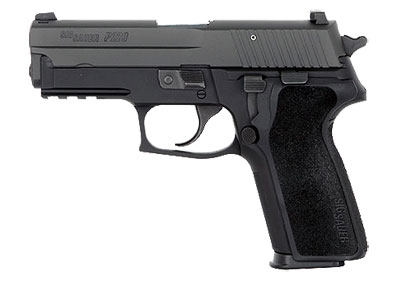
  • real prepper Go Bag that is useful practical logical and needed1 x Sig P229 pistol (.40cal S&W)
  • 2 x Sig magazine, P229, 12-round
  • 50 x 180gr XTP rounds
  • 1 x ESEE 3”
  • 1 x Blackhawk SERPA Level 2 holster, flat dark earth
  • 1 x xGalco International magazine and tactical light holster
  • 1 x LED Lenser tactical light with AAA Batteries
  • 3 x AAA batteries
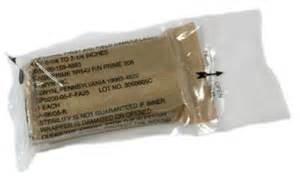
  • 1 x Dressing, First Aid, Camouflaged, 4” x 7”, Sterile : NSN# 6510-00-159-4883 – Elwyn Inc.
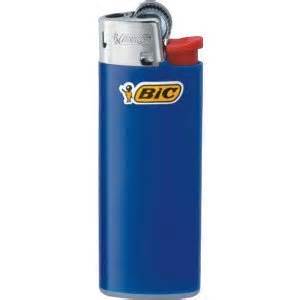
  • 1 x Bic Lighter

That’s it, nothing more; the bare necessities. Why nothing more?

Well, that can be answered a whole lot of different ways. But, the primary reasons are “low-profile” and priorities. I’ve learned over the years that your primary priority is to stay alive. And trying to carry a whole lot of stuff is not a good way to stay alive when you are being pursued. Not a good idea to be carrying a large backpack in an urban area where folks want what you have, or they just want to kill you.

Grey Man concept for survival blend in gray manWell, one way to avoid a stupid mistake being low-profile. And being low-profile means that anyone tracker you can’t distinguish you from any other folks. And that is exactly my point, being able to move about, returning home, or traveling to a survival cache, without being noticed. But if you are noticed, you must then have the ability to defend yourself with extreme violence if needed. My “go bag” gives me the ability to do that.


Contents –

So let me go through each item and explain my reasoning:

1 x Sig P229 pistol (.40cal S&W)

Sig Sauer P229 .40cal S&W for high capacity conceal carry with lots of powerThis is my primary defense weapon for this situation. Yes, I normally conceal carry when I am outside of the home. But there are rare times that I just can’t, or don’t choose to, carry. That being said, I will always have my “go-bag” in my vehicle. So why a Sig P229? Well, I am very, very partial to Sigs. They are an extremely dependable gun and they fit my hand perfectly. I like their reliability and have no problem betting my life, or my family’s safety, on them. Why a .40cal? It is a fast round, very lethal, and I can carry 50% more ammunition than my Sig 1911 Ultra Compact. I can hit 8” targets consistently at 100 yards and that round can still be fairly effective at greater distances.

2 x Sig magazines, P229, 12-round

I carry this brand and size of magazine because it is 100% compatible with my Sig P229 and 100% reliable since it is the same high-quality manufacturer. I carry one of the mags in the pistol and the other in the Galco holster. I don’t include more mags due to weight and space restrictions. I believe a single extra 12-round magazine to be entirely sufficient in this situation. I am not looking to get into a firefight. I will defend myself when the situation calls for it as I withdraw to safety and then switch in “evade” mode.

50 x 180gr XTP rounds Hornady .40cal S&W XTP 180gr

I chose this round because it is extremely efficient and lethal. It has a high velocity, can be shot long-range, and the stopping power is incredible. If you counted it, I have enough rounds for a full load of magazines and one complete reload. I don’t carry more than this due to weight and space restrictions.

1 x ESEE 3” Knife

ESEE 3 knifeKnives are a beautiful thing! Think about it for a second, you grab a high-quality knife and it just feels so good in your hand it isn’t even funny. The “feel” is hard to explain without sounding like some whack-job. But, a high-quality knife is essential when it comes to survival in an emergency or disaster. I chose an ESEE knife because they are so freaking good. I mean they are simply the best in my opinion. You may have to prepare a fire, skin a jack rabbit, or defend yourself up-close and personal. An ESEE knife will do it all and it will not break on you.

1 x Blackhawk SERPA Level 2 holster, flat dark earth

BlackHawkSerpaYou may be wondering why this exact holster for this application, and it would be a good question to ask. I don’t use a “retention” holster when I conceal carry. The reason is pretty simple, I don’t want any hindrance when trying to draw my weapon. I want to be able to draw my weapon quickly, no fumbling, and then get it on target. So why not the same for my go-bag? In normal conceal carry times I have no, or very little, active threats to worry about. In other words, I don’t feel that people will be standing in line to try and take my weapon. And if someone does try and take it, they will have to contend with a combination of Krav Maga and Kempo. During a “grid-down” or other serious situation when I am using my “go bag” to get home I see more people looking for, and willing to take, weapons from anyone they can. Society norms and morals, what little we have, will drop away quickly. In a fight, or if I am jumped, I don’t want it to be easy for a person to take my primary weapon from me.

1 x Galco International magazine and tactical light holster

Galco Mag & Light holsterNo specific reason why a Galco holster for my extra magazine and tactical light, they are good quality holsters and it fits my specific need. I use a combination holster simply because I want to go to the same place for either my spare mag or my tactical light. I have “muscle memory” through training that drives me to my “weak side” naturally for either item. Yes, I could put them in my pocket but I don’t think I can pull either out of my pocket as fast as I can get them off my belt.

1 x LED Lenser tactical light with AAA Batteries

LED Lenser Flashlight V2I am all about stealth most of the time. No, not like some “not-so-secret jet” or a Ninja warrior. But in a bad situation where I am needing my “go bag” I really don’t want a lot of people knowing I am around. This is especially true traversing an urban setting. So I don’t want to be lugging about a big four D-cell Mag light. Yeah, they’re kind of cool to club someone with, but they are heavy and very conspicuous. My little LED Lenser is very compact, easy to conceal but yet is awesome when it comes to lighting something up. I can shine that beam a 100 yards and see whatever I am looking at. Or, I can use my hand to pinch off a bunch of its light to a very small area where the light is barely noticeable. It is my “go-to” light for all tactical situations and use.

3 x AAA batteries

I have a couple of LED Lenser flashlights that have had batteries in them for a couple of years and the lights are still working just fine. But you never know when the batteries will hit that magical spot when they are done and just quit on you. When that happens I will have a spare set of batteries to get it going again.

Dressing for TBAK1 x Dressing, First Aid, Camouflaged, 4” x 7”, Sterile : NSN# 6510-00-159-4883 – Elwyn Inc.

This is my “blowout kit” (BOK). Yes, a full blown Individual First Aid Kit (IFAK) would be nice to have but it is bulky and high-profile. Remember, the whole idea/mission behind my “go bag” is to simply get me home, or some other specific destination with the minimum of gear. It is not a GOOD-BOB or even a GHB. So I am not going to worry about an IFAK at this point. I am going to avoid, evade, and conceal rather than engage. This dressing is to stop any bleeding that I expect to encounter. If the injury or wound is more serious then I go into “adapt and overcome” mode.

1 x Bic Lighter

BicLighterNo, not to smoke a cigarette or a blunt, I don’t do either. But I never know if I am going to need a fire to stay warm or purify some potential drinking water. There are also ways to use it as a weapon to defend yourself. Yeah, you gotta remember my profession to appreciate that statement. I am a wildland firefighter and retired structural firefighter. Part of what I do for a living is setting fires. So a lighter to me is a natural tool to have. Besides, it is very versatile.

So there you have it, my “go bag.” I hope you weren’t disappointed. It is small, light-weight and low-profile. But before I conclude this article let’s talk about the bag for just a second, it’s important.

What bag did I choose and why?

Remember, in this situation I want to maintain a low-profile, I don’t want to attract attention to myself. I want to be that Crowd“gray man” you’ve undoubtedly heard that term before. So I wanted something muted in color, not really visible at night, small and lightweight. And more than anything else, I didn’t want it to look “military” in any way, shape, or form. That military look would draw instant attention, and that is not what I am wanting.

So I happened to stumble upon a “Tek” pack by Camrac. It was built for carrying a SLR camera and a few extra accessories. It measures about 10” H x 8” W x 5” D. it is light-weight, no waist strap, dark blue and black in color. It weighs less than a pound by itself and is padded internally. There are several zippered fish-net interior pockets and the bag has a carry handle on top. Twin shoulder straps are more than adequate. The padding is an added bonus.

If all of the contents are in the bag and I am carrying it around you probably would even notice. It just seems too small and insignificant to be threatening…or valuable.

Now, when it comes time to put it into action:

  1. The Blackhawk and pistol go on my right hip.
  2. The Galco, light and spare mag go on my left hip.
  3. The lighter goes into my left front pants pocket.
  4. The ESEE goes horizontal in the small of my back.
  5. The dressing goes into my right front pants pocket.

That leaves the pack virtually empty. I can make the decision at that point to move the batteries and spare ammo into a pocket and discard the pack if I need to. Or I can retain the pack and use it to carry whatever I scavenge along the way.

For instance, if I was at work and the only option was my “go bag” I would take a couple bottles of water and an MRE with me inside the pack. If I was in my truck when the need arose (and I didn’t have my GHB or my vehicle kit in the truck), I would take my map and my two spare bottles of water with me in the pack.

That concludes my “go bag” list of contents and reasoning behind all of it. This is not the kind of “go bag” that you use to get out of dodge, head to the mountains, or even live out of while fighting off zombies. This bag is simply your option when the situation demands it or there is nothing else for you to use. It provides the minimal equipment and gear allowing you to defend yourself, treat a basic injury/wound and keep moving to your destination.

A couple of items that I might consider adding to the bag that you might find useful, and items that I almost put in there:

  • Map
  • Compass
  • Couple of granola bars

So why didn’t I put those items in the pack? No need for a map and compass for this mission. At this point I am in town and know my way around…or I can acquire a map. We have a mountain range that orients me north-south. As for the granola bars…I probably won’t be on the road long enough to need them. If I am, I will acquire food on the move as needed. See, I can boil it all down to the most Bad Go Bagbasic gear; I can keep it small and light.

What was the “myth” I busted?

The myth that you always need to “go big or stay home” that many preppers feel is the right way to go in virtually all circumstances.

I believe you pick and choose your gear based on the “mission” you’ve identified. If you can’t identify and clearly define the mission, then you will not be able to, and not going to, choose the correct gear and equipment.


2009 - 2019 Copyright © AHTrimble.com ~ All rights reserved
No reproduction or other use of this content 
without expressed written permission from AHTrimble.com
See Content Use Policy for more information.

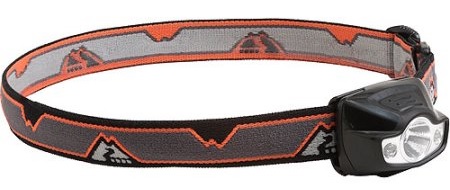
Ozark Trail 150-Lumen Multi-Color Headlamp

headlamp ozark trail walmart 150 lumenThis is one of those “Wow!” moments. Yeah…seriously.

You know me, I am a gear junkie of the worst sort. I am always looking at emergency preparedness gear. It is sooooo bad I have had several hundred dollars worth of small-battery chargers sitting around my home office for months while I work on those articles. So yes, I am a gear junkie!

And…sometimes a piece of gear comes along that just absolutely surprises me. That just happened again…at Walmart. Yup, Walmart! Not that long ago I wrote an article about finding the Ozark Trail Multi-Tool at Walmart for $3.97. I bought a couple, tried them out, and absolutely loved them for the price vs value of that piece of gear. It’s happened again!

My wife and I were heading to our property in Arizona for a long weekend of fence mending, homesite scouting, etc. One of the things that I wanted us to have on hand was a headlamp. I didn’t want to breakout one of our good Petzl or Princeton headlamps, I just wanted a real simple, virtually disposable, headlamp for night walks or around camp. Off to Walmart!

So I was looking around and they had a pretty decent variety for the most part, all third-tier units or worse, in my opinion. Then I spotted this little sporty little headlamp for $8.97 I think the price was. But, it was only 50 lumens as the retail package was telling me in bright orange coloring. Ah, but next to it was its bigger brother…”bigger” in terms of lumen, not size. And it was priced at $12.97. A really outstanding price for a 150 lumen headlamp.

Let me divert for just a second, when using a headlamp at night I far prefer the red light vs. the white light. I have very good night vision and white light just destroys that. But, using a red light maintains that night vision once you turn the headlamp off.

For the $12.97 price tag I figured that there would be no way the headlamp would have a red light option. I was wrong. Sure enough right there on the package it said there was a red light setting. Now, if it was anything like most headlamps’ operations getting to the red would be click this, while hold that, and doing thus for 3 seconds after pressing the other button for 2 seconds…making sure it was a cloudy night and standing on one foot. But, I was OK with that…I headlamp ozark trail walmart 150 lumenwas spending $12.97. Especially when I saw the headlamp package contained batteries…Duracell batteries!

I got home and started packing later that night. It came time to pack the headlamps in our respective gadget bags. I opened up the retail packaging and was again pleased to see the Duracell batteries. Duracell batteries…the best alkaline batteries made…period.

OK, so I am putting the batteries in the headlamp and I am actually impressed with the housing. Seems plenty durable enough. I hate the shiny sheen to the plastic but the housing is decent enough. There isn’t any rubber gasket sealing the battery compartment, but there is a respectable “lip” and the compartment closed pretty dang ozark trail 150 lumen headlamp - walmartsecurely. I have no idea if it will hold up underwater -I doubt it- but it appears that it would handle rain just fine.

I turned the unit on and there were two settings for the white light; high, low. The high was plenty bright enough to see a large area clearly. The low setting still provide a whole lot of light but in a much smaller area. But…where was that all elusive red light setting. I gave up and read the directions. Pressing and holding the “on” button for 2 seconds turned on the red light. That’s it…just press the same “on” button…just hold it for 2 seconds. I liked that.

We used them every night during a four-night stay. They worked every single time, they were easy to use, the headband in strong, comfortable, and nicely adjustable. A great little piece of equipment…VERY nice when you consider it only costs $12.97.

I say buy this headlamp!!

Note: This article originally posted in 2016. I bought three of these units and they are still working now in 2019.

Buy It !


2009 - 2019 Copyright © AHTrimble.com ~ All rights reserved
No reproduction or other use of this content 
without expressed written permission from AHTrimble.com
See Content Use Policy for more information.
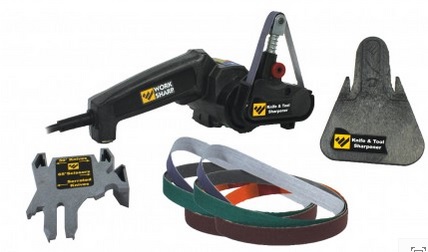
Work Sharp Knife & Tool Sharpener

WorkSarpSystem-010I’ve got a lot of knives…I mean a lot of knives. I also like them sharp…I mean really sharp. I have been using a Smith’s diamond stone and I am pleased with it. I actually like the coarse side a lot better than the fine side. I know it may sound crazy but it feels as if it puts a bunch of micro-serrations on the blade which makes cutting easier. But, that is not the object of this review…The Work Sharp system is. And I am going to post more than my usual number of pictures to give you a flavor of what this puppy can really do.

I was going through a lot of testing of knives a few months back and I was getting really tired of hand sharpening every knife every time I completed a test. So I started doing some research and found the Work Sharp system. Boy, am I glad I did!

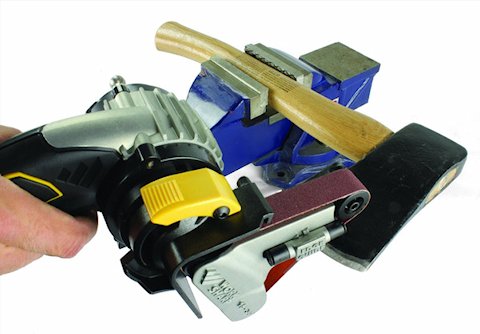
WorkSarpSystem-005To get an idea of what this tool does, imagine in your mind a small belt sander. And attached to the belt sander are a number of inter-changeable guides that allows you to sharpen just about any kind of blade on just about any kind of knife, scissor, garden tool etc. It comes with coarse, medium, and fine premium abrasive belts. And with those belts you can put an edge on any kind of steel that you might have in your shop.

And don’t worry about changing belts…it is easy and fast. I can WorkSarpSystem-003change a belt in under a minute. And belts last a pretty dang long time, even when doing heavy duty sharpening. But the heavier the use, the quicker the belt gets used up. One thing you will want to do is buy extra belts. Several of each kind of belt comes in the box but you will want more on-hand just in case the supply might dry up.

What’s in the Box
• (1) Original Knife & Tool Sharpener
• (1) 40° Kitchen Knife Guide
• (1) 50° Outdoor Knife Guide
• (2) P80 Coarse Abrasive Belts
• (2) P220 Medium Abrasive Belts
• (2) 6000 Extra-Fine Abrasive Belts
• (1) Instructional DVD
• (1) User’s Guide

Good stuff –
  • WorkSarpSystem-001Sharpens any steel blade I’ve tried so far, on any tool or knife.
  • Guides make keeping the right angle really easy.
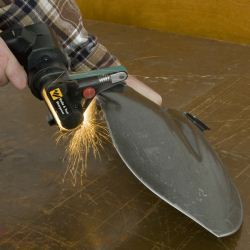
  • Even lawnmower blades…Work Sharp can handle them.
  • Yes, you can even sharpen kitchen knives, even the good stuff. Be careful, the blades come out extremely sharp when using the fine belts.
  • Yes, it can even sharpen food processor blades.
  • It can handle a 1/4” flat steel blade and put an edge on it starting from scratch.
Less good stuff –

WorkSarpSystem-008

  • Takes a little practice to get the “draw” right for the right kind of blade tip. “Dry fire” it a little for practice, it will get you use to the right draw without jeopardizing a blade tip.
  • For serrated knives it won’t do the “curved’ side of the blade, only the flat side. But, a good diamond rat tail can handle the little curves in the blade after the flat side is done.
  • I hope you’re not left-handed. It looks like this thing is set up only for right-handed people.
  • If you don’t practice and follow the directions, you might find yourself WorkSarpSystem-009disappointed.
  • Don’t run it for longer than about 15 – 20 minute without giving it time to cool off.
  • If you want to sharpen scissors, then buy the scissor guide…you’ll appreciate it a lot!


.

Buy It !

Bottom line…this gadget is a real time-saver and worth every dime I paid for it. I can sharpen 20 knives easily in an hour. This is a “Buy!”


Amazon Work Sharp sharpening system


Note #1 – Send in your warranty card, they will send you some new belts.


2009 - 2019 Copyright © AHTrimble.com ~ All rights reserved
No reproduction or other use of this content 
without expressed written permission from AHTrimble.com
See Content Use Policy for more information.
Emergency Radio Cache

Radio Cache for emergencies, disasters, and grid-down baofeng radio cachenote: first appeared in November 2015

I’ve been asked many times, “What kind of radios should I buy?” Or, “How many radios do I need?” And, “Where can I find radios that set-up ready-to-go?” And, “What accessories do I need to get the most performance out of my radio?”

I’ve written extensively on the Baofeng UV-5RA radio. I think it is simply the best value for the most people who are looking for a good alternative communications capability. And not only that, it really makes a great radio for a variety of purposes. Some of those are:

  • Family emergency radios.
  • Hunters & campers.
  • Church service groups.Ham Radios being used by Family
  • Neighborhood Watch
  • Emergency response teams.
  • Prepper groups.
  • The list could go on and on…

One of the situations that keeps coming up is buying a number of radios for a “cache” to be used as needed, properly and safely stored when not being used. Best possible answer to that is what I do right now for the group I am responsible for. If you have read my bio you know I am responsible for emergency preparedness for a 13-congregation church group; we call that group a “Stake” in our church. The 13 congregations are spread out over a three-county area.

In a perfect world each congregation would have their own cache of radios ready to go. But the world is rarely perfect. So the alternative is for me to maintain a radio cache that is ready to deploy when, where, and as needed. I thought the best way provide an answer is to show you a working example..the “8-Radio Cache”.

The mission for the radio cache is –

“Provide sufficient communications gear for two teams of four people to communicate while on the ground or traveling, and to provide that capability for a minimum of five days without the need to recharge any batteries.”

Requirements & Restrictions –

  1. Radio must be proven dependable.
  2. Radio must be able to operate on dual bands (2m & 70cm) simultaneously for use with a cross-band repeater.
  3. Radio must be able to programmable and cloned.
  4. Radio should be able to be programmed with NOAA, FRS, GMRS, and MURS frequencies.
  5. Radio should be able to receive FM band commercial and government broadcasts.
  6. Radio operations must be sustainable for five days with fully charged batteries.
  7. Radios must be operational from inside a moving vehicle by two separate teams.
  8. Radio operation must have “privacy” capabilities where no communication sounds can be heard by anyone but the user.
  9. Radio cache must have secure and protected storage capability that easily moved and transported.
  10. Radio operations must be easy to understand and easy to operate with minimal training.

The concept for our use is along the lines of the Incident Command System principle of operational teams. In this case two teams consisting of four people for a total of eight people. Each of the two teams would travel in separate vehicles. This ensures that each team also has vehicle radio operational capability as well.

However, a smaller team, say 3 people, could utilize a leader who had a radio while the remaining team members do not have a radio. This would be acceptable if all team members worked in close proximity to each other.Handheld Radio used by Firefighter

The radio needed to be sufficiently rugged to handle most emergency operational environments but not be subjected to “submersion” capabilities, etc. The Baofeng UV-5RA is a sturdy radio but isn’t made to operate in harsh environments such as structure fires, wildland fires, or where the radio is excessively exposed to the elements.

.

To meet all these demands here is what the cache consists of –Baofeng UV-5RA radio for sale

  • 8 x Baofeng UV-5RA radio kits. Each kit contains:
    • 1 x Boafeng UV-5RA radio
    • 1 x charger cradle
    • 1 x AC charger adapter
    • 1 x Stubby antennaBattery - Powermall 3800mAh
    • 1 x 14.5” antenna
    • 1 x ear piece w/lapel mic
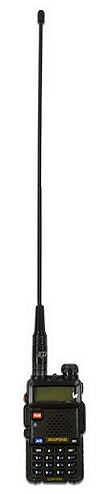
    • Baofeng UV-5RA antenna : ExpertPower XP-771 Elite 14.5-Inch Dual Band Antenna (144/430Mhz U/V SMA-F)2 x 1800mAh batteries
    • 1 x 3800mAh battery
    • 1 x 12vDC charger cradle adapter
    • 1 x Radio pouch
  • 1 x RT Systems Programming Software CD with cable
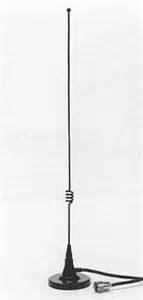
  • 2 x Tram 1185 Vehicle magnetic mount dual-band antennaTram 1185 Amateur Dual-Band Magnet Antenna Baofeng UV-5R antenna on car roof
  • 2 x MPD adapter cable
  • 2 x Tenq vehicle battery replacement adapter
  • 2 x Vehcile “4-to-1” cigarette adapter multiplier
  • 1 x Vaultz Secure Roller Case

Then there is the documentation –

  • Cache Inventory Sheet
  • Radio Check-Out/In Sheet
  • Quick Start User Guide
  • UV-5RA User Manual
  • UV-5RA Programming Guide
  • ARRL US Amateur Radio Bands chart

Then I custom programmed the radios using the RT Systems programming software. The programming meets all the requirements listed above in the “Requirements & Restrictions” section.

Here is each component in the cache –

♦  Baofeng UV-5r handheld radioBaofeng UV-5RA radio, stubby antenna, ear piece w/lapel mic, charging cradle, AC adapter, 1800mAh battery

  • Frequency Range: 136-174 / 400-479.995 MHz.
  • Full height two-color LED definition display. The screen has exquisite clarity.
  • Field programmable from keypad.
  • Programmable via computer software.

♦  ExpertPower XP-771 Elite 14.5-Inch Dual Band Antenna (144/430Mhz U/V SMA-F) Boafeng UV-5RExpertPower XP-771 Elite 14.5″ Dual Band Antenna.

  • Frequency Range: 144-146, 430-440 MHz
  • VSWR: less than 1.5
  • Gain: 2.15dBi (144-146 MHz), 3.5dBi (430-440 MHz)
  • Maximum Power Input-watts: 50 W
  • Height: 14.4 inches


♦  Battery - Powermall 3800mAhPowermall 3800mAh rechargeable battery. The 3800mAh battery will last about 3 – 5 days while the battery that comes with the radio will last 2 – 3 days. Of course that will depend on your actual usage, which is mostly predicated on how much time you spend transmitting.

.

Baofeng UV-5RA Radioshop888 12vDC vehicle adapter♦  Radioshop888 12vDC charger cradle adapter. Radioshop888 12vDC charger adapter you now have the ability to recharge your batteries from any 12vDC source. Examples would be; vehicle cigarette receptacle, solar charger unit, portable power pack, etc.

.

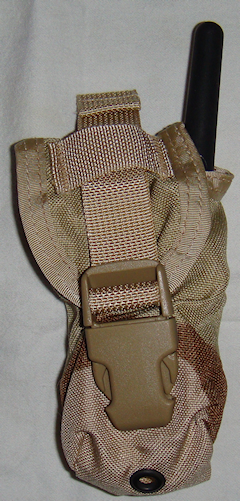
Military surplus flashbang grenade pouch used to carry a Motorola Family Radio♦  Flashbang Radio Pouch. The radio pouch is a really convenient way carry the Boafeng UV-5RA radio. It is a perfect fit and the pouch’s flap provides additional protection from rain. You won’t accidentally drop or lose your radio while it is secured in the pouch. The pouch is MOLLE II compatible and the same attachment can be used to secure it to your belt as well.

.

RTsystems3♦  RT Systems Software Programming CD with cable. to be used effectively it also requires the ability for you to program the radio. Programming is accomplished either manually through the keyboard or via a laptop computer/software. I far prefer the computer method, but it does require software.

.Tram 1185 Amateur Dual-Band Magnet Antenna Baofeng UV-5R

♦  Tram 1185 Vehicle magnetic mount dual-band antenna. The Tram antenna is the solution for radio operation in a vehicle. Even with the ExpertPower 14.5” Tram 1185 Amateur Dual-Band Magnet Antenna Baofeng UV-5R antenna on car roofantenna on the radio, the reception and transmission capabilities of a handheld radio are greatly diminished due to the vehicles metal body. Getting the antenna outside of the vehicle’s body makes a huge difference. And the vehicle’s roof is also usually higher than a normal person holds a radio so you get the increased antenna height as well.

♦  MPD Digital antenna adapter cable. The Tram antenna mentioned above comes with a cable that is long enough to reach inside the vehicle but you need to connect that cable to the radio. That takes a special adapter cable to connect the antenna cable to the RF coaxial cable SMA female to UHF SO239 PL259 female RG58 radio itself. There are other cables out there, some less expensive. But I like the MPD Digital cable (RF coaxial cable SMA female to UHF SO239 PL259 female RG58 20 inches). They are well-built, quality materials, and made in the USA.

.

♦  Tenq vehicle battery replacement adapter. Tenq® Baofeng Vps-001 Vehicle Power Supply Dual Band Car Battery Eliminator Simulator for BaofengThe Tenq power supply unit is a very handy piece of equipment. This option allows you to run the radio directly off of a 12vDC power supply. You remove the rechargeable battery from the radio, slide this unit into the radio where the battery normally goes. Then connect to a 12vDC power source via a cigarette adaptor and you are up and running. This type of operation would be very convenient for vehicle operations or while using the radio as part of the mini communications center.”

Cigarette Lighter Auto Socket Duplicator♦  Vehcile “4-to-1” cigarette adapter multiplier.

  • Plugs into car cigarette lighter! 1-into-4 12V DC auto adapter, charge all four team radio batteries at cone.
  • Includes adapter plug, 50″ cord.
  • One USB port with 5 Volt/ 1 Amp output to charge USB compatible devices.
  • Built in fuse for circuit protection.

♦  Vaultz Secure Roller Case. Baofeng radio cahce Vaultz Secure Roller Case radio cache

  • Highly mobile, with wheels and telescoping handle.
  • High-capacity locking chest.Vaultz Secure Roller Case radio cache
  • Double combination locks.
  • Rubber feet prevent skidding and surface scuffing.
  • Handles on the sides make carrying easy.
  • Large flat top is great for a working surface.

baofeng UV-5RA Radio CacheThis radio cache meets the needs of our emergency responders whether it is a small emergency or major disaster. And when a “grid-down” event occurs…we will be ready and able to communicate!

Now, let your thinking begin…design a radio cache that is right for you and your group.


2009 - 2019 Copyright © AHTrimble.com ~ All rights reserved
No reproduction or other use of this content 
without expressed written permission from AHTrimble.com
See Content Use Policy for more information.
Cross-Band Radio Repeater – Part #2

cross-band repeaternote: first appeared in early 2015

I really saw a need for “repeater” capability when a bunch of individuals got together and all they had was handheld radios.  Distance and Line-of-sight always limited their usefulness.  And when it came to responding to a disaster or emergency situation handheld radios are virtually essential.  But once again, they have limited transmit and receive capability.

When I stumbled upon the Baofeng UV-5R handheld radios <click for more info> a few years ago I knew I had in my hands an invaluable resource for “preparedness”, especially after “grid-down.”  I cannot stress enough what the ability to communicate will mean then or even during less dramatic disaster situations, or even while hunting or camping.  I was aware of “repeater” technology through my government day-job but it was appeared to expensive and complicated.

When I first got my Ham radio license I began my search for the best all-purpose radio that my budget could afford.  That took me to decide the Yaesu FT-8900R <click for more info> was it.  Once I dug into it I realized how easy it was to set it up for cross-band repeater operation, I knew I had the answer in my hands.  However, I decided a used Yaesu FT-8800R was a more economical solution for setting up a field-going repeater.  And that led me to this “build” and documenting it for you in this article.

In Part #1 I covered the first five steps, in this post I will conclude the build and summarize my experience at the end.

Yaesu FT-8800r based cross-band repeater.

Finished Product – Complete with the Yaesu mounted inside.


Step #6 –

Yaesu FT-8800r based cross-band repeater.I am installing the remote head separate from the radio body.  This is to allow the rear of the radio unit to be accessed from the front of the box.  And it allows the radio to run a bit cooler since the head is separate from the body.  To get the remote head installation bracket properly installed I used a piece of 2″ aluminum angle to give the bracket a solid mounting surface.  All mounting bolts utilized star washers to prevent the nuts from inadvertently spinning off. The remote head is mounted as “dedicated” for the repeater and will not be removed for any other usage needs.

Step #7 –

Yaesu FT-8800r based cross-band repeater.This was the easiest of all brackets to mount.  My only concern here was mounting the microphone bracket where the microphone would easy to grab while keeping it out of the way of the rest of the box contents, including the wiring.


Step #8 –

Yaesu FT-8800r based cross-band repeater.Last came putting it all together as a complete ready-to-go repeater package.  Couple notes:

  1. I had double fuses in the box.  The power cable coming in had a fuse on the positive and negative.  Then the power (+) cable to the radio had a fuse as well.
  2. Notice the short antenna coax jumper cable from the “through-the-box” double male 239 to the rear of the radio.  I used an 18″, I could have used a 12″.  Using an 18″ would enable me to remove the radio unit and set it on top of the box for troubleshooting or any other reason.
  3. I built my own remote head cable since all the commercially built cables were really long.  I didn’t want all that cable coiled up in the box so I built my own 6-wire.
  4. All my wire connections are Anderson PowerPole.  I use them for everything and doing so here ensured compatibility now and in the future whatever change might come…including repairs if needed.
General Question & Answers (questions from folks that have seen the repeater) –RadioAntennaCar
  1. Can a magnetic mount external vehicle dual-band antenna be used with this repeater?  Yes.  Since the antenna connection on the exterior of the box is a standard 239, basically any antenna can be used with this unit.  I slapped a Tram 1185 Amateur Dual-Band Magnet Antenna directly to the metal box and it worked just fine. It gave the repeater a very low profile and hard to spot.
  2. What antenna do you use with this unit?  I built a highly portable antenna for use with this unit whether using it as a repeaters or as a base unit.  I built it to blend in with the desert surroundings here in the desert southwest.  I will post an article about that soon.  But any dual-band antenna will work.  The heart of the antenna was a J-pole designed by Dr. Ed Fong WB6IQN of UC Berkeley, featured in the Feb. 2003 issue of QST.
  3. What do you use to power this unit?  I built it to work with the 12v 105 amp hour Energizer AGM gel battery I purchased through Sam’s Club. I expect the radio would operate about 1 – 2 days without the need for charging. I have two 30w solar panels with a charging unit to hook up to the battery.  A GoalZero charger controller handles regulating the battery charging.  I can run the unit with my Honda EU2000i if need be.
  4. You mentioned “base station”, explain?  If I am not needing a repeater, I can use this unit as a base station. I just leave the lid off and place the box where I don’t have to lay on the ground to use it.  It has everything needed to be able to operate it just fine as a base station.
  5. Do you set it on the ground to use?  No, not really.  I would set it on rocks to get it up off the ground.  I am working on a lightweight aluminum stand with folding legs to keep it about 6″ off the ground.
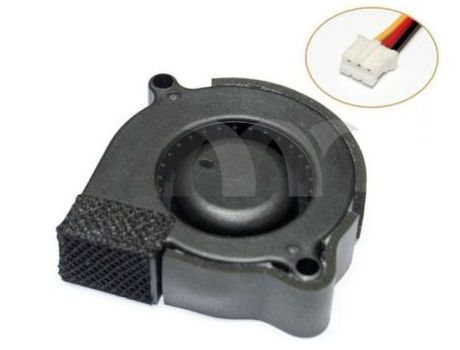
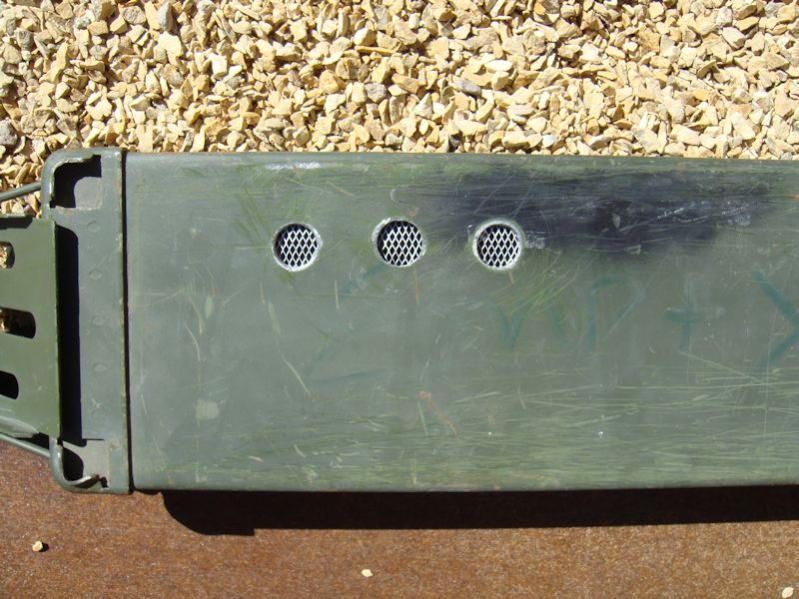
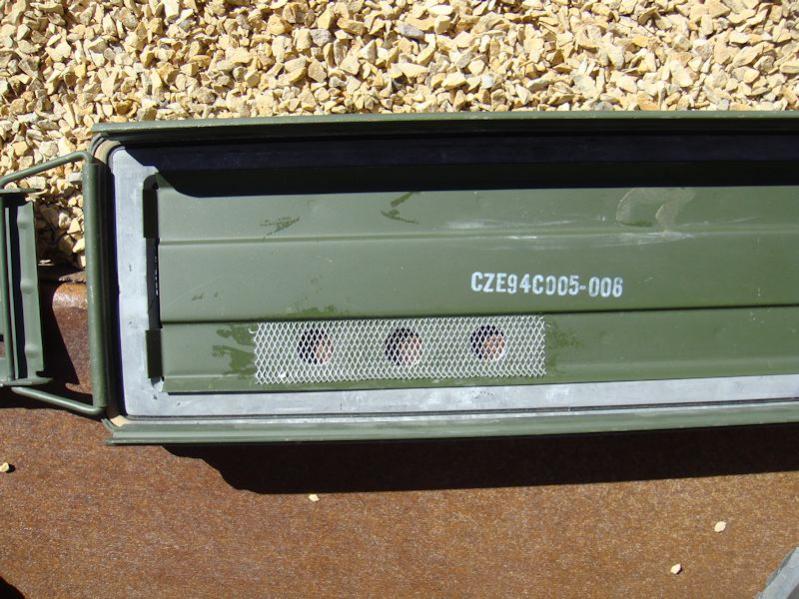
  6. What water-proofing have you done to the box?  Not much.  The box itself is extremely sturdy and the lid has a rubber seal.  All the screw/bolt heads that protrude on the exterior of the box have all have silicone seal on them.  The vent holes are the weak-link; fan and intake.  Not much I can do about that except maybe place a cover over the box that would act like a roof.  I might consider that when building the stand for it.

If you love your handhelds for ease of use, you will love this repeater to extend the range of your beloved handhelds.  Enjoy!


2009 - 2019 Copyright © AHTrimble.com ~ All rights reserved
No reproduction or other use of this content 
without expressed written permission from AHTrimble.com
See Content Use Policy for more information.

Cross-Band Radio Repeater – Part #1

cross-ban repeaternote: first appeared in early 2015

In my day job I use often radios over very long distances.  To accomplish this the government has installed a series of repeaters in various locations around our six county area.  Repeaters make it possible for me to talk to folks hundreds of miles away as if they were sitting around the corner.  I wanted that same capability for any disaster or “grid-down” situation that I might have to personally deal with.  That led me on the journey to come up with my own repeater capable of operating in the field for long periods of time in rough conditions.  Here is that story…

Mission –

Provide the ability of handheld and mobile radios to communicate when line-of-sight was not possible.  Provide a dual band Ham radio unit that was field-going and sturdy/rugged to use when a repeater was not required.

Requirements & Limitations –
  1. Must be capable of repeater operation on 2m and 70cm bands.
  2. Must be a rugged, sturdy radio capable of operating in the field.
  3. Must use 12vDC power.
  4. Must be very conservative on power usage.
  5. Should be easy to program, set-up and use.

Radio of choice – Yaesu FT-8800R (to read more about the radio read the 2-part article posted 3 days ago.).

Box of choice – Army Surplus 40mm ammo box in good shape, seal intact.

Yaesu FT-8800r based cross-band repeater.

Finished Product – Complete with the Yaesu Radio mounted inside.

Notes before staring – I laid out the box contents first.  I kept moving them around until I had what I thought was the perfect location for each component.  I then used a felt-tipped pen to mark the location of mounting screws.  I did this to make sure that all the holes I had to drill made sense in relation to the box itself.

Step #1 –

Yaesu FT-8800r based cross-band repeater.I drilled a hole for the double-male 239 connector to fit in and pass through the box.  This gets the antenna lead from the radio to the outside of the box while making sure the seal stays “burr-free” and actually water tight.  The hole was slightly larger than the 239 barrel diameter.  The rubber grommet was purchased at Lowes.  I won’t put in the sizes of drilled hole, grommet, etc. since your 239 double-male barrel may be a different configuration or size than the one I used.  Take the 239 to Lowes and buy the right size grommet by trying it out right there in the store.  Then you will know the size of hole to drill based on the size of the grommet based on the exact pass-through you are using..

Same thing for the power leads, buy the smallest possible grommet to get the wires through, then drill the appropriate sized hole based on the grommet size.  I wasn’t trying to make it water tight, just “tight enough” to keep dust and rain out.  If I ever make the repeater a semi-permanent installation I will slather silicone seal all over the outside of the grommets.  Based on the “finished product” picture above, I drilled the holes on the back-upper-right-top corner.  It will be approximately the same height as the ventilation holes from the ground when the box is laying on its side for operations.  I drilled the holes from the outside towards the inside to make it easier with the drilling.

Step #2 –

Yaesu FT-8800r based cross-band repeater.I wanted to move some “cooling” air around in the box to keep the radio as cool as possible.  The radio itself has a cooling fan on the rear of the radio integrated with a heat-sink.  But I wanted to move air around and through the box itself to keep the operating temperature as low as possible.  Just in case the radio fan couldn’t handle sufficient air movement on its own, I wanted to give it a little help.  The fan is to draw air out of the box by drawing air from the outside through the three ventilation holes.Yaesu FT-8800r based cross-band repeater.

The fan is a 12vDC fan for computers that I found on Amazon.  I chose this particular fan based on the large intake area of the fan and the “flatness” of its construction.  The fan sits over the radio but to the rear of the box in relation to the radio’s built in heat-sink and fan.  In the event that the fan stops working I was trying to leverage the flow of air coming off the radio unimpeded.  So I drilled the three ventilation holes above the radio’s heat sink just in case.  I was thinking that natural air flow might move the hotter air out through the holes should the fan stop working.

I cut appropriate sized hole in the upper rear corner of the ammo can to match the outlet of the cooling fan. It required a square hole, so I drilled the center, cleaned it up with a saber saw, then finished it off with a flat diamond file.  Then I used another grommet on the squared-off hole before mounting the fan.  I wanted some cushion between the fan and the box to minimize any potential problem from vibration.  If you wanted to reverse the airflow to blow cooler outside air onto the radio heat sink you can reverse the power wires of the fan and it reverses the fan rotation.
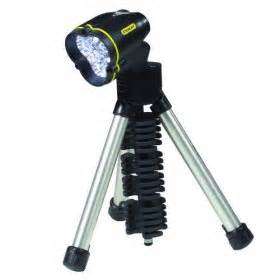
Next I drilled the holes for the two screws that holds the cooling fan housing in-place.  But I did a trial run to ensure I knew exactly where the fan housing had to be placed to match up with the square hole for the fan’s square outlet/inlet.  Notice that I used a couple of rubber grommet again on the screws securing the fan housing.  But this time I didn’t worry about putting the grommets into the holes.  I used them as a “stand-off” to properly align the fan housing and absorb vibration from the fan.  But the grommets sealed the holes anyways due to the compression from tightening them.

Step #3 –

Yaesu FT-8800r based cross-band repeater.Yaesu FT-8800r based cross-band repeater.I am concerned about moving air through the box so the radio doesn’t overheat.  But I also don’t want to run down the 12vDC battery that will be powering this repeater either. So I decided to install this temperature controlled rheostat to drive the fan. Since I am using DC to power the unit, the rheostat controller will continually pass on some minimal current to the fan.  So the fan will always be turning a little bit.  However, if the temperature is within the operating limits of the radio I don’t need the fan spinning like crazy, moving hurricane force winds through the box and eating up precious ampere hours from the battery.  So the rheostat will pass on more current as the heat rises and the fan will then spin faster.  Result – the fan doesn’t use any more juice than is needed conserving precious power for actual radio operations.  But as the temperature rises the fan spins faster pulling the hotter air out of the box through the ventilation holes located above the radio heat-sink.

I mounted the controller board close to the fan towards the rear of the box.  A picture a little later in the article will show its position.

To find the rheostat I did my search on Amazon for this little electronic beauty.  But what I noticed is these electronic parts come and go pretty quickly (i.e. what is available today may not be available next month).  So I am not quoting a specific part number of even manufacturer.  Just get online and search for a 12vDC temperature controlled rheostat, there will be plenty out there for you to choose from.  Or contact your favorite electronics site and they can direct you from there.

Step #4 – 

Picture of ventilation holes with metal mesh screening to keep little critters out.

Yaesu FT-8800r based cross-band repeater.Yaesu FT-8800r based cross-band repeater.Next I installed the radio housing bracket on the radio unit and placed it in the box towards the left side of the box.  Don’t crowd the cooling fan and keep the radio as far to the left in the box as possible.  Don’t forget that you will have several sets of wires (antenna & power) coming out of the backside of the radio unit so don’t crowd the front of the box either.  Using a felt-tipped pen mark the holes for the mounting bracket.  Then placing the lid into position mark the center of each ventilation hole; they should be directly in front of and above the radio’s heat-sink and fan.  Drill the holes for ventilation and the mounting bracket.

To pull in fresh (hopefully cooler air) that will pass over the radio’s heat sink then out of the box via the cooling fan, I placed three 7/8″ holes in the box lid above the radio’s heat-sink but on the “side” of the box, not the top.  This would pull air over the radio’s heat-sink across the top of the inside of the box drawing the warmer air outside via the fan.  Should the box’s cooling fan fail, the radio’s own cooling fan should pull air into the ventilation holes from the outside, or push it out, not sure which.  This may create a “positive-pressure” environment inside the box which in-turn moves air naturally out of the box’s cooling fan hole.

To reduce the derbies that might come in the box that I don’t want in there (i.e. dirt, sand, leaves, critters, etc.), I placed a metal screen mesh over the holes. Making a rough calculation on the reduction of air volume due to the screen material I decided on the three entrance holes in relation to the cooling powered exit hole. I might have to drill another hole, maybe two, but I thought this was a good guesstimate. I drilled them 7/8″ to give me enough room to secure the screen to the lid on the inside. I used a metal-to-metal glue to attach the screen material to the box lid.

I may put a thin layer of cotton gauze over the holes in addition to the screening to reduce the amount of fine dirt/sand that can enter the unit.  However, I would drill more holes if I did that to off-set the reduction in airflow from the gauze.

Step #5 –

Yaesu FT-8800r based cross-band repeater.Next comes installing all the various brackets for the radio components itself. First up was the radio housing bracket.  In Step #4 I talked about mounting the radio so the radio’s heat-sink was located next to the ventilation holes in the box’s lid.  This allows for cooling air movement even if the cooling fan fails.  But it leverages the cooling fan’s movement of air when all is functioning normally.

For practicality it is also very convenient to mount the radio with the rear of the radio exposed for access to the antenna, power, and programming ports.  Yes, this means you are doing a “remote head” installation.  And in my opinion works out well as an added bonus.  The radio’s control head is disconnected from the radio and that adds to keeping it just a bit cooler.
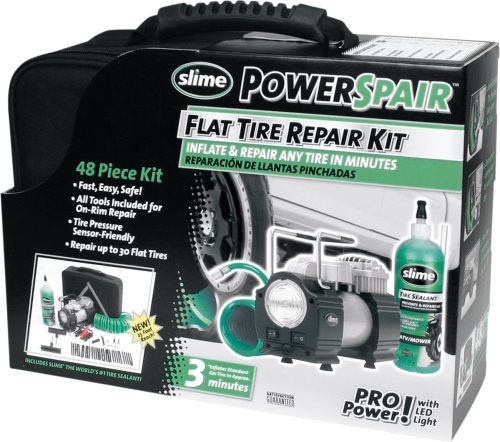
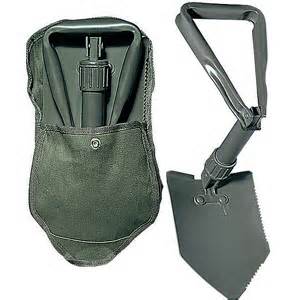
Go ahead and take the radio housing bracket off the radio and screw it to the box.

In the next part we will finish up the build.


2009 - 2019 Copyright © AHTrimble.com ~ All rights reserved
No reproduction or other use of this content 
without expressed written permission from AHTrimble.com
See Content Use Policy for more information.