
I get this question a lot. I thought I covered it before but I will have another go at it with details. The question is “What can I plant and grow in my garden to survive on if there is no food available at all in the store?”
I am going to change that and make it much more dramatic.

The I am going to use scenario:
- Food supply chain is done, gone, not available.
- I need to live off my garden as the only source of food.
- I know I need calories and protein.
- I need lots of pounds of food.
- I need to be able to store it from harvest (year 1) through planting (year 2) to harvest (year 2).
- I need some of the seeds from the harvest in year 1 to use for planting in year 2.
- Space is not an issue…reasonably.
- I have a family of 4; 1 adult man, 1 adult woman, 1 teen child, 1 pre-teen child.
Here are some basics:
- These become your priorities; calories, protein, fat/oils, storage life, seed saving, growth reliability, climate adaptation, production per square foot, nutritional density, and ability to preserve.
- For my specific glamstead location, I have to consider crops that work with a shorter growing season, cool nights, intense UV, low humidity, spring wind, periodic drought, and possible early/late frosts/freezes. I can offset the “drought” issue because I have a well. But, will the well hold out? Think for a minute…a garden without reliable water is just landscaping.
- We know that people need calories, carbohydrates, fats, and protein in our diets as priorities.
- You will starve to death if you think you can survive on lettuce, tomatoes, cucumbers, and peppers.
- And then there is the actual calorie intake requirements:
These numbers are rough estimates based on my climate, my soil, my family assumptions, and reasonable yields. Real-world results could vary dramatically. Please do your own research for your own area and family needs.

Let’s make it more real when looking at it as a family combined…

But under survival conditions where hard/persistent physical labor is present the calorie intake could easily double.
Now, let me share this with you…I am talking pure survival. I am not talking about balanced diet, healthy, gluten free, non-GMO, none of that crap. I am talking food that will keep you alive and the most efficient way to go about it.
Last note, the list is for my area…my location…not yours…unless you are a neighbor. You would have to look up what is right for your area. DO NOT TRUST INTERNET EXPERTS !!! Do not trust gardener or survivalist keyboard warriors. Do not trust me. Do your own research for your area. I will make one suggestion that might help…use some AI program for help. I worked on my list then double-checked it against a very detailed and specific prompt using chatgpt.com It helped me to understand I was off on one of my choices…there was a better one. It also gave me the reasoning for the difference.
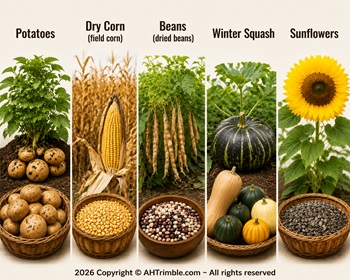
Here are the top 5 foods to plant, harvest, eat, and survive…in my area:
- Potatoes
- Dry Corn (field corn)
- Beans (dried beans)
- Winter Squash
- Sunflowers
* There will be three substitutions/options/alternatives that I will mention at the end.
Here are the details:
#1 Potatoes –

First off, I’m about 1/3 Irish…so this is an obvious #1 choice for me. And in addition to that they have a huge calorie count, they are really productive, they store well, spread and reproduce easily, they are adaptable to most climates including ours, they are very calorie dense, and contain other useful nutrients.
For us the varieties would probably be Yukon Gold or Kennebec. They would store for months in a cool place like a dug pit (which we would do) or root cellar (which we don’t have). And all we would have to do is save some of the potatoes with the most sprouts to use as seed potatoes for the next year’s crop.
They can take up some space but can be grown densely. The soil we would use would need amending (compost) but that could be acquired from under our tress, etc.
#2 Dry Corn (field corn) –

This is not sweet corn we’re talking about…it’s “field” corn, specifically “dent” corn. For our area we would want to use Painted Mountain Corn or Hopi Blue Corn, probably both. These varieties are excellent storage types, pretty dang cold tolerant, they can thrive in a shorter growing season, and can handle more adverse weather conditions that our climate produces. This is a “grain” vs a picnic type corn on the cob. With this corn you can have cornmeal, flour, hominy, masa, and animal feed. But it takes processing; drying, shelling, grinding, and storage.
Our #1 issue is a dry climate, #2 is short growing season. Painted Mountain Corn is excellent at both and Hopi Blue Corn is very good at both. Hopi Blue Corn is a little better at nutrition.
A bonus with dent corn is the “leftover” after the ear of corn is picked and the kernels are shucked…EVERYTHING else is 100% usable.
The stalks and leaves can be used for fresh animal feed, silage animal feed (chopped & fermented), and dried animal feed. Animals that can eat it are cattle, goats, sheep, pigs, and to a limited degree chickens and rabbits. The stalks and leaves can also be used for composting and mulch. And our soil could seriously benefit from both. And the cobs can also be used as fuel. Once dried, they should be viewed as compressed natural tinder…it burns hot and fast. One interesting uses…biochar. Cobs are a good source that can be converted into biochar…another important soil amendment for our area.
#3 Beans (dry beans) –

For our area I would choose Anasazi beans. I am already familiar with them, they taste really great, they are a desert adapted bean, store really well, and they a very good-looking colorful bean. I am considering the addition of Tepary beans. I’ve never grown them but I will try some next year. If I am successful with them…they are actually even better suited for our area and conditions than the Anasazi beans.
Anasazi beans are high protein, high fiber, calorie dense…basically, nutritionally serious food. Yup, and they are great for the soil…they fix nitrogen and improve soil fertility. This would be a crop that you plant in the area where you plant corn the following year. Why? Corn uses a lot of nitrogen, beans put nitrogen into the soil. Once the beans are harvested, leave the roots in the ground (that’s where the nitrogen is) and then compost the plant separately with other organic matter. Nitrogen-fixing bacteria in the bean roots leave some nitrogen in the soil when the roots decompose.
Interesting side-note…if I was caught short and didn’t have any Anasazi beans to use as seeds…well, I would happily use green been seeds. Just let green bean pods mature and dry on the plant. Once fully dried they can be shelled and stored like any other dried bean. And yes, compost the removed shell material.
#4 Winter Squash –

For me there is only one choice…Butternut. This squash is incredible for storage (6 – 12 months), a reliable plant for gardeners (productive & vigorous), and packed with nutrition…and it tastes amazing. Butternut is a perfect plant for our climate…handles dry condition really well and doesn’t need perfect soil. And yes, you can seed save. Speaking of seeds…
Butternut seeds contain fats, protein, minerals, and calories…basically concentrated survival nutrition. These seeds really help solve the whole survival “fat” problem…they have lots of fat. Harvest the seeds from mature fruit, roast em, store them properly, enjoy the flavor and the nutrition! Look, you can grind them into flour or simply add them to a stew…or eat as a convenient snack. It’s all good…it’s all nutrition.
I will mention that two alternatives would be Hubbard squash and Seminole pumpkin. From my research both are good survival options, and both would do good here. I have no personal experience with them as of now…next year I will do a test plot. Treat them like you would Butternut squash.
#5 Sunflowers –

I bet that one surprised you. Sunflowers may be one of the most underrated survival/preparedness crops there is. It is a fantastic source of fats, oil, protein, and calories. The stalks and leaves can also be used for animal feed. The flowers are magnets for pollinators which support all the other garden crops. If you don’t use the stalks and leaves for animal feed there will be lots of biomass for composting.
For our climate they can handle our sun, can handle the heat, and can tolerate dry conditions pretty well. Our variety choice would probably be Black Oil sunflowers for their high oil content. I’ve never grown them before…on the list for next year. For snacking and stews I would go with Mammoth or Russian Giant. Those two varieties have larger edible seeds and are easier to process but contain less oil than Black Oil.
Along with the leftover stalks and flowers being animal feed, the flowers themselves are really beautiful and can provide a big morale boost. Once all the harvesting is done, if you don’t have animals they are great for composting due to their large amount of biomass.
Sunflower seeds are really nutritious, they provide a concentrated source of calories, fat, protein, and…what’s really cool…micronutrients. The seeds can be eaten raw, roasted, or you can grind them into sunflower “butter.” The seeds can also be stored long-term if you keep them dry and cool. That is a huge benefit…long-term storage food reserve. Sunflower seeds can be pressed to extract oil, which is then used for cooking, adding calories, and could be used as a barter item. The oil has a long shelf-life if stored properly.
Sunflowers are relatively easy to grow in most climates and soils…even our moderately amended local soil. They tolerate drought better than many other crops, which is valuable in hot, dry regions like ours. And obviously, you can seed-save and produce next year’s crop.
Now…how much do you need of each?
Why do I ask that? Well, if you want to survive off your garden you gonna need to know how much you are going to use…and then that tells you how much you are gonna need to grow. And that tells you how much space is needed for your garden.
So how much do you need of each of the 5 foods?
So here is the basis of my estimates…

Here’s a nice info-graphic presentation…

Bottom line…5,400 pounds of food from your garden! That’s almost 3 tons of garden production!!! Whoa!!!! That is a lot of garden production. I don’t think I’ve gotten more than about 1,000lbs of produce from any garden I’ve ever had. I would be hard pressed to think I could grow that much. However, there are only 2 of us…so we could get by on about 60% of that list. Still, that’s a huge demand…3200lbs of garden production.
So, how would you produce that much from your garden? Well, let’s get into that a bit…in Part #2.

Click here to read Part #2 article →
Articles in this series –
Related Articles –
- Top 3 Apocalypse Vegetables
- Why garden at all?
- Garden: Let’s Talk a Minute…
- Glenn Beck, Destination, Prepping, & Gardening
Q & A Time…Ask me a question or send me a message…

